
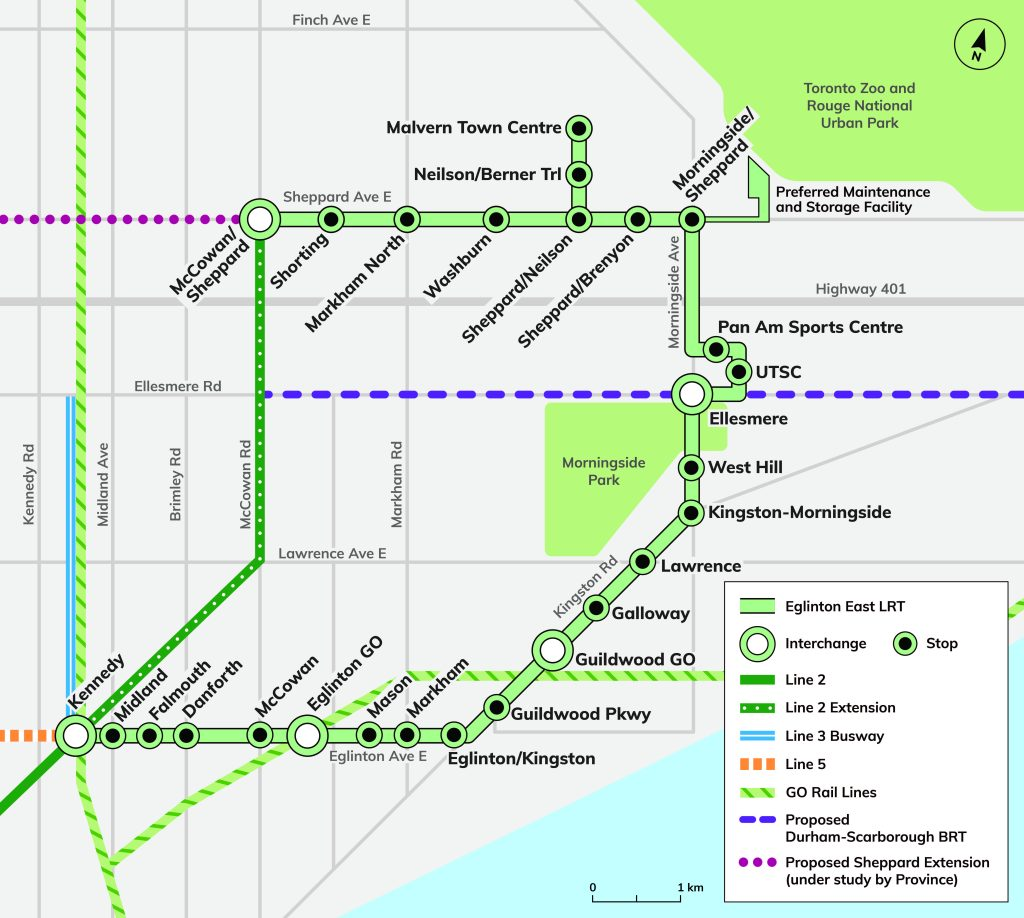
The Eglinton East LRT project is a vestige of the amusingly named “Transit City” plan that the City of Toronto has continued to carry forward despite a lack of funding and Metrolinx’ role as the GTHA’s transit builder.
The route, which forms an arc through Scarborough connecting to the University of Toronto’s Scarborough Campus and Malvern via a branch is nearly 20 kilometres long, and is seen as a “top priority” (what this means without the resources to actually build is unclear) because of the aforementioned connections.

The issue I have with the Eglinton East LRT plan, especially today, is that it has all of the classic problems with Toronto area-“LRT” plans: The alignment is uncreative, the priority would likely be lacking, and speeds are supposedly (and unsurprisingly) not set to be a whole lot faster than existing buses in dedicated lanes. The line would also not through run onto the Eglinton Crosstown, so it would likely introduce new transfers into people’s journeys — just like the much maligned Scarborough RT. Maybe in France where a tram would come with a speedy service, beautiful street redesigns, and a fraction of the price tag, this project would pencil out, but given the realities of transit in the GTHA today, there are just many higher-value projects than a “rail-ification” of the buses to UTSC.

However, there is an element of the Eglinton East LRT that is quite valuable, and that’s the connections to Eglinton and Guildwood GO stations. Sadly, we don’t seem to be thinking about alternatives to the Eglinton East LRT that would just serve the stations, thus capturing most of the benefit and doing away with much of the cost of the project. Connecting to the GO stations is as simple as continuing east along Eglinton and then up Kingston road around 6 kilometres.

The hypothetical benefit of adding this relatively modest extension to the line is that you pick up both another GO line connection on the Eglinton Crosstown/TTC Line 5 — the frequent and heavily-trafficked Lakeshore East line, as well as Scarborough’s VIA rail station at Guildwood. Thus, the project helps make Eglinton even more powerful as an orbital service that would now connect 4 out of the 7 different GO lines (and it could probably also connect the Richmond Hill line if that was desired), allowing people to make a journey between, say, Oshawa and York region, or York University, or Yorkdale without having to go through downtown or even south of Eglinton. It would also seriously improve the connectivity of GO in Scarborough, since the Lakeshore East line is not currently planned to connect to the TTC rail system in this part of the city, and even getting up to Kennedy via the Stouffville line will be a huge pain because Metrolinx is not planning to have both the Stouffville and Lakeshore East lines stop at Scarborough Junction. By connecting the Lakeshore East line to Eglinton, you also enable trips between East Scarborough and Durham, Scarborough Town Centre, Northeast Scarborough, and destinations along Eglinton, as well as better (albeit not optimal) connections to the Stouffville line. At the same time, you’d be giving people in Midtown, East Toronto, and Scarborough a much easier connection to VIA services.
Now, you might ask — why not extend the Eglinton Crosstown east? The answer is unfortunately because the extension of Line 2 will supposedly get in the way, crossing in front of the Line 5 station box as it leaves Kennedy heading east. This seems like it probably wasn’t necessary — you could have designed a structure to carry Line 2 to its bored tunnel further east and Line 5 to the surface, but that would mean expending more money and doing more planning work upfront for a project that isn’t going to immediately happen (or cynically a city project)… so it didn’t. The city’s approach to this problem is to frustratingly turn Eglinton East into its own totally independent line separate from Line 5, continuing Toronto’s habit of using light rail in an irrational way with no branching or overlapping service patterns meant to serve journeys people actually make. Just imagine getting off of a GO train onto a tram for 5 minutes, just to walk across a station to another tram to continue in the same direction. Its really bad and shows a total disregard for how people actually travel, just to try and present a more impressive “rail” map.

Based on my assessment, the best way to extend Line 5 further east is probably to elevate the line through Kennedy, over the Stouffville line, and back towards the surface just west of Midland. This solves the underground conflicts with Line 2, as well as with the road overpass (and likely foundations) that carries Eglinton over the Stouffville line. Running the Crosstown on the surface of Eglinton over the Stouffville line seems like it might be an option, but this would probably mean a crappy connection at Kennedy, so elevation is likely the simplest option. The only issue is that just west of Kennedy station are above ground high-voltage transmission pylons, so I imagine you might have to take a bit of a weird southerly route through the Kennedy station area to manage to both be high enough to cross the Stouffville line, and low enough to pass under the high voltage transmission lines — while also having a level segment where you can have platforms at Kennedy (perhaps in roughly the same spot as the SRT platforms, but raised higher to clear the Stouffville line). The ideal option is probably just undergrounding the high voltage transmission lines for a few hundred metres and running a more rational elevated guideway alignment that starts where Line 5 currently dips underground west of Kennedy.

Whatever happens, I hope we take the situation at Kennedy as both a lesson in planning (plan your projects in an integrated and forward thinking way), and in rejecting poor passenger experiences where they need not exist (replacing the SRT shuttle that people disliked with another shuttle east along Eglinton would be very ironic).





Leave a Reply