Happy New Year! If you’ve not already done so, please consider subscribing to this blog for more content directly delivered to your inbox.


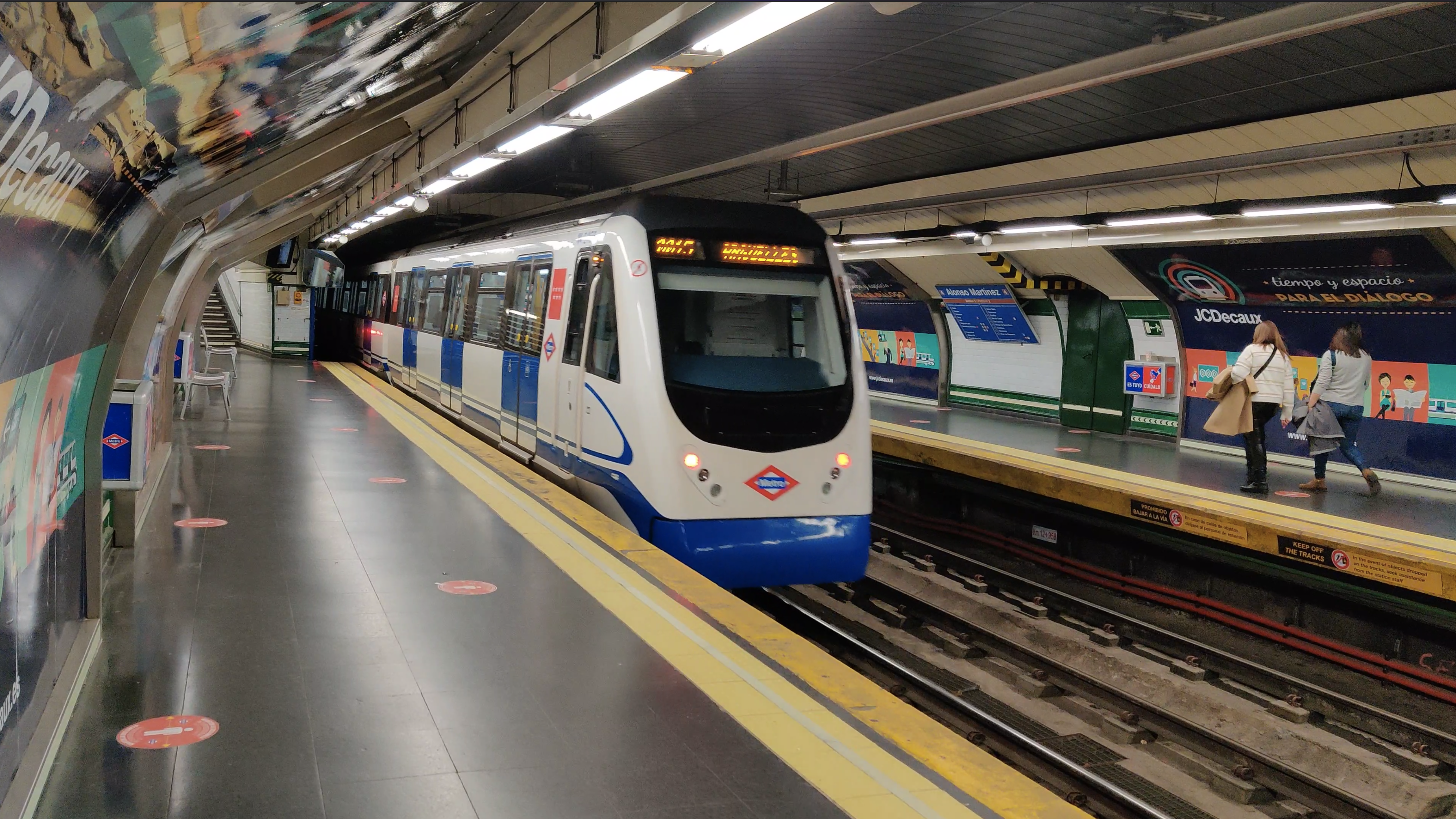
Something that I have promoted in a number of videos and blog posts over the years is what I have called the “many-lines model” for building metro systems — modelled on Madrid.

A small Madrid Metro train. (Credit: Matteo Allegri)

The idea here is that instead of building any given line to a capacity X, it may be better to build 2 lines to capacity X/2; more and lower-capacity lines should allow for the same capacity, and it means that a disruption on any line is going to have a smaller impact on overall network capacity.

More lines also means putting rapid transit closer to more people. While buses can be great, a metro provides a level of service that is difficult (and arguably impossible) to provide in an economically viable way with buses.

There is also a construction capacity benefit to this approach. When you build a lot more, you have more practice and experience, which lets you keep building, which is important as cities continue to grow.

But when I look at many new(er) metro systems, the many lines model is rarely pursued. Sure, there are cities that are building a LOT, and perhaps you could argue that a city like say Shanghai is doing many lines at a large scale (few lines have >6 car trains), but Shanghai does not have the low costs of Madrid.

Lean Metros

Instead, the pattern I see emerging is in line with the broader ones you have seen as the world’s metro construction capital has shifted from Europe to Asia and the global south.

One thing I’ve always found interesting about the MTR in Hong Kong is that it isn’t very large: with less than 200 km of rail and around 100 stations, there are many significantly larger systems; however ,few match MTR on riders per kilometre. It should also be noted that Hong Kong’s system is highly interconnected with many interchanges. Hong Kong has a great system, but not really a big system. You could say this is because Hong Kong has very challenging geography, which is true — but the pattern of a “leaner” network with less track and stations can be seen in other places. Some examples that come to mind being Cairo (3 lines moving several million per day with less than 100 stations), and Sao Paulo, which also has less than 100 stations and moves millions every day.

And it’s not just cities in the global south: Copenhagen’s metro uses much smaller trains even when compared to most other European Metro systems and doesn’t have much mileage; it also has lots of interconnectivity. Another example on the microscale that comes to mind for me is Toulouse with Line C or Vancouver with the Canada line — both which are arguably “leaner” lines than the previous lines in their respective metro networks, with stubby wider trains meant to run frequently.

In fact, even looking at Toronto’s future subway network, it feels fairly “lean” — when you look at true rapid transit lines (that is lines 1, 2, 4, and the Ontario line) they will still have less than 100 stations from 2030 onwards despite probably moving around 2 million riders every day.

But, what is lean?

I think the way I look at it is that lean metros are ones that move more people on every bit of rail; calling them “maximum metros” or “high-density metros” might also make sense. In such systems, you have fewer lines with more frequency, and you move more people with the same given frequency because the trains tend to be bigger, with 6 large cars or more on main lines.

Lean metros are also more likely to have more connected networks, because connectivity enables higher “loading multipliers”, which let you move more people on less mileage.

And for what it’s worth, there’s probably a debate to be had about what’s more futureproofed between lean and many-line metros — because while many-line cities maintain institutional capacity to build, lean cities maintain space on parallel corridors to build. I don’t think I have a definitive answer on which is better, but getting space back is nigh impossible; learning to build again should not be.

Why are we seeing more lean metros?

I think the interesting question to ask is — why are we seeing more lean metro systems? Many “historic” metro networks like Paris, London, New York (which isn’t really lean), and Berlin seemed to build much more before growth slowed down.

A Berlin S-Bahn train.

I think the biggest reason is that, especially with modern standards with regard to disruption and construction standards, building really has become harder, while at the same time cities have become even denser on a micro scale. By building fewer stations with more intense density around them — Hong Kong stands out here — you can still put rail close to many people, but instead by focusing efforts on building more housing density rather than metro, which seems significantly simpler. This is something Alon Levy discusses in a blog post from back in 2019.

To circle back to my point about the trade off of space for institutional knowledge, I think it’s worth reiterating that if you build lots quickly, you are likely to build for lower-capacity per line and also expend you “easiest” corridors most quickly. The more infrastructure you already have, the more challenging building is going to be, especially in non-crazy geographical situations (i.e. Hong Kong).

I think that the idea of building more lines also probably makes less sense in a future where growth is less certain. While sure in countries like China and India there is a strong case for still building big, in many places (population growth in many countries is lower than we have projected, and while cities will continue to grow I think the days of a large number of cities around the world exploding with growth are probably almost gone) it probably makes sense to play it safe and heavily optimize a smaller amount of infrastructure and taking a wait-and-see approach. More lines is probably more resilient, until you’ve overbuilt and swamped yourself.

Of course the most obvious reason for lean is that it’s more cost effective, especially over the long run — you’re maintaining fewer, larger trains, but the economic value of each mile of track is also a lot higher, so it’s easier to justify long term maintenance of all of your infrastructure. Rebuilding the tunnels for lightly used metro lines in some cities in the distant future may well not pencil out if cost increases we see in the Anglosphere spread.

And I think the “lean” future is something we can already see emerging in places where the transit systems were not built lean from the start. For example, London and Paris upgrading signalling and trains on their oldest lines to try and boost capacity as much as conceivable instead of trying to build new city centre metro lines — it’s just easier in many cases to use operational and infrastructural slack to eke out more capacity than building something totally new under dense city centres.

To be clear, I’m not saying lean metros are better than many-line metros, but I do think they are becoming more common, and I believe as density increases in our cities and economic imperatives change, we will see far more of them.

26 responses to “The Future of Transit is Lean(er)”

  1. Thanks Reece for this article. One minor detail you mentioned regarding slowing population growth, I think it’ll be much more pronounced even in “large” countries like China, where we are already seeing population stagnation and even declines in some cities. Combine that with a slowing macro economy and lower government revenue, I think we will see a lot more cautious approach when it comes to large infrastructure spend in China in the coming decade. Already, many municipal governments in China are feeling the pressure because of the massive debt they’ve taken on in the last 2 decades building out their transit (and road and highway networks): all of this was negligible when the economy was growing at 10% or 12% per year, when real estate prices and land sales formed 50% of a local government’s revenue, but those days are long gone for many municipalities in China. Because of this, we are seeing the fiscal strain translate into declining spend on transit infrastructure maintenance spend, most noticeably with the recent subway crash / metro car split in Beijing’s Changping subway line (December 15, 2023), where the official response was that this was due to “signal degradation”, causing 500+ passenger injuries during this crash. It would be interesting to see how mainland Chinese municipalities handle the debt-fueled fiscal pressures on their transit networks in the coming decade.

    1. This really makes the case for lean systems I think, Chinese Metros probably should use larger trains – its surprising how few lines go beyond 6 car type A!

      Will be interesting to see how the trajectory for transit expansion in China changes over time!

  2. Driverless trains permit operating lower capacity trains at greater frequencies.

    1. That was the idea behind short metro trains in Mainland China cities but they didn’t seems to be able to work it out

  3. Abdullah Rizwan Avatar
    Abdullah Rizwan

    Hey Reece, people who have been giving a 10$ monthly subscription for the substack, is that cancelled now? Or is it automatically transferred to your new Patreon?

    1. I posted about it here: https://reecemartin.substack.com/p/pausing-substack

      All paid subscribers have refunds being processed and from what I can tell many people already received refunds. While I appreciate support on Patreon, there is no automatic transfer.

  4. Thanks for this article, Reece, and the new website is cool.

    I like these insights about different styles of metro construction, and the validity of a “metro-maximal” approach compared to “many lines.” However, I don’t think I can get behind calling this style “lean.”

    For recent heavier metro construction in the US, lines sacrifice important stations, or do not cover their full alignment, because high construction costs and unnecessary station scope require other cuts to get a project going.

    In San Jose, providing the “best” heavy metro infrastructure has resulted in a project that is missing a station at 13th St, despite the need to dig an evacuation and ventilation structure there. This infill station will be practically impossible to build in the future. Service east and west of the new line will also remain a twinkle in crayonners’ eyes. Apart from missing stations and line coverage, station access time and low frequency will limit utility for local trips anyway.

    In San Francisco, early plans for BART on Geary go halfway down the corridor before turning to also serve part of the 19th Ave corridor; if built this project would lock out two corridors to provide a few stations that only improve regional trips.

    Similarly, I hear that the Second Avenue Subway is limited by slow, phased construction and interlined manual operation, despite high quality infrastructure and high demand.

    Building new lines with high station and train capacity but poor service and missing stations is of course not good, and isn’t what you mean by lean construction, but I worry it’s too easily confused with the concept.

    I’d prefer to categorize the metro build strategies you described instead as “Wide” vs “Tall,” borrowing from the Civilization games. Wide prioritizes covering a lot of ground; tall prioritizes as much capacity as you can get in fewer projects, but both strategies need to be executed well to be successful.

    In smaller cities, or contexts like the US with lower capacity to accomplish projects, you’d rather build one complete medium-capacity metro line than only part of a heavy metro line. There’s a point at which insisting on heavy metro causes cuts in a project that ruin its utility, jeopardizing the next project. If there’s no next project, running out of corridors doesn’t matter. If the buildout instead snowballs into a successful network, deeper bore tunnels and difficult transfer stations around the original lines become justified by the mode shift and demand for more construction.

    Not sure how I square this with IBX or Toronto Line 5. Don’t do those where it’s clear low capacity is insufficient in an established network, I suppose.

    1. I don’t disagree with what you’ve said in your comment and I think it makes sense. I do think its pretty dependent on the US context though, with high prices and sometimes shaky support for public transport (as well as low experience with it). I am not sure that “lean” would have the same connotation in most places (I appreciate how you mentioned that wasn’t necessarily what I was getting at).

      I think your comment reminds me of Adams, in some places the local context and a lack of transit friendly urban form – such as in the US, the way you plan the dynamics of a system is probably going to be different! That being said, even newer American systems do have some of the lean tendencies – i.e. DC, BART – with big trains and wide station spacings – just too often not supported by good feeder service and reasonable land use!

  5. I had 2 main thoughts on that topic while reading.

    First, regarding resilience future growth not materializing, I’d imagine that constraint plays very differently in a city with a lot of current transit usage chasing future population, versus a city with low current transit usage chasing growth of users among the current population.

    In the latter (most North American cities), as the population’s probably not going to collapse overnight, I’d imagine a many-lines approach makes more sense.

    1/2

    Second, my concern with what I’ve seen that I’d consider a lean(er/ish) approach in a city of the latter mold (looking at Edmonton’s current/recent LRT expansions), is that there’s still pressure to “hit everything important”, and you end up with a snaking neighbourhood collector style route that snakes and weaves back and forth trying to cover every destination with the one route that you’re going to build. Which makes it slower and less effective at serving any of them, cannibalizes the presence of any unserved destinations that would justify a second line, and poisons public acceptance for more transit because the existing example they have to look for is disruptive and ineffective.

    1. Great comments, I agree re overall growth vs trasnsit user growth – this obviously means different potential land use too, in the latter case you’ve already got a city, which is not necessarily true in the former.

      The risk of trying to “hit everything important” is a real one, but relating to your first point is more of an issue when you don’t build your city *with* the transit. Ideally even in places without much rapid transit major destinations are placed on corridors which *could* be linked together well with PT.

  6. From Hong Kong, I believe the biggest reason Hong Kong metro being “lean” until now is because the government is not willing to invest much into transit constantly, and the mindset that transit need to be profitable not just operationally but also have to be able to recoup construction cost. So rail are only built when the demand is extremely high and thus ensure high ridership density on every line actually being constructed by now. (But nowadays they seems to be changing their mindset to promote development that help integration with Mainland China)

    And another reason behind the “lean” rail is extensive city center expressway that aren’t very congested, which permit buses operating competitively and reliably against rail. Communities that are ~5-15 minutes away from metro stations usually travel not by taking feeder transport to rail station and transfer to rail, instead they take the bus that go directly onto expressway that reach destinations directly, and they can usually reach their destination just as fast or sometimes fastet than people taking the rail.

    1. I think its an interesting model – “lean” definitely requires less investment and for what its worth Hong Kong seems to be in a pretty happy spot where the ridership demand isn’t so high that the system collapses, but things are always very busy.

      The competition with buses is very interesting, on one hand it means great bus service, but these buses are expensive to operate and use fossil fuels which has a negative environmental impact – the ideal system is probably 10-50% larger and has the buses feed rather than compete with the MTR.

      1. The system have not “collapsed”, but in commute hours, many interchange stations require passengers waiting multiple trains before they can board it, and even some non-interchange stations on Tuen Ma Line, East Rail Line, TKO Line, and Kwun Tong Line are also facing similar situation.
        Plan exists to build metro that parallel Island Line to the north and parallel eastern half of Kwun Tong Line + TKO Line to both hillside and coastal side to alleviate such situation, however North Island Line have been indefinitely suspended, and lines that parallel Kwun Tong Line have been downgraded to elevated busway, due to budget issue that Hong Kong government want to spend the money on development of Western and Northern frontier of the city in accordance with China’s national plan.

        As for buses, they used to be operationally profitable and thus companies were happy to operate more express bus routes that can charge higher fare and have shorter trip time. However, since coronavirus and subsequent recovery and other changes over the city in the mean time, ridership dropped while labor cost increased rapidly, making buses in Hong Kong repeate the history of bus operation in developed world mid-20th-century and it’s not certain whether this is sustainable. The Hong Kong government do not intend to solve the issue by directly subsidizing the buses, and instead offered to introduce lower cost labor from Mainland China and rest of Global South. Bus companies have also tried to lower costs by reducing frequency and merging routes that make routes less express, and both these made them harder for bus to remain competitive against rail on long distance trips.

    2. I would have to say that the overwhelming reason for HK’s system being lean is indeed geographic. In turn the limited availability of developable land and thus the creation of very high density urban centres predates any concept of TOD or the building of transit to serve it. The mountainous geography also means most of that developable land is in linear runs (valleys or coastal strips) and, conveniently, that is the ideal in terms of coverage by transit. The HK Metro covers almost all the dense population centres you would want, except perhaps where it is really seriously expensive (south-east coast of HK island etc).

      Most governments don’t like spending big on transit and of course HK is notoriously shy of taxes. That is why their model of allowing the HK-MTRC to run a very effective land-value-capture system was created. Approximately 50% of the capital cost of building new transit is captured by the MTRC itself via this mechanism–not just the usual property developers–to develop, own and recoup some of the value created by the transit it builds, particularly above and around its biggest stations.

      This model should be applied in parts of the world that desperately needs transit investment but where there is inadequate state funding and/or inadequate enthusiasm. But the property developer class, who in the Anglosphere have politicians in their pockets, consider this source of unearned super-profits is exclusively their domain and won’t ever allow it. While HK’s property developers are among the world’s most cold-blooded rapacious capitalists possibly they are slightly more pragmatic in a city-state that simply can’t put much of its population on the roads; HK is #158 in the world in km of roads per capita, of the order of one hundredth of the developed world. Further, they probably realised that it was either allowing the transit system to value capture and thus self-finance a lot of its own development or the alternative was an inevitable increase in taxes.

  7. I think there’s a Goldilocks zone in btw lean and ‘spread’ transit, and we end up having a little bit of both.

    For example, São Paulo and Mexico city, despite their lean configuration, are constantly expanding their commuter trains and BRT lines and connecting them to the metro lines via new stations. Also, a fair share of new metro stations are being built, though not at neck breaking speed as we see in Asia. Constant small improvements and financial sustainability is the rule of the day.

    1. Oh for sure, though these projects are pretty low cost generally since they aren’t heading into the densest parts of the city OR making major capital investments – so I think the network “cores” remain pretty lean!

  8. Like with a lot of things in network design, I think both types should be present in every city.

    Similar to how most metropolitan areas have arterial stroads and urban expressways to get around, There should be core metro lines that are “metro-maximal” built for high capacities and high speeds, like the planned 110 mph Purple Line in San Diego. These lines can hit all the important destinations like downtown, universities, town centers, the union station, etc.

    Most metro lines should be something more like light metro, or subway-surface, and they can serve the rest of the city, with many interchange stations between the “many lines” light metro and the “metro-maximal” express metros so that people can both have access to metros near where they live and fast trains across town.

    The further someone is travelling, the higher percent of their total trip will be on the express metro and not the light metro; just like how driving trips have more time spent on expressways and not arterial stroads, the longer the drive is.

    I bet if someone did a simulation of a city with express and light metro, it’d come out with a higher ridership to construct cost ratio than both the system with all metro-maximal and one with all small metro lines.

    1. I am not necessarily disagreeing with you, but what you are suggesting sort of misses the point that these lean systems are lean because they are cost effective, and while combining with other models is an interesting idea it kind of gets rid of the cost effectiveness point.

      Whats the status of the Purple Line, I don’t think I’ve heard of that project?

  9. I completely understand the cost-effectiveness of a few heavy lines with TOD around them.

    The Purple Line was going to be a light rail line running from the port of entry at San Ysidro, through eastern Chula Vista, eastern San Diego, to UC San Diego. But SANDAG is now including in their approx. 10-year commuter rail plans.

    The awesome thing about SANDAG’s “commuter rail” is that it’s not the typical American meaning of the term (4 round trips per weekday with diesel trainsets only at peak hours), but it’s going to be an electrified network with 5-15 minute frequencies, and it’s going to be similar to BART.

    SANDAG sucks at publicizing most of their projects, and the 110 mph speed is hidden in the middle of some random document (I’d link it if I had it on hand!)

    1. I am confused, its meant to be “commuter rail” similar to BART but will be light rail? This seems like the wrong mode choice?

  10. […] public transportation, and has begun text-blogging more regularly, which I appreciate greatly. But a post of his from six days ago, talking about lean metros, misses a key aspect of short metro systems. He compares old legacy […]

  11. […] The Future of Transit is Lean(er) […]

  12. I don’t know if I’d read much of anything into the “leanness” of Cairo’s system. I just came back from 2 weeks in Cairo and rode the Metro twice (once on Line 1 and once on Line 3). I was visiting family in the city, so I’m pretty familiar with Egyptian politics/policy.

    The Metro’s paltry size is not the result of detailed planning, it’s because the government has not made good transit a priority. On a mentality level, the Egyptian ruling class has always been pretty car-brained, and the Sisi iteration is also both obsessed with big “nation-building” projects and not too concerned with (or unable to understand) the importance of providing something actually useful to the public with those projects.

    So infrastructure spending in Cairo has largely been in the form of expanding roads and building “bridges”–long elevated roadways running in the middle of the arterial streets, which do in fact go over each other where there once were major intersections/public squares. Meanwhile, the government is busy building a “new administrative capital” in the desert, built to a distinctly car-oriented, suburban plan and serviced by a gadgetbahn that is planned to connect to the Metro but not be part of it. The only purpose for this “new administrative capital” (besides allowing Sisi to say he built something) is to move the government away from where the people are and make another revolution harder. The metro is de-prioritized, and the city’s once-excellent (if distinctly third-world) tram system has been completely removed in favor of the “bridges”.

    The issue in Cairo is that the city is huge and economically dense, so demand for all kinds of urban transportation is very high. So anything that gets built that can get high throughput will see high ridership. But there’s also a lot of demand left hanging on the vine. City buses are underfunded and are always packed. Meanwhile, there’s a massive industry in private microbuses (legally regulated and licensed as share taxis), showing the massive amounts of demand unserved and underserved by the official transit system. The government doesn’t care, because building a sensible metro for the public isn’t a priority.

    I should note also that the “bridges” use pretty much exactly the same kind of viaducts you’d expect to build a modern elevated rapid transit line, but are usually double or even triple the width because they need to carry 2-4 lanes of traffic in 2 directions instead of just 1 pair of tracks. They also almost always run along streets that are important enough transportation corridors that they could easily serve as routes for a metro line. So even if Cairo has high tunneling costs, clearly its costs to build elevated are not outside what the government is able and willing to spend–just not on trains.

    1. I think its important to note I mentioned that leanness is an observation, not something aspirational or planned. Its what happens when transit demand is high and the ability to build is low.

  13. As someone who lives in São Paulo, I marvel at the efficiency of the metro here due to how “lean” it is. It actually makes me feel quite happy when I ride a packed subway during rush hour because I know that means it’s a successful transit system. But the reality is that our city (and many others in the global south) is simply underserved right now.
    https://www.metrocptm.com.br/futura-rede-de-trilhos-de-sp-podera-adicionar-mais-9-milhoes-de-passageiros-ao-sistema/
    This article about the future demand of the SP Metro shows a little bit how the biggest projects are like honey to ants: people just really need to move places quickly and because of the amazing service we currently have, people trust the metro to do that and want it everywhere. Maybe you’ll consider the future, more built out, system of 200km of metro to be lean for a metropolitan region of 22mi people, but the suburban rail here is also moving millions and is also getting expansions and new lines. I would consider SP a lean metro city for now, but I think it’s a mix of many many aspects, one of those being the design intentionally trying to maximize ridership at every station and turn (because we have to)
    The other reasons are the usual things, I think. High labor costs, high cost of tunnelling, lack of local expertise (which you can see in how constructions for line 6 are FLYING because they’re being led by Spanish Acciona), government trying to control costs or at least make up for an expensive project with ridership, etc etc.

    That being said I always love when people mention SP. The metro here is like a friend to me. It’s the mother I never had, it’s the sister everybody wants. I don’t know a better person.

    1. I really think some through running regional rail tunnels would be a good idea, and the 710!

Leave a Reply

Trending

Discover more from Reece Martin

Subscribe now to keep reading and get access to the full archive.

Continue reading