
If you enjoy my writings on transit around the world, please subscribe:
and consider supporting my work on Patreon:
for lots of extras (and to help keep the lights on!)
Just yesterday, it was announced that as of January 1, 2025, OnXpress Operations — (a consortium of Deutsche Bahn and Aecon) will be taking over the operations of the GO train system from Alstom (who is really just a rebrand of the legacy Bombardier GO operations). This is exciting, because it’s a big component of GO Expansion (better operations — crewing, equipment maintenance, service delivery) that is actually now a done deal with a signed contract. Infrastructure and rolling stock is a separate thing that appears to still be moving along in the background (naturally, this takes more time than changing how the system is operated).
With this great news, I thought it would be good to discuss where I think our plans and approach to higher-order transit in need to get with the times and evolve from vague promises “better service”, “more trains”, “less congestion” into material service and infrastructure improvements. There are still major gaps in our plans, and I think filling them would ensure a solid foundation for a great mass transit system that we can grow and grow into long-term.
The article will focus on the GO network, with future articles covering general “policy” and rapid transit. It’s fairly long so feel free to jump around.
Better GO Trains
The Greater Toronto region is investing a lot of money into the infrastructure needed to turn the regional GO train system (which I’d argue has already evolved beyond its commuter train roots) into a “regional rapid transit system”, similar in concept to European S-Train systems.

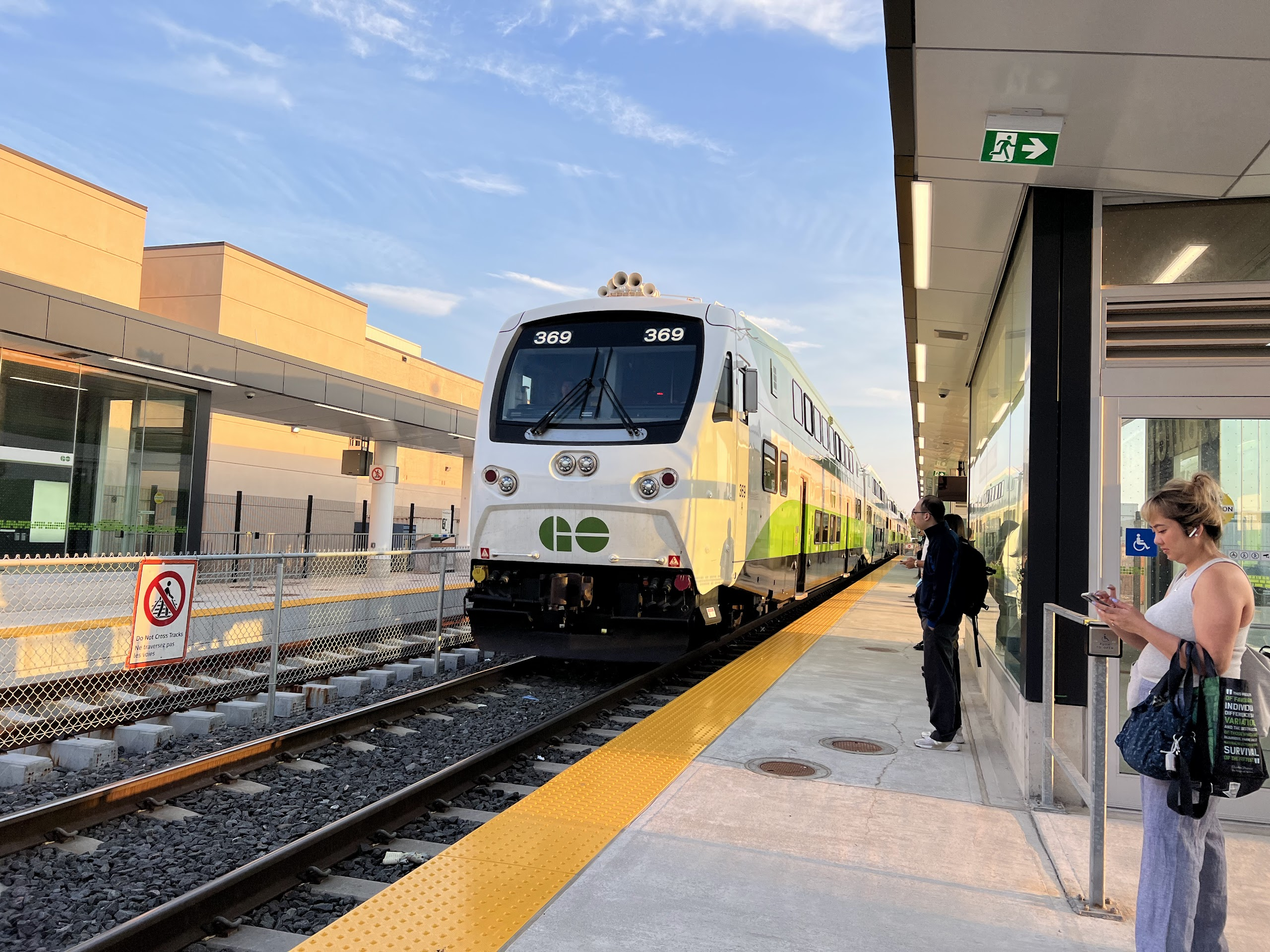
Unfortunately though, the trains on GO remain ill-suited for this type of operation for a number of reasons. They have too few doors and no level boarding, which both lead to long dwell times at stations that limit frequency and slow run times. The layout of the bilevel cars interiors is also an issue (which could and should be fixed even before new rolling stock is acquired) — the “facing” layout currently used is not good for maximizing passenger comfort or capacity and leads to a lot of feet and bags on seats (overhead space like on most long distance trains would help with the latter).
That’s not to mention that GO does not have EMUs — which I’ve advocated for previously. EMUs aren’t necessary for all services GO wants to operate long-term, but for the frequently-stopping inner routes (where the biggest new potential ridership and service level are possible), the high power-to-weight ratio and many-powered axles of EMUs would allow for better performance and faster trips. To some extent, GO’s network seems to have too few stations to take advantage of all of this improved performance, and that’s a good reason to add more stations — on top of the new “SmartTrack” ones like Liberty Village.
It should be noted that even just putting off thinking about what the specification for GO EMUs would be is a very bad thing, since right now GO has a fleet entirely composed of Bombardier Bilevel coaches all infrastructure is a function of that rolling stock. EMUs with shorter carriages and better performance could allow for more aggressive track work in corners, and importantly for flyovers and tunnels. Having a sense of what GO’s eventual trains will be capable of is critical for planning future infrastructure designed to work optimally with said future trains. For example, perhaps new flyovers on the “urban” parts of the network can be steeper than in places where diesel locomotives will still operate, perhaps tunnels could be built to standards closer to those seen on the subway network, and perhaps stations could be built slightly shorter than the massive 300+ meter monsters of today (some of the longest in the world!).
Of course, some may note that DB operates lots of locomotive pulled regional trains in Germany which is true, but on high frequency S-Bahn services virtually all rolling stock is EMU. Even for regional services much of the new rolling stock DB is acquiring is of the multiple unit variety – sometimes even from Alstom! (These trains would be so good for GO)
Infill and Shoulder Stations
Shoulder stations are truly the thing I spend the most time moaning about, because investing in them is just so obviously a good thing for our future — and yet Metrolinx has no plans to do this, or even just protect the sites for the future. This is so utterly lacking in foresight that it boggles the mind, and I can already imagine discussions in a few decades of us needing to spend 10 billion to build a “Union-relief station” at Spadina under a sea of new condos, because nobody thought protecting for more than one station in the CBD of North America’s fastest growing big city was a good idea.

The most probable shoulder stations (so named because they sit on the shoulders of the city centre) we would build are as I said, at Spadina to the west of Union and Sherbourne to the east. These two sites are both about a kilometre from Union, meaning that there is not a ton of overlap in their walksheds — and allowing them to siphon away riders who might have to “backtrack” to their destination on foot after getting off at Union. The sites are both already surrounded by lots of dense development, meaning a huge market of riders (and for riders) is already there and growing. And because they are both proximal to a few streetcar corridors, they would both be able to support trips beyond their immediate walkshed.
East Harbour and Exhibition frequently come up as fulfilling the role of “city centre relief stations”, but they don’t actually relieve Union. For one, East Harbour and Exhibition are not short walks from the downtown core, so its not reasonable to expect people to easily divert to them (in the same way you can easily walk between the Yonge and University subway lines during a delay or shutdown) should their be a problem getting into or out of Union Station; and for two, they both miss some of the GO corridors.
The connectivity benefits of Spadina and Sherbourne should not be overlooked either. They could be designed with large, open platforms and vertical access that makes them much more attractive for passengers transferring between GO lines as opposed to the dark and cramped Union, and they would surely also help draw intense development into a wider area surrounding the traditional financial district. This is all stuff we should be thinking about today because even without dramatically improved GO service (and with the nice, but not super function Union Renovations), crowding at Union is already common and increasingly extreme during special events — as seen on New Year’s eve.
Of course, the most obvious reason to build stations at these sites or at least protect for them is that they are not (yet) underground or completely constrained by development and would therefore be much easier than in a hypothetical future where the core parts of the Union Station rail corridor are effectively underground — on a dollar per rider basis, I think these interventions are among the strongest on the continent.
I mentioned the value of more infill stations for unlocking ridership and capacity in the previous section, and I want to flesh this out more. At the very least, it makes sense to place more “urban” stations along sections of line where you have both a high-frequency “local” service and high-frequency longer-distance express services that can operate and thus still provide long distance riders with compelling service — which roughly translates to the inner parts of the Lakeshore and Kitchener corridors — running roughly to Pearson, Port Credit and Scarborough (each about 20 kilometres from downtown Toronto, similar to the Yonge Subway post extension to Richmond Hill Centre).
These local services probably shouldn’t have station spacings that are exactly like the subway (GO trains can go much faster and taking advantage of that make sense), and so as opposed to the subway’s station spacing of ~500 metres in the core and ~1 kilometres in the suburbs, I would suggest a station spacing of ~1 kilometre in the core and 1.5 – 2 kilometres in the suburbs. This still leaves lots of new stations to potentially be built (at much lower cost than subway stations) such as Kitchener Line stations at Lansdowne and Islington, as well as potentially in between Islington and the future Woodbine station should that area redevelop; Lakeshore West stations at Cawthra, Kipling, and Roncesvalles; And on either Lakeshore East or Stouffville (depending on whether you prefer a throughrunning Kitchener-Stouffville or Lakeshore Local Service) at Greenwood or Coxwell, and Danforth Avenue. This would create a much more rapid transit-like “core” on the GO network, which could operate on separate tracks from long-distance services and further encourage densification of core parts of the region, especially south of Bloor/Danforth. It would also enable “fine-grained” access for longer-distance GO riders who could switch at larger stations to a local train to access intermediate stations without overwhelming local transit service.
To be clear, our current plans — which use our low-performance rolling stock to throw cold water on the idea of more stations (EMUs please!) — are alright, but they just don’t seem to do any one thing particularly well. As the track capacity exists to do something truly S-Bahn-like on at least three corridors on the network, that we aren’t planning on running trains more than every 7.5 minutes on a track pair or adding even more infill stations seem unambitious.
Irrational Junctions
Junctions are naturally a very important part of any rail network, because they are the most efficient point for connection between services which are diverging. Unfortunately, we are seriously screwing up with the junctions on the GO network. The natural approach at a junction station (that is, a station located just before two lines split apart) is to have the capability to stop trains on both diverging routes so passengers can connect between them. Imagine Scarborough station as an example — directly east of this station the Lakeshore East and Stouffville GO lines head east and north respectively, however you cannot connect between the lines at this station.

In fact, the only common station that currently exists between the Stouffville and Lakeshore East lines is Union (again, we should be trying to not have people change at Union needlessly), and this means you can’t pop onto the Lakeshore East line at, say, Danforth and head east to change to the Stouffville Line at Scarborough (having a common station right at the end of a shared section is natural because of trips like this); instead, you’d need to ride back to Union at get a Stouffville line train there — wasting lots of time, but also creating a psychological barrier (people naturally don’t like backtracking even if it’s not actually slower).
What’s even worse is that the lack of a connection between the Stouffville and Lakeshore East line at Scarborough makes doing a very natural Durham to York trip (suburb to suburb trips are often hard on transit; this one shouldn’t be and we are still failing on it) — like, say, from a home near Pickering to a job in downtown Markham or studies at the new York University Markham campus (right next to Unionville GO on the Stouffville line). This is even worse because there are platforms at Scarborough that Stouffville line trains could stop at (although yes a redesign would be needed long-term)!
This also isn’t the only case where a natural junction station opportunity isn’t being taken: Spadina would be a natural junction station just east of where the Lakeshore West line splits from the Kitchener, Barrie, and Milton lines, and the Lansdowne station I mentioned earlier could act as a junction station between the Barrie and Kitchener corridors (if perhaps we want to have at most two lines stopping at the same station). The reason the lack of a junction station at Scarborough is the worst is because the angle between the Stouffville and Lakeshore East lines is huge — nearly 90 degrees, which means that taking a rail journey between those two lines could very well be competitive and much better than between other pairs of lines.
GO the Edges
One very strange element of the current plans for improved GO service is where the very frequent services end, such as at Unionville in Markham or Bramalea in Brampton. While in these cases there might be practical reasons for terminating frequent service at these locations — for example, beyond Bramalea station, CN Railway both owns the tracks and operates lots of freight trains — not having most service terminate at the edge or the urban boundary is a bad idea. In both cases, extending frequent electric service to the “mountains” that is Mount Joy in Markham and Mount Pleasant in Brampton would take frequent train service to its logical terminus sooner.
While this is challenging on the Kitchener line given the track ownership situation, it’s clearly possibly to do a “right of way sharing” solution like is seen on the Lakeshore East line in Durham (with Lakeshore trains sharing a corridor, but not tracks with freight) — which should make it possible to electrify the GO tracks and run frequent service; this simplifies service planning because diesel trains don’t need to fill the outer suburban demand in Brampton, and creates a more natural infrastructure setup. Of course, building those extra tracks on the Kitchener line won’t be trivial, and a flyover will be needed for service beyond Brampton, but this is all the more reason for us to move rapidly towards more performant trains with more flexible infrastructure guidelines.
Ideally in the long-term across the region, a sort of fairly high frequency regional express service (think every 15-minutes) can operate to the edge or the developed urban areas, to Hamilton, Mount Pleasant, Mount Joy and the like, running as an overlay on top of even more frequent urban/suburban services I discussed before.
Foreign Lands — Pearson and Mississauga
Toronto was blessed with a large train network that goes to a lot of useful places, which means now that so much of the region’s train network is in the hands of Metrolinx, we really have a golden goose. But, there are some very important places — like Pearson Airport and the “city centre” of Mississauga (yay highways!) where the trains don’t go (at least GO trains).
While there are many locations which people might argue deserve regional rail service, Pearson and Mississauga City Centre stand out because they are both already major transportation hubs and quite poorly-served by existing higher-order transit.
In the case of Mississauga, it blows my mind that there is no talk of rapid transit to the self-proclaimed city centre — at all. Instead, there will be a streetcar on Hurontario, and frequent electric trains to Port Credit. Meanwhile in York region, the major centres of development – Vaughan Metropolitan Centre, Richmond Hill Centre, and Downtown Markham are all on an existing or soon-to-be-build subway or electric GO train line.

The fantastic TRBOT report from a few years ago discussed the idea of a Milton Line diversion to serve the city centre as well as various other ideas, but I am aware of zero talk of mass rapid transit to this key node (which has a crazy amount of density already) from the city or Metrolinx, which shouldn’t be the case — we should have plans!
Of course, even if we did decide to do a Milton Line diversion (probably my preferred option), we’d need to get serious about service on the Milton Line, which basically doesn’t come up beyond “well um, you see it’s tricky because CP owns the tracks” as if there aren’t a large number of possible ways of creating a frequent, Milton Line equivalent transit service (or just sort out the Milton Line with CP as we have done with CN in other places) between Mississauga City Centre and Toronto.
The situation for Pearson is in some ways worse. The UP Express does go to the Airport, but its crappy rolling stock has an expiry date and the crappy viaduct we built connecting the airport spur to the Kitchener line means running any serious mainline-style service on it is no bueno. That means that there is less obvious reason why creating a high-quality rail link to the airport should be a priority — this is cemented by the “eventually hopefully” extension of Line 5 that final bit of the way from Renforth to pearson.

But the need is real: the UP Express with the current rolling stock can basically at best operate around the current every 15 minutes — meanwhile Vancouver already runs the Canada Line every 6 minutes. Given Pearson is a much larger airport and the Greater Toronto region is growing much faster, clearly the status quo of much less rail capacity to the airport can’t stay.
These problems might be less pressing if the GTAA hadn’t foolishly put its “Union Station West” plans on ice during the pandemic. Indeed, it seems a big reason why airport projects are all in a Heathrow-style holding pattern is because nobody knows what’s going to happen. This is bad because the airport has so much opportunity with better transit connections — as a potential waypoint between Downtown Brampton, Mississauga City Centre, and Downtown Toronto, as a destination beyond flying, and as a proper transit hub. Of course, GTAA probably shouldn’t have been mostly in charge with making a transit plan, but then again it’s hard for anybody to make a plan when key long-term decisions like rolling stock and infrastructure design for things like regional rail are up in the air (GTAA’s up-in-the-air terminal expansion plans obviously do not help).
All of these gaps require reconsidering what GO is and what it will be long term. And that there is not clarity around so many of them makes me very concerned about the planning process Metrolinx has undertaken over the better part of the past decade.
The fact that it’s still not clear why we aren’t putting stations in particular (often obvious) locations, or exactly how frequently trains will run and to where, is a planning and management failure. From the outside looking in, I can only imagine the reason these things are not clear is that they are not yet known, which suggests a bad case of analysis paralysis or a terrible bout of indecision. It’s also even more concerning because we’ve been studying for a very long time. Not committing to a plan for service, means not committing to a plan for infrastructure, which means not committing to a plan for construction and committing to a plan to the public. It is astonishing how little we actually know about the specifics of this massive project that is costing billions and billions of dollars (and for which we’ve already spent a lot), and the cynical side of me thinks that’s because nobody really knows.
Of course if you ask a lot of these questions you get answers like “it’s under study”, or that’s “confidential”, which is an appropriate answer for creating a nuclear fusion reactor or for discussing top secret classified material, not how many trains per hour a curb in Scarborough will see. That lack of transparency, which parallels the refusal to provide an expected opening date for the Eglinton Crosstown, betrays a sense of arrogance at worst (“we know better than the public and we know the public doesn’t need to know”) and a totally non-committal attitude at best. But we need to be committal sometimes! If you don’t make commitments, you have nothing to strive for and that makes the endless analysis paralysis treadmill all the easier to stay on.
While the argument might be made that we should not rush into decisions that are so critical for the region’s future, I think we are instead suffering death from stasis. I truly think we would be far better implementing an electric regional/suburban rail system today (or 5 years ago) with some obvious flaws, than trying endlessly to get blood from a stone and find an impossible perfect solution (which is of course horrendously expensive because you’ve gotta pay people to do a million studies over years and years). We seem to be creating more and more complex processes and organizational structures (I had to explain to a number of people what the heck the announcement in the tweet at the top of the article actually meant) rather than outcomes — and it concerns me that nobody seems to be paying attention to this. Not delivering substantial things just makes for a culture of not delivering and being indecisive. Ironically, despite being what is widely acknowledged as a political project leading up to the Pan-Am games — with many obvious flaws, in many ways the UP Express has born much more fruit than GO Expansion, because it’s actually happened.
Imagine for a second, the UP Express — absolutely problem-ridden, from its GO-incompatible infrastructure to its janky high floor diesel trains — and yet people can actually use it and it actually benefits the city and the public. While the UP might not be perfect, it is real and it’s teaching us things! More service is run on UP than any existing GO line, higher-performance multiple-unit trains, and it’s shown that there is a huge demand for service.
Committing to things like new rolling stock and stations today might limit our options in the future, but not doing it is wasting years and years of potential system growth and long-term incremental improvement. Sure, we shouldn’t buy janky diesel trains that are incompatible with the rest of the fleet and operate on painfully curvy elevated viaducts, but we’re clearly far beyond the point of a happy median. We’d be much better off with an imperfect system today than in ten years — because we will inevitably need to tweak things in the future, as with all railways.
All of this might have seemed to go fairly negative, and I don’t want you to have that impression. I am happy with the direction we are moving in, but the way which we are doing things does not really appear to be improving, and in some cases that’s going to create some real problems down the road, be that with a lack of suburb-to-suburb train connections, new downtown stations, or transit service to dense new TOD-less TOD nodes like Mississauga city centre. We need better.







Leave a Reply