
If you enjoy my writings on transit around the world, please subscribe:
and consider supporting my work on Patreon:
for lots of extras (and to help keep the lights on!)
For someone as interested in public transit — and in particular, “heavy rail” — as I am, you may be surprised that I haven’t written or talked more about the idea of heavy regional rail in my hometown of Vancouver.

Challenges
The truth is, a big reason for that is that making “conventional” North American regional rail work in a region like Metro Vancouver is very difficult for a number of reasons:
- The existing rail network is heavily used by freight, and is likely to be very challenging to upgrade when compared to a city like Toronto, where there are a number of lines that are very light on freight heading into the city centre through urban neighbourhoods.
- The existing rail network doesn’t serve the region’s population centres very well, and moreover is often located close to waterways or on low-lying land that make it quite susceptible to natural disasters, from flooding, to sea level rise, to liquefaction in an earthquake.
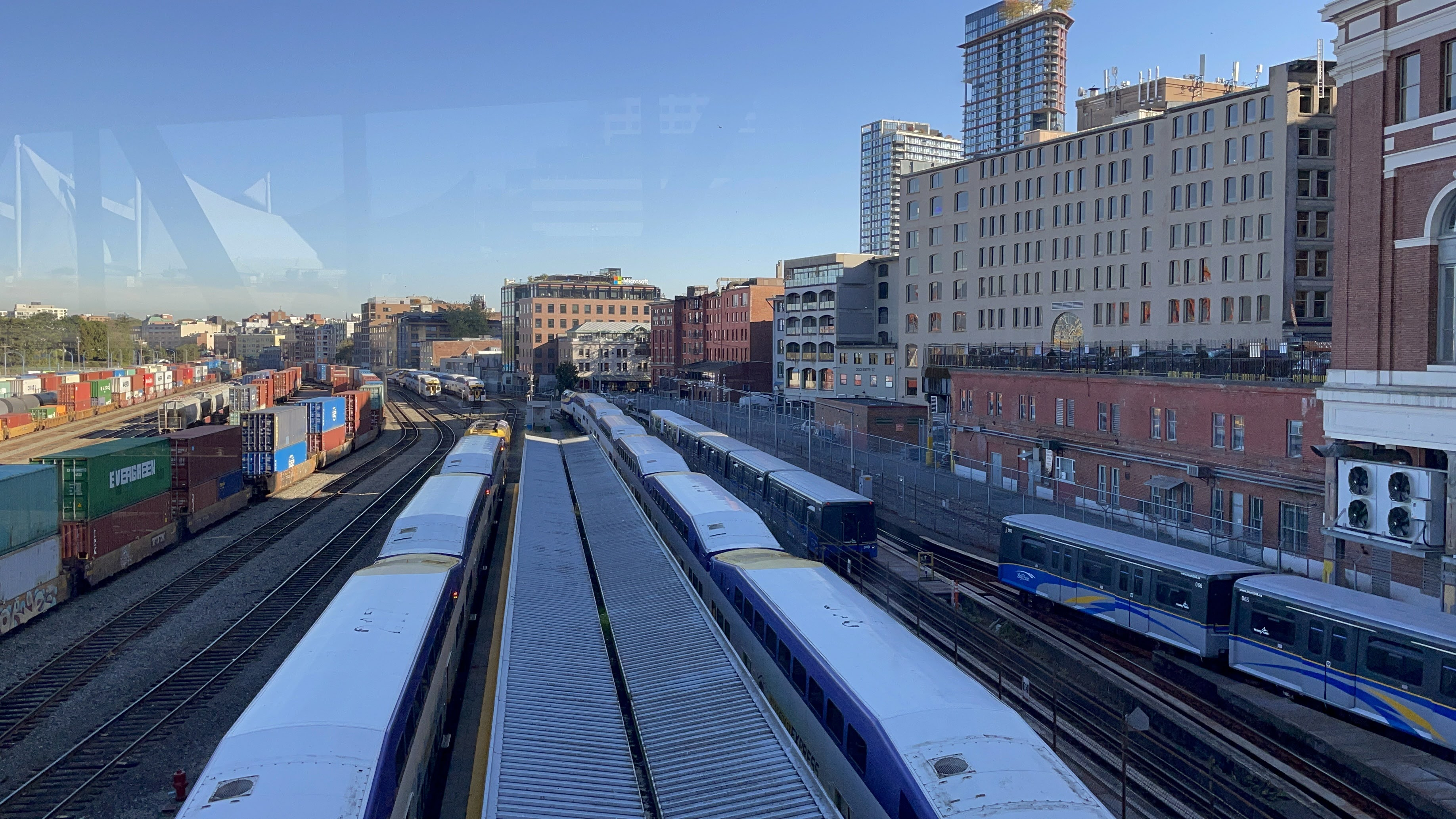
- There is minimal existing “heavy rail” experience in the region, with the only significant passenger rail service being the “couple times a day” West Coast Express commuter train.
Despite the challenges, a group has been advancing a concept for what they call “regional rail” running from the Fraser Valley to Vancouver and up to Squamish and Whistler as well as to the airport and Tsawwassen under the name “Mountain Valley Express” (I’ll likely write a few blog posts about the idea of “regional rail” for Metro Vancouver). To be clear, my goal is not to throw cold water on ideas to improve Metro Vancouver, but to highlight the real challenges that come with such an endeavour. The region does clearly need a rail transit system that can serve a broader area than SkyTrain with more capacity, but I’m not sure what’s highlighted in the plan is the best way to get there.
High Value Plans?
Much of the plans for “MVX” can be found in the following document, and I think the graphic seen on page 6 is particularly worth looking at:

Notably, the headline ridership is listed as 130,000 per day at a cost of 10 billion CAD (which, to the authors credit is suggested as a high-estimate that could be reduced with common sense cost control measures, but some of those things are big asks). The issue I see with these numbers is that they suggest building a project with similar daily ridership to the Canada Line, but at approximately 3 times the cost. While there is obviously inflation to consider, this implies a project with significantly lower value than the Canada Line — despite over a decade of regional growth (and hopefully learning about big infrastructure projects!).
Now, I actually think there is good news and bad news with these numbers. On the positive side, I think 130,000 daily riders is very conservative for what a high-quality regional rail system in Metro Vancouver could move (I would be aiming for more like 1 million daily riders per day after a few decades), but on the negative side, looking at the scope proposed in the map — which is well over 200 kilometres in length — a cost on the order of ~$10B CAD is not realistic. The Grand Paris Express, which is a shorter project (heavily-tunnelled, but built quite cost effectively) costs several times more — and that’s for a lighter, metro-type system.
Adjustments
The natural response when value is low is to trim scope; increasing benefits and reducing costs. I think the obvious way of doing this based on the map above is trimming a lot of the network. For example, the “North Fraser” line that more or less follows the existing West Coast Express route is duplicative of the “South Fraser” line, which could be built more cost effectively, and would actually serve new places. There are other similar examples one can draw.
There also needs to be serious consideration of technology and how this project would fit in with others which are proposed. Much of the plan hinges on improving and integrating with the existing mainline rail network, there’s mention of tilting trains, as well as shared infrastructure between the new “regional rail” and the slow heavy North American trains of today, and I think this is pretty clearly the wrong approach.
By interfacing heavily with the extant mainline network (and services such as the current small number of Amtrak and VIA trains running to Vancouver) you suddenly massively increase the costs for building infrastructure, as you need to comply with the gentle grades and curves that these systems can handle (even today’s passenger trains often have pretty poor performance). This combined approach also creates less value, because transit priority still wouldn’t always be guaranteed even after massive amounts of funding had been sunk into the system — such as on the proposed “North Fraser” route.
There are very specific examples of the problems an integrated approach would create early in the linked document: for example, a new tunnel under the Fraser for “regional” trains shared with VIA and Amtrak trains — which are low-performance and unelectrified — would need to be flatter and thus much longer and expensive than a regional rail-only crossing. Similar examples come up throughout.

Mentions of Cascadia High-Speed rail throw another huge wildcard into the whole endeavour, since accommodating high-speed trains means considering another entirely different performance profile. Moreover, high-speed trains are long: while the report suggests high-speed trains might be 150 metres in length, this is extremely short for a high-speed train (Eurostar and Shinkansen sets are 400 metres long and 200 metres is very standard); having longer trains is counter-intuitively possibly less expensive if high-speed services are made to share limited track space with slower regional services.
And then there’s what I think is the ultimate issue — trying to have this whole “network” be regional rail. While I think a train service to Whistler would be amazing, that’s either going to be billions of dollars alone or require an overhaul of epic proportions of the existing very poor rail alignment, which is low-capacity, covered in level crossings, and which will be slow even with tilting trains. It seems pretty clear to me that as a rail network, the needs of serving modern high-speed rail trains on one side and a very legacy level crossing-riddled route crammed between mountains and an inlet is going to require rolling stock, which basically does not exist — and I’m not sure it should.
Suggestions
I’m going to try and briefly suggest how I would change the plans to try to achieve much more cost effectiveness and a more workable rail system that could be feasibly built, inter-compatible with high-speed rail, and constructable in a phased manner.
- Drop the plan for rail to the Tsawwassen Ferry Terminal. The southern leg of this requires a new rail right-of-way in very low-lying areas where we are likely to not want to encourage development, and I can’t see a good reason why a hig- quality bus service from Bridgeport with highway-adjacent busways couldn’t provide a very good passenger experience. Better yet, this solution also lets you do things like run the same high-quality buses to Scott Road to serve more of the region. The northern leg of this route is highly duplicative of the Canada Line, and any new line on such a route needs to carefully consider whether that line should be upgraded or if a new line should be built. This highlights the problem with all of these routes being the same network though: the capacity and frequency requirements of a north-south Vancouver and Richmond rail route are very different from those of a route to Tsawassen.
- Drop the plan for an upgrade “North Fraser” West Coast Express service. The only way I see upgraded West Coast Express service making sense is a very low-cost program to allow hourly service from Coquitlam to Mission using a few passenger tracks and Stadler FLIRT-style DMUs. Coquitlam already has a SkyTrain connection that is far from saturated and would still feed into a regional rail trunk somewhere near Lougheed. If more money is going to be spent, a south of Fraser route is much more promising, and can be accessed by residents north of the Fraser with feeder buses.
- Fast and frequent rail on the Sea-to-Sky corridor is an idea I want to work, but creating something compelling is going to be incredibly expensive. I appreciate that the MVX team has highlighted some ways to control costs in their report, but this is just a very challenging environment to build in, and some of the cost-saving measures seem superficial, such as large single-bore tunneling (which makes using trains with a large loading gauge dubious, and which has had a lot of issues in Barcelona as well as on the Evergreen SkyTrain extension), and sharing infrastructure with costly legacy rail. I think providing an excellent bus service is once again a much better option, and much more compatible with incremental upgrades over time. For one, since the Sea-to-Sky highway already has a number of narrowings, there are natural places to put bus lanes that let buses jump the queue. This infrastructure could also be used by the many existing tour and shuttle buses that operate on the route and connect people to destinations in and around Whistler and Squamish (where you could invest in lovely — but cost effective — terminals in central locations). The Sea-to-Sky highway is also an incredibly important goods movement route, and rather susceptible to disasters like rockslides and earthquakes, and in most countries like Canada, such a route would have a lot more tunnels on it, not only flattening the route out and getting rid of tight corners but also improving resiliency in areas at risk of washouts, as well as rock and landslides (while also improving seismic resilience). I think an improvement project for the Sea-to-Sky highway that adds tons of bus priority measures to the route would not only be much less expensive than even modest rail, but higher-value for transit and the province at large.
Beyond these three legs, I think rail can still be a compelling option for the main “Valley-Vancouver-North Shore” trunk, but how it’s built is very important. I’ve long thought that something with the general layout of a system like BART would make a lot of sense for Metro Vancouver and the Fraser Valley (of course with standard gauge, signalling, overhead wire power, and higher top speeds due to the long distances). Big, rapid transit-style trains with the capability to run high-frequency service in the core and lots of thought given to serving many different regional journeys provide the capacity and comfort of “mainline” rail, but with the performance of rapid transit.

Trains should be BART-sized at ~200 metres long (and the loading gauge should probably accommodate bilevel trains) because you are unlikely to ever build another major electric rail trunk like this, and high frequencies alone can only go so far. If infrastructure is one day to be shared with high-speed trains operating a different service pattern, this will seriously eat into capacity on shared sections, and while this is doable as seen in places like Istanbul (with the Marmaray) and Hong Kong (with the East Rail Line), it’s a real challenge. I’d argue the core of the network from Surrey Central to Downtown Vancouver — which is only about 25-kilometres of track — should be designed to allow quad-tracking long-term (with stations prebuilt with either four platforms or two platforms and centre overtaking tracks) because this is likely to be the highest demand section, and because it would allow more through services on branches to South Surrey, the Fraser Valley, and perhaps places like Coquitlam and Maple Ridge in the long term. It would also making mixing high-speed services in more feasible.
Note: This is just my general sense of the direction such a project should head, leaning more into a greenfield system rather than trying to upgrade and augment the rather bad existing railway system in Metro Vancouver (which often doesn’t connect very well with existing transit or activity centres). I will likely write a follow-up article with a more detailed proposal.
With these changes, I think you could build a rail system that starts with the central trunk and then adds branches to Abbotsford and it’s airport (with an eventual extension to Chilliwack), South Surrey and White Rock, the North Shore (coordinated with a potential SkyTrain extension), and beyond. While it might disappoint some to only run buses to some of the other destinations, I really do not think they pencil out for rail — certainly not the type of rail we’d need to build to recoup the cost of such a major investment. Fortunately, there is no reason why buses and trains could not form an integrated high-speed regional public transit system for the Lower Mainland that has a consistently high-quality passenger experience — something like R-Net in the Randstad could be a good model of the type of branding and system worth pursuing.
Even with all of the trimming, I also think that this rail system is likely to cost tens of billions of dollars and take at least a decade or two to build out, but for that high price and extended timeline, we’d have a system the region could grow into, and lots of new land opened up for high-density housing and development (which is scarce!). Moreover, such a system would nicely augment SkyTrain, allowing that system to actually become more local instead of having to sit as an awkward in-between of a regional train system and an urban metro.
To check out the MVX concept and project, visit their website here: https://www.mvx.vision/




Leave a Reply