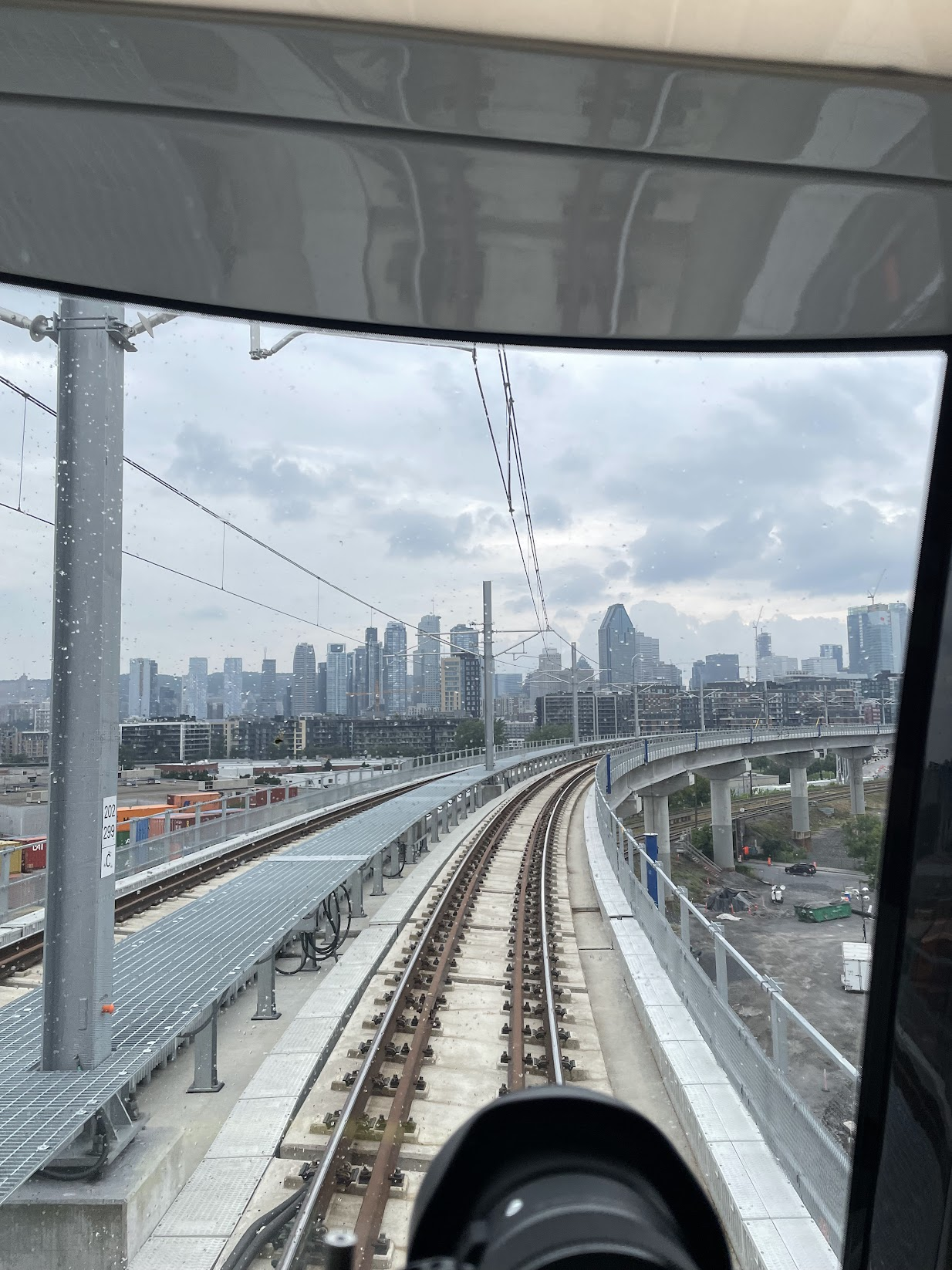
Last week, Canada’s environment minister walked back comments about not funding new highways before I could even manage to send the comments to my friends in amazement. And while the US Secretary of Transportation has talked a big game about new transit and rail investments, there still isn’t any rail being laid for a 300-kph rail line anywhere in the US.

I think a big issue with the current crop of Can-American politicians on this issue is that while they recognize that there is a problem, they don’t seem to have the answer.

An Avelia Liberty high-speed train. Ari Ofsevit, CC BY-SA 4.0 https://creativecommons.org/licenses/by-sa/4.0, via Wikimedia Commons

Throwing more money at the systems that have delivered us so little transit and intercity rail (especially the later) over the last several decades, and expecting that to amount of anything substantial is a fool’s errand. If a few subway and light rail extensions, some Northeast Corridor improvements (that mostly should have happened generations ago), and Brightline West are a majority of the new capital projects that have come out of the unprecedented funding that the US has thrown at new rail projects since 2020, I think it’s very fair to label this effort a failure (seriously, we are talking amounts of money that would more than build several of the world’s high speed rail systems in their entirety!). We just do not need a degree change in the way we are building rail and public transport projects; we need a sea change.

Canada has arguably fared better; we seem to be more capable of building cost effectively and we’ve thrown way more funding on a per capita basis at capital expansion, and so there has been an impact. But many of the same issues that dog the US also dog its neighbour to the north, and we are worse on intercity rail — I mean, politicians are afraid to even utter the phrase “high-speed”!

It was less than ten years between when John F. Kennedy announced that the US would put a man on the moon to that actually happening, and I really think a similar national- (or perhaps continental) level initiative is needed for high-speed rail. It can’t just be something that we would like and that we’ll throw some money towards, if we want high-speed rail on the scale that we frankly need it, then we also need a dramatic push for it. Laws need to be changed, funding priorities need to be reconsidered, and crippling problems like high costs need to be tackled head on (much like Apollo, building a big high-speed rail network that — unlike Brightline West, actually goes to city centres — will require lots of funding and cost effective construction). Mountains were moved to build the Interstate Highway system, and more than 70-billion dollars and some nice comments about fast trains will be needed to see real progress on this front.


If you enjoy my writing and would like to support me, check out my Patreon!

11 responses to “A Space Program-Approach to High-Speed Rail”

  1. CAHSR is America’s best Apollo analogue. Savage amounts of money dumped into it on a “Damn-the-costs-we-will-get-this-done” basis, with the cost of failing to invest (long-term loss of economic competitiveness) making present costs almost irrelevant.

    1. I don’t agree because 1) The money isn’t all there and has never really been 2) The amount of federal support and law / policy changes seem fairly minor. CAHSR has already been going on for more than a decade too!

      1. On paper, CAHSR seems like it should have been the HSR space race move, but I agree with Reece that it hasn’t had that transformative role that the Apollo program did. (I still want to see it finished and improved/extended so Americans can start experiencing actual HSR.)

    1. Strabag is a pretty well known international tunnel builder

  2. If cost effective is the goal, I suspect a lot of the problem is both that the government is an inexperienced client of rail projects, and that North American builders lack the experience building passenger rail. The solution to that isn’t more money, or giant earth shaking projects; it’s a continual flow of smaller projects, upgrading existing lines, both for capacity and speed, grade separating junctions and level crossings, electrifying the most important sections and building short spurs and bypasses in order to get more stations in. The goal shouldn’t be a big bang of €70bn or whatever amount, but a consistently increasing spend, where the team that built one project, both within the civil service and within the actual builders, go on to build two or three projects as soon as they’re finished.

    The consistency lets you invest in both skills and in equipment; that’s not something that’ll be done if rail is a single project that comes and goes with administrations

    1. I very much agree, but a pipeline could absolutely be part of a moonshot, and any serious attempt to build HSR will require a change of direction anyways – its a big step beyond regular rail projects

  3. Good points. But maybe more politically feasible in Canada than in the US, where rural and exurban constituencies who are pro-highway have now and will continue to have outsize political clout (given how the US Constitution is written) that makes it difficult to see how funding of a scale such a “moon shot” project for HSR would get through Congress. Throw in the automakers and automaker unions, and it becomes even more difficult.

    1. Indeed its probably easier for Canada, but we also have way less wealth!

  4. Definitely I would want to see HSR between Montreal and Toronto to begin with, with further expansion to places like Quebec City, Sherbrooke, Ottawa, Hamilton, London and Windsor. Maybe also Trois-Rivières and other Ontario towns I am less familiar with. To your point, develop the expertise in the planning, design and construction of the Montreal to Toronto route and have it help to finance all of the other branches. I also have a bigger vision of tying Canada together coast to coast in the highest possible speed of rail given the large distances involved, but I know this is in no way economical given our population outside of a handful of large metropolitan areas. That we are getting a HFR instead is a half measure; I am not certain if you have covered the HFR plan here or in a video, I’m sure you must have but there’s been no news about it lately to talk about it again.

  5. […] we were to approach rail travel with an Apollo-level approach, then maybe wanting to ride the train wouldn’t feel like grasping at hopes and dreams and […]

Leave a Reply

Trending

Discover more from Reece Martin

Subscribe now to keep reading and get access to the full archive.

Continue reading