
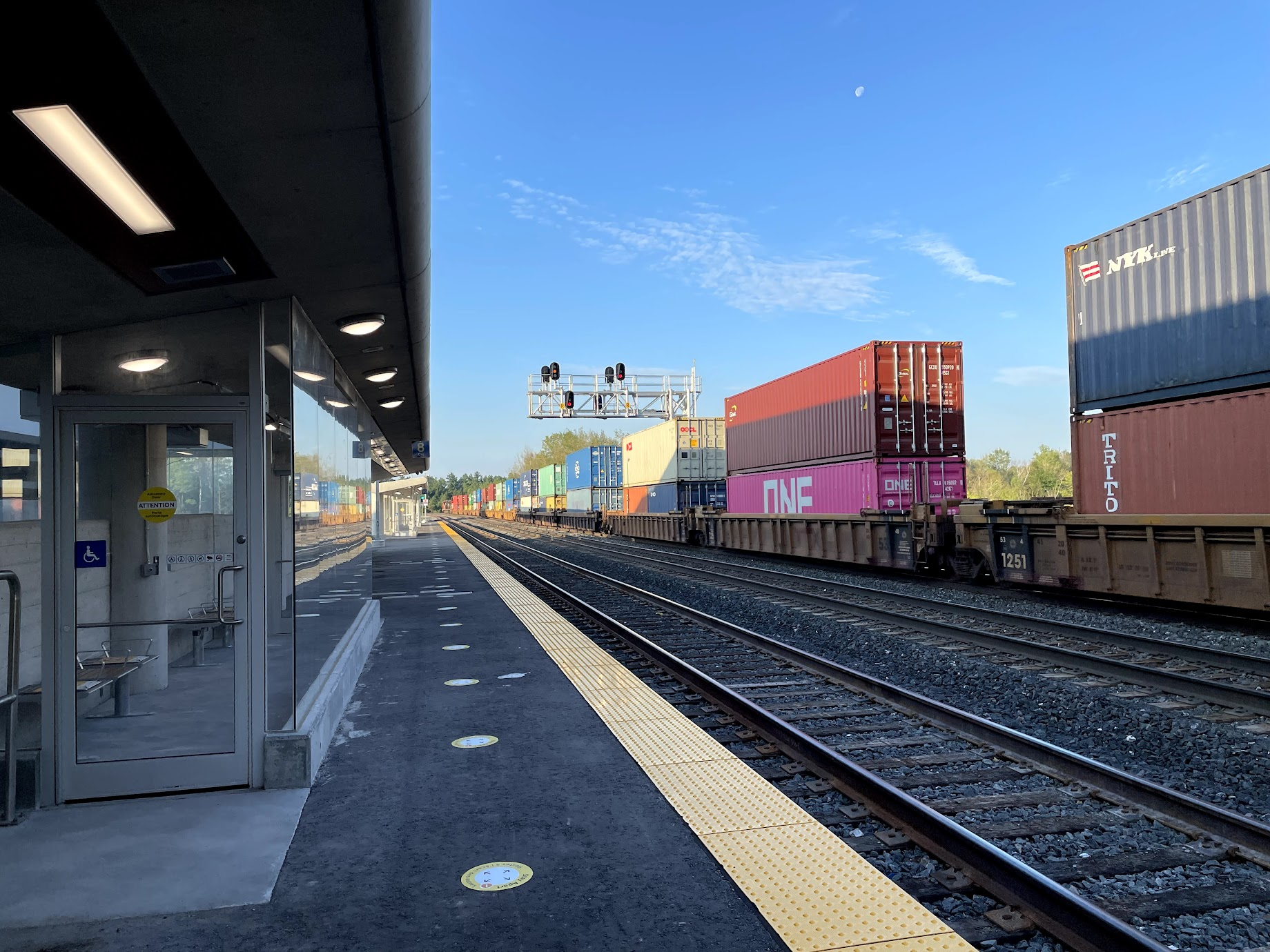
North America has (despite what many seem to think) a lot of positive elements: Tons of wide open spaces, beautiful nature, and a lot of nice cities. The continent also has geography which is pretty great compared to what many places in Europe and Asia are working with. But I really do worry that the continent’s complete lack of modern railways is going to hamper growth in the future.
To be clear, North America does have a lot of railways, and those railways have some redeeming features, most notably they go to most of the big population centres, allow for high-axle weights, and huge clearances that allow for double-decker passenger cars basically everywhere, and more importantly (for today’s railways) double-stacked containers.
But that’s where I’d say the positives mostly stop.
If you enjoy my content, consider subscribing to my blog:
or supporting me on Patreon:
Your support will help me bring you more content faster!
Freight-Only Ideology
Probably the biggest impediment to modern railways in North America is that most railways — and thus railroaders — operate with a freight-only ideology. Freight is prime, passenger trains (if they exist at all) are an annoying inconvenience, cars and planes are for moving people.

Now, to be clear, the North American railway system does do freight movement fairly well — we manage to move a huge volume of goods economically and inter-modally through rail, including right to massive ports. Hoever, even on rail freight, we have some major weaknesses.
For one, while the whole “land barge” style of freight movement might be good for moving large volumes with minimal effort and staffing, freight railways in North America are much weaker when it comes to the value of goods carried, and that’s probably because just-in-time for the railways is rarely on time for anyone who’d want to receive a shipment. The erosion of traditional rail freight has been long-running and very unfortunate.
At the same time, infrastructure quality is a big issue. Much of the North American network is single track, sidings are often too short (in many cases, railways have actively downgraded their infrastructure so they have less to maintain, but can also do less…), there is essentially zero freight electrification (there may still be a mine railway or two), signalling is a generation or two behind the rest of the world, and of course: passenger trains are rarely prioritized. Even in places where it’s clear that passenger trains should get priority, the entire culture of freight-first often does not allow it to happen.
And that attitude of impairing a diverse array of services, from more types of freight to passenger trains, has made the North American railways one trick ponies. While at one point they might have operated impressive passenger services, I can’t imagine UP or CN running a high-quality conventional passenger service today, much less high-speed rail! In a lot of ways, it feels like self-sabotage and a lack of discipline, and so often the freight railways need not give anything up to enable the whole rail sector to move forward — say, by letting passenger railways build parallel tracks in the same right-of-way, but this might incumber freight and so it either is disallowed, not proposed, or requires incredible sums of money.
Refusal To Move To Modern or International Standards
There’s also a complete refusal to adopt global standards and highly prevalent “not invented here” syndrome. Want to use ETCS? Electrification? Safety and operating procedures used in hundreds of countries? All of these things face enormous pushback. And when something does end up making its way through (like, say, “enhanced train control”) it is often watered down, overpriced, and underwhelming — which isn’t surprising for a bespoke solution.
At the same time, while railways around the world are focused on pushing themselves forward as climate-positive and complete mobility solutions, North American railways only seem to be able to think about the next shareholders meeting or quarterly numbers release.
Lack of High-Speed Lines
Now, I have harped a lot on the freight railways in this post — because to a large degree in North America the freight railways are the railways, but more broadly the continent seems likely to suffer from a lack of high speed, and even just modern passenger lines. And the fact that our legacy railways are tied up by freight (again, pretty effective freight) is a bad excuse here, because we now have quite a few examples of countries building modern passenger rail independent of legacy railway systems — often to more internationalized standards.

The obvious examples I think are Japan and China, both of which have country spanning high-speed train networks built to different, or higher standards, than their legacy mainline train systems. If North America was serious about high-speed rail, this seems like a pretty promising approach to take, but instead in almost every case — Brightline West excluded (which is interestingly also trying to use the European Train Control System) — our high-speed lines existing or under construction are stuck with a lot of rail-based baggage. California High-Speed rail for example will run through level crossings, and the Northeast Corridor still has some crazy sections that should clearly be replaced with more direct diversions.
That North America does not have a modern high-speed railway system is going to mean our cities and megaregions are a lot less competitive, more expensive to operate, slower moving, and worse for the planet. It’s hard to compete with the speed, cost, and efficiency of well-executed railways, and looking at Southern China recently I can’t help but think that the amount of modern high-speed and regional infrastructure they have built is going to pay unthinkable dividends for generations.

Lack of Building Experience
Probably the biggest problem we face though is that we as a continent do not know how to build. Transit projects, and of course high-speed rail projects in North America, should in many ways be easier: we have more space than in other parts of the world and lower-density urban areas, but somehow our costs are the highest. At the same time, not having any real modern passenger mainline that extends between two cities (I guess Brightline Florida might count here) means we have no experience even building or seriously planning such corridors.
The difference on this compared to a place like China is super obvious, but all around the world there are a lot of countries that are building or have recently built serious modern passenger rail infrastructure — i.e. not from an existing railway to an airport, or from the edge of a city to a suburban train station surrounded by parking lots. The UK, France, Korea, India, Germany, and many other nations are building new intercity railways right now, and they all have existing railway networks that are far ahead of what we have.
And yes, there’s China: everyone knows China builds a lot, but the scale and technical complexity of what they build still goes under-appreciated. Look at the existing and planned tracks around Shenzhen North High-Speed rail station for example: quad-track high-speed railways, enormous tunnels under mountains, all intermingled with more metro lines than any city outside of Asia.
And I think this kind of gets at my underlying point — North American cities have built some new commuter rail, and some freight track has been laid, but compared to the scale of stuff being built in Europe — think Stuttgart 21, or massive base tunnels under the Alps — it’s trivial. In much the same way, China building Stuttgart 21, but in a city which is far more densely populated than Stuttgart and which has far more existing infrastructure, oh and it’s for high-speed trains makes the stuff Europe is doing look small by comparison.

Suffice to say, I think our lack of modern railways and our lack of a plan to build our way to them is deeply problematic. How can we fix this? Perhaps the topic of a future blog post.





Leave a Reply