
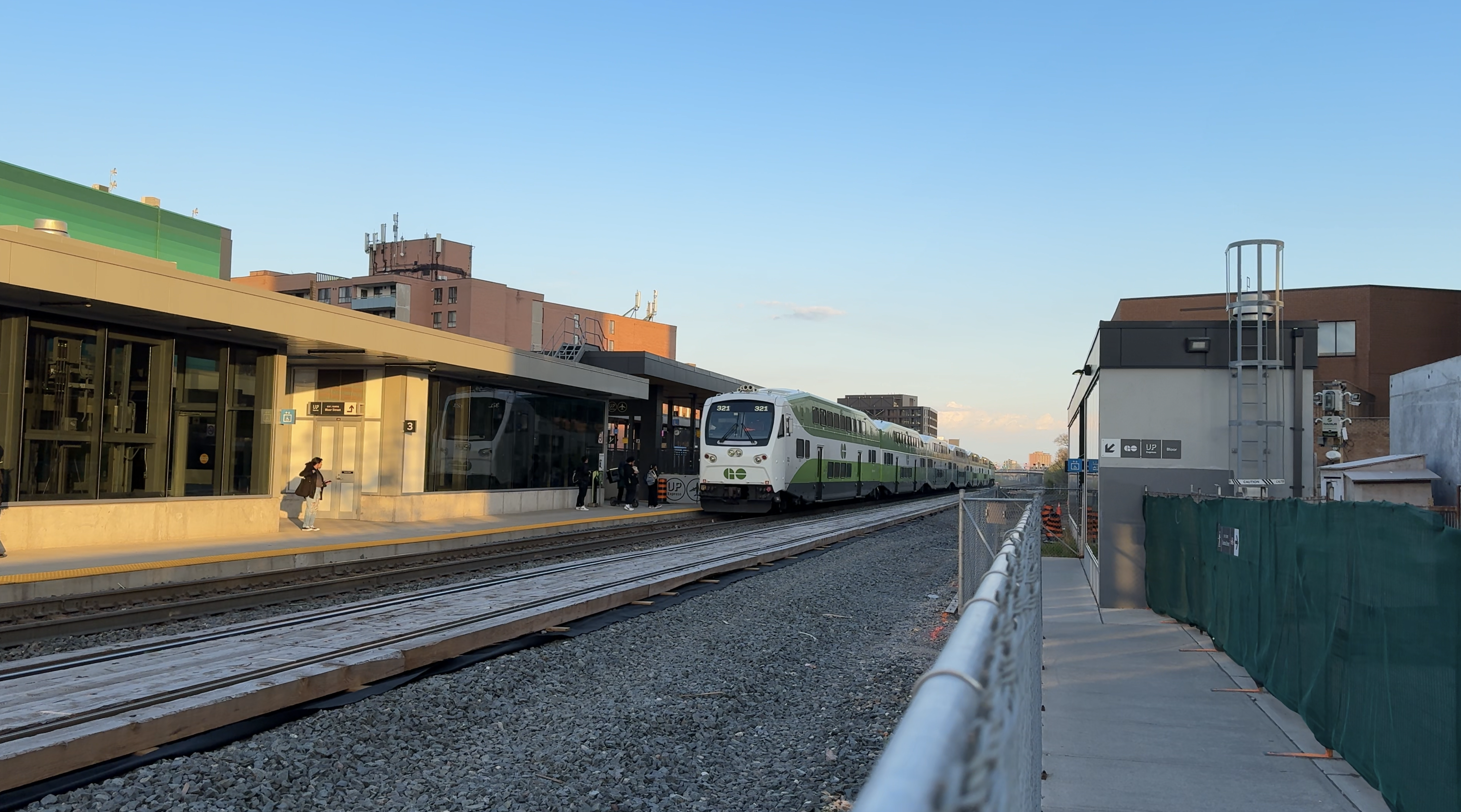
April Engelberg, a longtime advocate of building an UP Express stop in Liberty Village, has yet another piece in the Toronto Star suggesting such a stop is built, in large part as a short term solution to congestion in and around Liberty Village, and perhaps to also serve some demand for the FIFA 2026 games Toronto will be hosting.

I actually think it is conceivable that if it was an all out imperative for government and Metrolinx to get such a station built, it could be done by mid 2026, since it is a surface station and it need not be all that complicated. But, the issue is, it would probably create issues forcing redesign of the existing (and just starting construction) King-Liberty regional rail station, which will be designed to serve GO trains, but not UP Express trains.
And that station can give us a sense of what this station is taking to build given it does not seem to be a particular priority — at the soonest, it will be open a couple of years after the World Cup, when the Gardiner Expressway will be reopened, and complaints about congestion at large (though probably not in Liberty Village) will have subsided.
Probably the bigger issue here is that Metrolinx just does not seem to have enough UP trains to make an extra stop while maintaining the current all-day, 15-minute frequency, and that’s before we talk about adding the stop connecting with the Eglinton Crosstown at Mt. Dennis — and even if new trains were ordered today, it’s very unlikely they would be ready in time.
The other issue is that you would need to order more than a few trains, because the UP is getting quite busy, and since it was designed as a niched down airport express service that would run in parallel to frequent GO trains, it doesn’t have very long platforms.
Maybe UP is the Answer to Regional Rail
But, putting all that aside, I do think you can ask an interesting question out of this: What if Toronto’s big regional rail expansion — the plan to electrify GO and implement global standard ETCS signalling — was just an expansion of UP service to all high-frequency corridors instead?
This isn’t mean to be a serious proposal, but a counterfactual: what if Metrolinx just wanted to implement much better service on the cheap and stick to North American standards (as much as this is not what they should do).
Well, first I want to address the bad stuff, which should be obvious.
Not adopting global standard signalling is going to be more expensive in the long term, and it will also limit our “upgrade path” and make it difficult to eke out even better frequencies in the future. It also means that Toronto will need to rely on, and suffer with the rather bad rail equipment market in North America — which until recently has pumped out a lot of dated and poor performing equipment by international passenger rail standards.

Of course, using UP standards for “RER” would also be more expensive than GO standards, because UP standards include high platforms, that would require major construction at a huge chunk of GO stations (but maybe you could count showing Philly and New Jersey that this can be done as a tertiary benefit!), and since we’d want longer platforms to accommodate longer trains than the ones currently operating on UP, that would probably mean some design difficulties and complex staging because the “UP platform at the end of a GO platform” design is probably not practical everywhere, and doesn’t make sense if traditional GO trains would eventually be phased out on these corridors. There is also the issue of the existing GO fleet, which might need to be replaced artificially early if this approach was taken, since GO bilevels cannot board from high platforms.
But, despite all of these problems, there are actually some pretty compelling reasons to go with a “expanded UP Express” plan.
For one, new high platforms could be rationalized in terms of length, 8- or I’d argue 6-car trains, with the footprint to extend in the future would be fine, and this would allow a Hamburg S-Bahn style maneuver approaching Pearson, where the train splits in half at Woodbine, and only half goes to Pearson (matching the existing three-car platform there). This would also fix the problem of trying to determine how to integrate it with RER, and avoid needing to do major modification.
Instead of phasing the project starting with the heavily used Lakeshore line, you could start with the Kitchener—Stouffville corridor, redoing the signalling on the Lakeshore East/Stouffville corridor to massively increase its density, changing the SmartTrack station plans to use high platforms instead (high platforms already exist at other stations, and on most tracks), and converting the Stouffville line platforms at Kennedy (also please Scarborough), Agincourt, Milliken, Unionville, and the rest of the stations up the line to high-level ones — which could probably be done with a <1 year modification of service where only part of GO trains would open at each station, something that has already happened on the line in the past. Doing this would get you to a very nice level of infrastructure quite quickly, and could provide subway-level service with trains that look like subway trains, would cost less, and also provide the ability to easily be configured with more doors.

I think this would also create a helpful break from GO service. The trains would look different, and you’d want a new name, and this would be good for signifying to the public (but also transit agencies) that this was a totally different level of service. And with a new line running every ~7 minutes between Bramalea, Pearson, Union, and Markham, with stops connecting to Line 2 and 5 in two places as well as Line 1 and potentially Line 6, you’d actually have a super compelling corridor.
What’s nice is since the UP already has screen doors, you also would have to do a lot less work to argue that this line should be designed with them, as suburban trains in Tokyo and Seoul are. The nice thing here is you would also create a clearer narrative both internally at Metrolinx and for the public and politicians: “we are going to expand UP Express service across the region, if you want to know what the future of GO is, go try that out!” And since the UP already has multiple units and provision for electrification as well as level boarding, the frustrating discussion around the need for those and their standards could just be ended.
At the same time, the new trains the region orders could be “standard” North American EMUs like those used in New York (M8s) or Denver (Silverliner Vs — although I would hope we would create a better design with more doors and a less silly seating layout), while some modified UP train DMU design could be used on unelectrified parts of the network.
Again, all of this is just a counterfactual, but I think it’s a really interesting one. Because with a “starter line” to point to, good standards for things like platforms and traction and problems like the future of the Pearson spur eliminated — it begins to be… kind of compelling.




Leave a Reply