
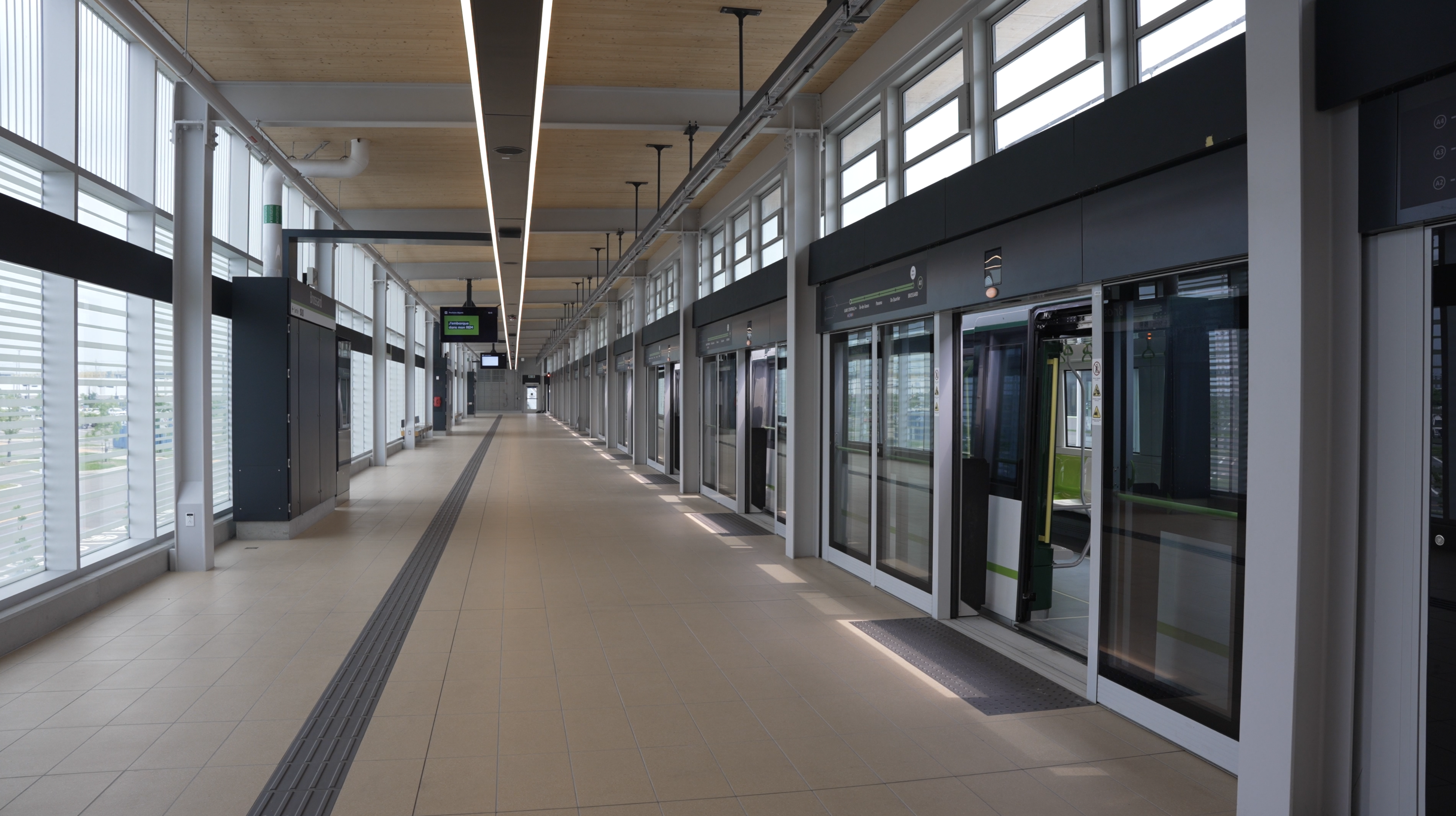
The REM is going to be a transformative system for Montreal, because it will extend metro-level public transit service deep in Montreal’s suburbs with fast automated trains (as well as features even the metro doesn’t have, like Wi-fi, screen doors, and air conditioning) , but what excites me even more than the initial network buildout (which, to be clear, is hugely exciting) is how the network will develop.

If you enjoy my content, consider subscribing to my blog:
or supporting me on Patreon:
Your support will help me bring you more content faster!
Two of the biggest automated (or semi-automated) urban transit systems in the world are the Vancouver SkyTrain and London’s DLR or Docklands Light Railway. Both of these systems share a lot in common with the REM: being automated, largely-elevated (but sometimes located on old railways) networks with roughly 80 metre-long trains. And what’s interesting about both networks is how they’ve been able to incrementally grow both their infrastructure and service in the decades since they opened in the late 20th century.

That these systems were able to be upgraded and expanded piece by piece is no accident. By using light, flexible trains and having most of your tracks above ground, it’s easy to add on new branches and extensions to your network to create additional capacity and serve new development areas. You can see this particularly well in London, where the DLR has several branches extending along the river Thames and through the Docklands entirely surrounded by new housing and development projects — and built on the cheap by going above ground on economical but attractive elevated structures.

Automation is also an underrated enabler of incremental expansion — it allows service patterns and operations to change substantially without retraining tens if not hundreds of staff, and it can allow a level of scheduling precision that can let you go with less infrastructure than would otherwise be the case. Two examples of this that come to mind are the sections of the DLR and SkyTrain that operate reliable frequent service with single-track sections (something that would be less likely outside of, say, Switzerland to be so reliable at such high frequencies), but also to completely change operating patterns based on minimizing infrastructure wear (SkyTrain used to do a weird wrong side operation of trains going to the “Evergreen Extension”, where trains would operate the wrong way for one station to simplify merge conflicts — something that was abandoned after the impacts were determined to be too significant, but that would probably have never been tried had humans been driving the trains).
Now, ironic as it is, the first big expansions that I think make sense to set the groundwork for the REM are actually expansions of the Montreal Metro. The Metro network is connected to the REM on its three main lines, but the connections all being near Mount Royal means that trips are forced into radial patterns. Additional connection points away from the mountain could be created at low cost, expanding connectivity, allowing passengers to avoid the congested city centre, and maximizing REM capacity by allowing trains to unload and refill with passengers at more points along their journeys.

The obvious first extension is taking the Orange Line to Bois Franc, which in many ways will be a Berri-UQAM-level interchange — with metro to downtown and to the MUHC, and REM connections out to all four branches. If there is a place in Montreal that justifies a big and dense transit oriented development it’s this site, and with fast connections to the airport and downtown it could be any attractive place for offices and conference space as well, creating a valuable mixed-use node.

The extension of the Orange Line to Bois Franc is less than 2 kilometres (thanks to the extended tunnels built at the same time as the new Cote-Vertu metro garage) and could be built for less than many metro extensions, with the terminus station tightly integrated with the REM above ground (in a sealed building, keeping the metro trains dry), platform screen doors from day one (which the Metro can already support), and perhaps, if we are ambitious (which I think we should be), cross-platform transfers (Bois Franc REM has side platforms!) with tail tracks for turning trains. This is something I have thought a lot about, and I think it would take this interchange from nice to amazing. This connection and design would create an immensely convenient link for people on the Orange Line heading to the airport, the West Island, or Deux-Montagnes, and it would similarly give passengers from these destinations a super easy connection onto the Orange Line — say, for going to an appointment at the MUHC or to Lucien L’Allier for a game at the Bell Centre. This kind of cross platform transfer would be just as useful as the one at Lionel Groulx, but intermodal and arguably even more valuable since it would link all 3 northern REM branches seamlessly into the metro.
The other extension I would suggest is one of the Green Line’s western leg from just south of Charlevoix, branching to the south to connect to the REM and serve redevelopments south of the VIA rail maintenance yard (as well as redevelopments on the yard land itself if VIA relocates those facilities). This branch would allow a train every 5 – 10 minutes on the Green line to run down to the riverside and connect with an infill REM station near Rue Marc Cantin, where the track should enable the addition of a station. The raison d’être for this connection would be to enable some passengers headed for destination along the east of the Green line to change here, securing a seat for their journey or for passengers headed to Guy or Atwater to have a slightly more reasonable trip. Probably most importantly though, it would allow an easy connection to the western end of the Orange line, without needing to make the rather annoying connection at Bonaventure.

The connection is also attractive because it’s logistically easy. The junction box could be built cut-and-cover alongside the A-15, and the tunnels could also be built cut-and-cover under Gaétan Laberge. The waterfront site could also play host to a large modern metro garage for the Green line that would enable very high service frequency on the line with housing developed on top of it. And yes, you could do another cross platform transfer, albeit you’d want the tracks to crash over so that the inbound REM passengers could change easily to a Green line train heading down the line
Both of these connections mean some REM passengers will get off of trains before reaching the three central interchanges, and that will allow more capacity for urban redevelopment (at the Peel Basin, or in TMR) and transit connections to occur near to the city centre (not that I think the capacity will really be needed anytime soon). Of course, those passengers would be getting on the metro, but thankfully the western legs of both the Orange and Green lines should have no problems absorbing the passengers and they still have much room for increased capacity with higher frequencies in the future and which have already started to be enabled by the Cote Vertu garage.
Linking the metro more heavily with the REM helps to create a stronger overall network for Montreal, and helps to relieve local congestion across the network in a way that lets us think about further cost-effective REM expansion, without short term concern about the core of the line being able to handle all of the passengers. How the REM network might grow from here will be the subject of future posts in this series.





Leave a Reply