
Public Transit should be accessible to all.
One of the topics I should be talking about more in all of my discussion of transit is accessibility — it’s an important topic that all too often falls by the wayside.
Recently, a new subscriber mentioned that they would be interested in an assessment of how Toronto’s subway was faring accessibility-wise given the TTC’s much-publicized miss on its commitment for full-system accessibility by 2025. In this post, I’m going to start with some macro-level things that in my opinion need to be thought about when it comes to rapid transit accessibility (this post will only talk about accessibility within stations),before looking at how Toronto specifically is doing in a later post.
To be clear, accessibility is not just elevators, and these measures aren’t just for those with disabilities either — basically all accessibility features make transit better for everyone, though anyone can become dependent on these provisions at a moment’s notice — so the need for them should be considered obvious and universal.

Elements of Accessibility
A good way to look at accessibility is as a multifaceted thing that applies to different elements of the passenger journey through a transit system. In this section, I’ll try to highlight many key elements of consideration, but of course this will not be exhaustive. You can think of accessibility less as a binary consideration but more of a spectrum, and one that is evolving over time as new technologies continue to improve access.
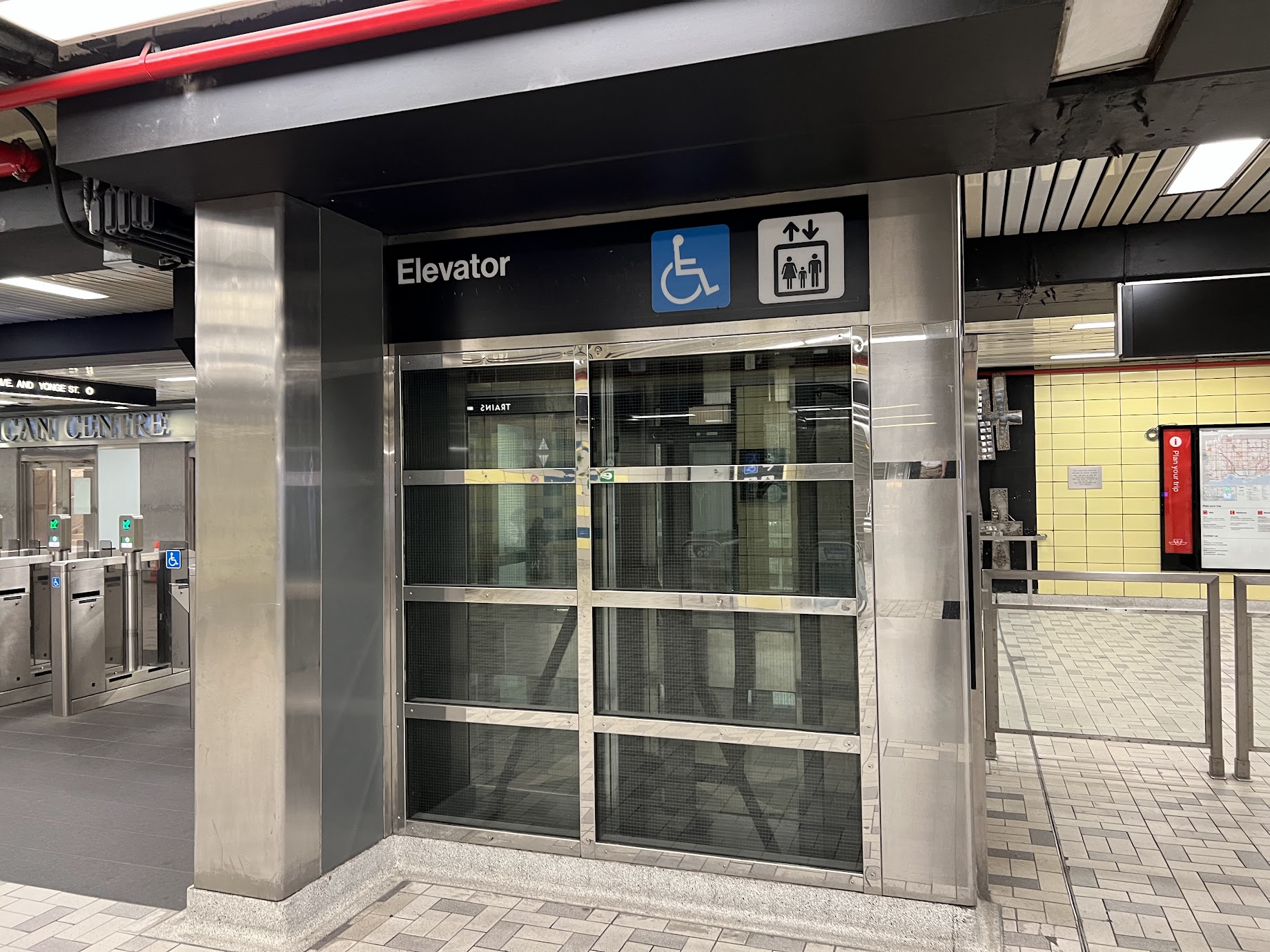
At the top, I mentioned that accessibility is not just elevators, but of course elevators are a big component. However, elevators are just part of what are known as VCEs — vertical circulation elements. By their very nature of being grade separated, some level of going up, down, or over tracks is required for rapid transit, and so providing accessible vertical access is one of the most obvious accessibility considerations that must be made.
Escalators, while often being seen as a nice-to-have, are for example an accessibility feature that allow people who might struggle to climb stairs to ascend and descend levels fairly easily, while providing much higher capacity than elevators thanks to their continuous operation. Escalators are something you might think are pretty standard, but there’s actually a wide range of models, with different speeds, widths, as well as features like automatic slowing to save power and even direction changing.
Elevators are of course essential as well, because they can be used by people who cannot balance on an escalator safely, or for people with a mobility device such as a walker or a wheelchair, a stroller, or even just folks with a lot of groceries or luggage — a regular reminder that accessibility is a rising tide that lifts all boats. Much like with escalators, there is a lot of important variability between different elevators and implementation. For one, elevators need to be sufficiently large to move large volumes of passengers, particularly at busy stations (some stations out there are even elevator access-only). They should also be transit-specific, with a robust design that’s meant to be heavily used, and ideally lots of windows for passive security. One issue that is worth considering is placing elevator control buttons in an accessible location, because otherwise they can be hard to get to for some passengers — an interesting solution to this problem that’s being trialed in some places are apps which allow you to control elevators from your phone.

This is actually a pretty cool idea, and while downloading an app to use an elevator might seem like a bit much, it’s totally worth it if you’re regularly using them or if you have impaired mobility. It’s the type of feature that shouldn’t be too hard to implement and will notably improve access, which is awesome.
Another thing to consider with elevators are “forward motion” designs. Often in transit stations, elevators simply shuttle between two levels or two sets of levels — like platforms and a concourse, and with such designs, you can plan the station and elevator to put the elevator door on opposite sides on the levels that passengers will frequently travel between. This allows passengers to roll forwards when entering and exiting the elevator, which is safer and more efficient because people can move more quickly. Whenever I experience a forward motion elevator in the wild, I smile because it usually means someone really thought about the experience.
Another interesting type of escalator is known as an “inclinator”. These type of elevators operate on an incline and have been used to repurpose diagonal shafts built for escalators to also accommodate elevators — a number of these were used on London’s Elizabeth Line.

An interesting issue that comes up with elevators is redundancy. Historically, my belief has been that having redundant elevators everywhere — that is two where you would traditionally see one — is a natural move that is great for accessibility, but Marco Chitti makes a good point that this is often a high-priced response to low elevator availability in places like North America, with poor technical standards and a lack of trained technicians. In some places you may only have one elevator, but if it is well-maintained, it may basically never be out-of-service to passengers. That being said, even a little bit of elevator down time is a big issue — it essentially makes the station unusable for a portion of passengers. I think this has only cemented my appreciation for island platforms: with an island platform, you can have two elevators operating in redundancy, which is half as many as you need for redundancy in a side platform configuration. There’s also a case to be made for simplified station designs such as in Berlin — such designs might allow an entire station to be served with just two elevators while still having full redundancy, which is great.
In the past, some accessibility advocates have actually suggested that island platforms are worse because they can create an uncomfortable feeling for people with vision impairment where they can’t easily back up against a wall and have dangerous tracks on both sides of them. This really just makes the case for platform screen doors (which can extend to head height or be integrated into the ceiling) or gates.
Screen doors are great for accessibility: They provide a hard, wall-like barrier that makes falling onto the tracks or rolling onto the tracks basically impossible; they also encourage queueing up to board and allow trains to enter stations at higher speeds and maintain safety when stations are crowded which improves service. Keeping trash and debris off the tracks also helps maintain service reliability. Screen doors are just another one of those features that provide a wide range of benefits that go beyond basic accessibility.
Actually retrofitting screen doors on existing systems generally happens after the installation of modern communications-based train control that allows for precise train stopping at doors. Most modern rapid transit stations are being built with screen doors, and an enormous number are being retrofitted with them, including a number of systems in Asia that have them at every station.

The platform-train interface is also very important — this includes the gap, both horizontal and vertical, between the train and the platform. Systems lacking level boarding are quietly very inaccessible because they can require passengers to request a ramp deployed by an employee to access trains; even in London, where many stations have been retrofitted for “level boarding”, passengers can only board with a small gap at a select part of the platform. Among systems that do have level boarding, there is still a great deal of variability between the tightness of platform train interfaces with bigger gaps, often making it hard to board, which can be humiliating and will delay service.





Leave a Reply to midtoadCancel reply