
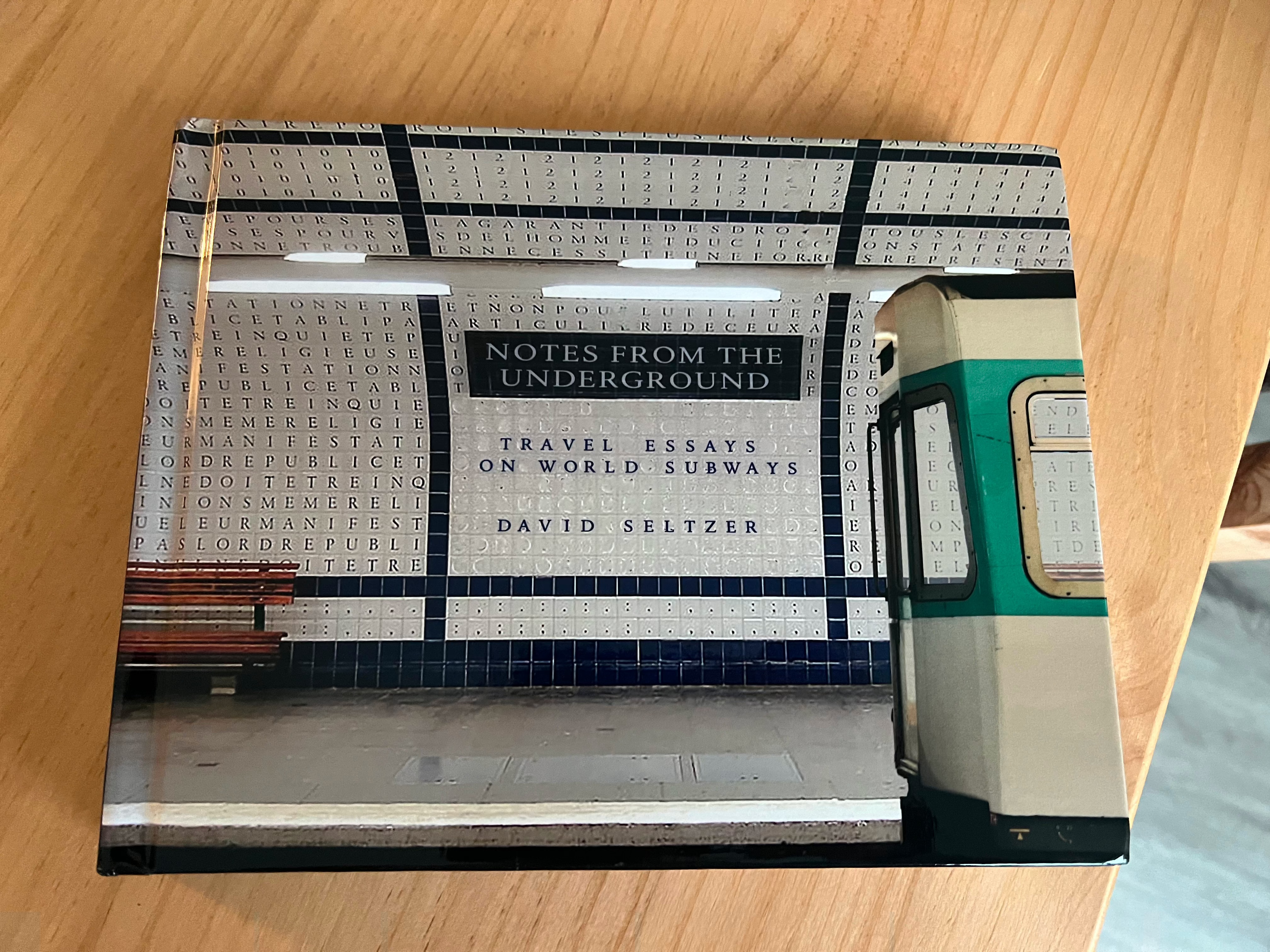
Today’s post is a sort of book review, I’ll likely do these from time to time going forward both because I have a big stack of unread transit books and because people frequently ask me for recommendations!
As a regular reminder, to support my writing please consider subscribing,
and if you want to go even further, consider supporting me on Patreon for some exclusive content!
I recently read Notes From The Underground (full disclosure — sent to me by author David Seltzer, though to be fair this is the type of thing I like to read), which is a collection of “essays” on subway systems from around the world. David is quite the global traveller and has worked in transit project financing and so is a very well equipped guide.

The book essentially amounts to reviews of a number of transit systems around the world, with systems covered in the Americas, Europe, and Asia.
The coverage is not completely evenly distributed, and David covers North America and Europe more than Asia. However, what I appreciated was that the book didn’t only cover the upper echelon of cities — in a couple countries, the most obvious city wasn’t chosen for review, for example discussing Munich rather than Berlin, Naples rather than Milan or Rome, and Beijing rather than Shanghai. There are also cities covered in the book that don’t get nearly enough attention from writers, especially in the English-speaking world, including Istanbul and Brussels (a video on the latter will be coming this year).

The book also covers topics that I certainly appreciate, but don’t always cover in fine details, such as history and station art. For example, somehow I was unaware of the existence of similar “Universal Declaration of Human Rights” art piece’s by François Schein located in Brussels, Paris, São Paulo, Stockholm.
In some ways, the book therefore feels like a number of writings from passionate locals familiar with their cities’ special stations, art, and history brought together and that’s a very cool thing.
Personally, what also made things very interesting were the many first-hand comments and cross-comparisons spread throughout, which I loved. I feel like there aren’t that many pieces of transit media that do this — that is, take elements of one system and compare them to systems on the other side of the planet. Doing this is obviously challenging because it requires knowledge of systems across the world, but as with the above art example, it can really open your eyes to interesting things that contrary to your beliefs may not be unique!
On the whole, the book was a really nice read, not written in a sterile or clinical tone and instead is very light-hearted. Better yet, since it misses a bunch of really iconic cities ,I can imagine that as an awesome follow up, including Hong Kong, Shanghai, Delhi, Riyadh, Milan, Berlin, Oslo, San Francisco, Vancouver, Toronto, Santiago, Rio, and more.
As another somewhat related read, if you enjoy this book (or the sound of it) I really recommend The Second Age of Rail by Murray Hughes, which is a similar globetrotting volume on high-speed rail around the world.





Leave a Reply