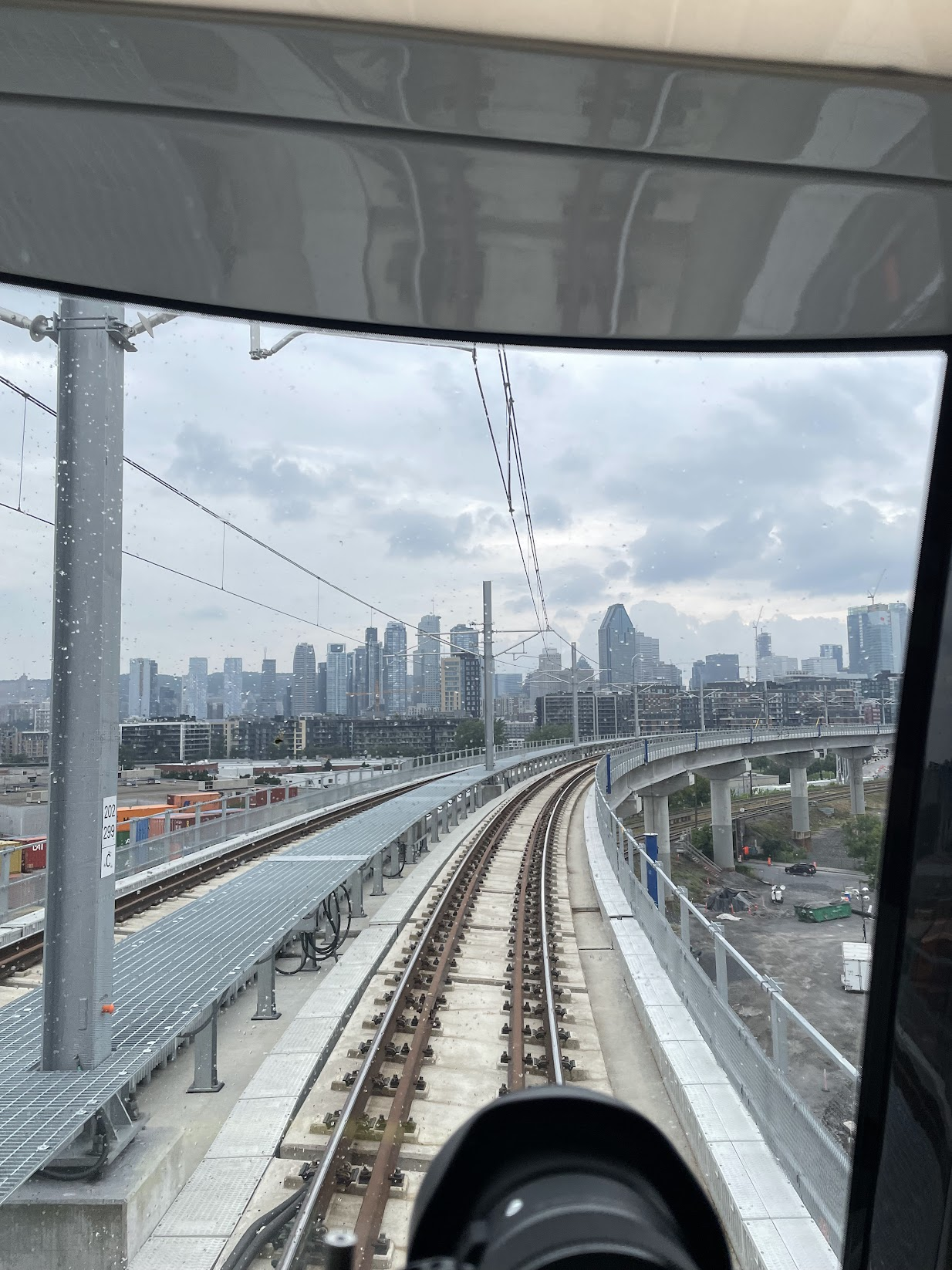
This last weekend, Seattle opened a substantial portion of East Link, a new light rail line that will eventually allow for a quick, single-seat, rail journey from Downtown Seattle to Downtown Bellevue and Redmond, connecting most of the important centres for technology in the Puget Sound region along a single rail corridor. The opening was well received, and only happened because politicians pushed to open the east of Lake Washington portion of the line — possible because it has its own operations and maintenance facility, while works are completed on the complex portions crossing Mercer Island and the lake.

Opening day of the East Link Starter Line. (Credit: Oran Viriyincy)

Of course, Sound Transit is far from perfect, and their transit expansion program has many of the same issues as other agencies like high costs, a significant excess of parking, and light rail where it does not belong. And yet, they also feel a cut above other agencies in the US; in some ways, the agency and its programs remind me of those going on in Canada. With sleek marketing materials, and things like wayfinding that totally obliterates most of what you will see on this continent, this all gives me a lot of hope, and so I wanted to talk about it in more detail.


If you enjoy my content, consider subscribing to my blog:

or supporting me on Patreon:

Your support will help me bring you more content faster!


Service Levels are Solid

While Seattleites rightly complain about lacking service on Central Link given how busy it is, most American light rail systems have far worse service than Link, which doesn’t get super frequent, but also doesn’t get super infrequent — East Link will run every 10 minutes. By comparison, Denver’s East Side suburb of Aurora’s relatively new light rail line gets 1/3 the service with 30-minute headways.

At the same time, Seattle broadly seems to understand the value of high levels of service — urban buses in the city are frequent, the excellent RapidRide BRT-lite dispatches with the fluff of many BRT services in North America and focus on frequency, and Sound Transit’s highway services are also an under-appreciated bright spot.

Wayfinding and UX is Great

The wayfinding on Link has always been rather good, which I chalk up in large part to the system being quite young, and in a very international and tech-savvy city (insert comments about Californian transit systems with bad wayfinding), but some of the new changes have been very nice indeed. Over the last few years, the city adopted a nice number-based service designation, and the new full-LCD next train displays that show the next two trains are also lovely. There are also nice new LCD internal displays on the new Siemens S700 trains (which I think look great), although like most of the cities in North America with modern Siemens LRVs with these displays, I think they are underused.

Inside a new Siemens LRV for the East Link. (Credit: Oran Viriyincy)

Plans are Strong

Of course, Seattle’s future plans are quite strong, with plans to extend “Central Link” all the way up to Everett and South to Tacoma quite advanced (portions of the route to Lynnwood and Federal Way are both well on their way), and additional plans to serve more parts of Seattle and the East Side are also underway. The changes made with East Link (more grade separation, better station & stop designs) also make me optimistic that as more and more projects are completed, we will see more gradual improvement and learnings. That desire for improvement, general humility with plans, and lots of transparency is a breath of fresh air on a continent that struggles with all of these things.

And the great plans don’t stop at rail: the “Stride” BRT system, while rather expensive, is exactly the type of highway based regional express transit that more North American cities ought to implement. And its use of electric buses — while a liability for the Puget Sound Region (electric buses are still kind of in their infancy in North America, especially for long distance highway services) — will clearly benefit a lot of cities. I also think there will be a lot of value provided by Stride in allowing people travelling north and south from Bellevue, or to Bellevue and the East Side from the north and south being able to take Stride as opposed to the capacity constrained Central Link.

The Vancouver Connection

I have a hard time believing that a lot of the changes you see in Seattle’s light rail projects in particular are not influenced by Vancouver, which is an easy Amtrak ride up to from Seattle. From the addition of very substantial elevated sections to the Link network, to those new next train displays, a lot of the changes we see in Seattle seem like they may have their origins from up north. That being said, I still think there is much to learn from Vancouver on providing feeder bus service, using proper metro technology for rapid transit (the second downtown Seattle tunnel really ought to carry automated metro trains to Ballard and West Seattle, instead of compounding the mistake of choosing light rail for central link), open payment with credit and debit, transit-oriented development (a lot more high rises to be found in Metro Vancouver), and right-of-way and station planning (Seattle often has odd gaps between stations, missed station opportunities, and weird station designs with too much parking).

In the future, I hope the learning can go both ways. While I think Vancouver is the clear winner on rail, Stride will surely be a great model for the highway buses in Metro Vancouver — which aren’t nicely branded, electric, or coherently organized — to move towards. I also think that as each city adds new stations, lines, and technologies, the other will take notice, and healthy competition is powerful!

40 responses to “American Cities have a lot to learn from Seattle”

  1. I wish Montreal and Toronto competed (I am in Montreal) but with the CAQ government not having any representation in Montreal they have no voter push to improve transit in Montreal.

    1. Yep it’s really unfortunate, they might start thinking about this a few years after Toronto massively grows its subway system.

  2. San Diego is another US city whose transit has a lot of Canadian touches. Consider that:

    1. San Diego’s Blue Line runs every 7.5 minutes off-peak, without interlining (the single most frequent off-peak LRT service in the US)

    2. The Mid-Coast Trolley will introduce 7.5 minute peak frequencies in June 2025

    3. Open payments will debut in May

    4. All remaining 30-minute Trolley frequencies will be increased to 15 minutes this June

    5. The Trolley enjoyed exceptional ridership recovery, ranking #1 in 2023 US LRT ridership

    6. Christof Spieler’s “Bus, Trains, People” says San Diego has the highest percentage of residents within 1/2 mile of frequent transit of any US metro area outside NYC

    7. The Trolley is polycentric–the biggest TOD megaprojects are clustered in secondary centers like Mission Valley rather than in Downtown.

    8. The city’s largest under-construction TOD, SDSU Mission Valley, will have more housing and offices than Moody Centre TOD, and is a satellite campus connected to the main campus by an 8-minute, grade-separated LRT ride.

    1. I think the first part can be put down to the fact that San Diego opened their LRT system pretty early, alongside Edmonton and Calgary.

    2. Yes, San Diego is doing a great job, I am surprised it doesn’t get more attention funding wise for more projects!

  3. >> “which is an easy Amtrak ride up to from Seattle”
    I’ve done this trip, from Seattle to Vancouver. There are many things which are great, especially the terminus location in Vancouver and Canadian customs experience. But a lack of investment means the the journey is super slow, and the WiFi isn’t reliable. So it’s not a trip I’m likely to repeat. Still beats driving, though.

    1. No doubt it could be dramatically improved with little effort!

      1. Yes little effort. Just building entirely new civil infrastructure, main line track, signal and comm system, PTC, etc.

      2. I mean you clearly don’t need to do those things to dramatically improve service.

      3. I don’t think the issue is really about society’s propensity to abide by rules. Just do more fare inspection.

  4. That’s a good assessment of the current status of the Link system. I do hope the rest of the East Link (or 2 Line as Sound Transit has rebranded it) from South Bellevue across Mercer Island and Lake Washington to downtown Seattle opens early next year as scheduled. The extension of Central Link (1 Line) north to Lynnwood is slated to open at the end of August, it’s done except for testing of the trains. Also, in reference to the odd spacing of the lines, that extension was not originally scheduled to have a station at NE 130th St, but due to requests from projected users (and the TOD that is already taking place) one is currently being built as an infill station. It will open some time after the extension. Without that, the next station after Northgate will be at NE 145th St, about two miles away.

    1. Amtrak to Vancouver could definitely improve. It is just the right distance where high speed (but not super high speed) rail would make a huge difference. Washington State already has a plan for that (which has gathered dust): https://www.aawa.us/site/assets/files/7322/2006_washington_state_long-range_plan_for_amtrak_cascades.pdf. The trip across the border could also benefit from a different approach. They could do a lot of the customs work while you are on the train, which would make the crossing faster than a typical drive across the border.

    2. East Link seems like it should be able to open on the new schedule without issue!

      1. Honestly I wish it just wasn’t so slow.

  5. “I have a hard time believing that a lot of the changes you see in Seattle’s light rail projects in particular are not influenced by Vancouver.”

    I wish. As someone who lives in Seattle and takes transit regularly I just have to repeat: I wish. Vancouver is so far ahead of Seattle in terms of what they are building and what they have built already it is laughable. We will never catch up. We will never have a system as good as what Vancouver already has (let alone what they will have in a few years). The worst part is, Seattle is spending a ton of money on it. Seattle basically ignored Vancouver, and built a system similar to BART. Oops.

    Just to back up here, Vancouver’s transit system works extremely well because the trains and buses complement each other. They form what Jarrett Walker called “an almost perfect grid”. The trains are very frequent, which is very important when making a transfer. This helps explain why the Canada Line is so much more popular than expected (lots of people transfer to it). Otherwise the various SkyTrain lines resemble a traditional metro (with stations not that far apart). As a result, you can get pretty much anywhere via a bus/train combination. Around half a million people ride SkyTrain, while 3/4 of a million ride the buses. It is an excellent model for North American cities (which have some density in the core, but also sprawl).

    In contrast, the Link trains aren’t sure what they are. It is a hybrid system. It will go to distant, low-density cities and suburbs like a commuter rail line. But unlike most commuter rail lines — as well as S-Bahn type systems — it doesn’t leverage existing rail lines or rail right of way. It will largely run next to the freeway. This is extremely expensive and you end up with stations that we know (from experience as well as studies) won’t perform well. It is commuter rail at metro prices along with travel times for most riders that are worse than their old express bus. Oops.

    But wait, it gets worse. This all might be forgivable if they at least did a good job covering the urban core. They didn’t. In the zeal to go ever farther to more distant places better suited for commuter rail or express buses they shortchanged the very destinations that could attract those suburban riders (along with the people in the city). The result in a system that is backwards. You will be able to travel from park & ride to park and ride via the train, while trying to get around the city requires a slow bus.

    It isn’t like Seattle does everything wrong. The newly opened East Link line will be OK (when it goes across the lake). Link at least mostly covers the biggest areas (Downtown Seattle, UW, etc.). Not with as many stations as they should (no station for First Hill, only two in the UW, etc.) but I’ve seen worse (again, BART). The buses could use more funding and are not especially grid-like, but for the most part do the job. We actually have very good regional bus service compared to most cities, and this could very well be a model for the rest of the country. So yeah, there is that. Ironically a lot of it will go away as Link goes farther out but for a while it looks pretty good. So yeah, you could use bits and pieces of Seattle’s system as a model, but you would be much, much better off just looking at Vancouver.

    1. There are a lot of major issues with the way the system has been planned yes. It has neither the speed nor capacity of BART either.

    2. Charles Bosse Avatar
      Charles Bosse

      This is a good analysis of what I have seen in Seattle. I spent two years working in Portland’s (OR) transit system, which isn’t perfect but is, overall, solidly good. Moreover, in some specific but important ways it stands out as having solved problems Seattle’s metro transit options still struggle with.

      It seems like many of these problems are rooted in fragmentation. Transfers between bus and rail, bus and express bus and either the street car or mono rail and anything else are complicated because they are managed by different operators, which…well, don’t always agree or communicate. The one system they do, at least mostly, agree on is a card that you have to purchase separately and then load and then, awkwardly, use within a short time or that money goes away. The app enabled Transit Go does help remediate some of this frustration but it’s still frustrating, especially with the light rail having a “tap off” portion to the fares.

      It also has seemingly stopped any kind of sensible unilateral decisions about fairs, which remain complicated in a way that I would argue is actually discrimination and

      1. Charles Bosse Avatar
        Charles Bosse

        … which is probably an ADA violation (not that any city anywhere is actually compliant with ADA). Instead of one price and policy anywhere in the area, you can pay five different fairs outside of rail and then the rail fair changes depending on how far you travel, and what rail you are using. Some people think this makes fare fair, but since the main use of fair is to allow a transit system to exclude people who are repeated problems (which may or may not be a reasonable thing itself) and it absolutely does NOT pay the costs of public transit, there’s no reason to have complex or varied or even high priced fares. King Co. Transit, which runs most of the busses, has a policy that recognizes this, but otherwise the whole system is an obfuscated tangle that even most of the people working in the systems don’t fully understand. Oh, and good luck “way finding” between systems unless you go to something like Google that integrates multiple systems by default.

        I won’t go on about escalator repairs or cost over runs except to say that I have seen systems with more parts have fewer problems, or at least better maintenance. In terms of planning, in addition to the fragmented system Seattle Metro was more than two decades behind Portland’s rail system despite Seattle having more wealth and more people and certainly more commuters. Compared to some place like Boston, DC, or San Francisco, Seattle’s transit and especially high capacity transit infrastructure and planning is still laughable, whatever flaws you might rightly point out with those respective systems. It doesn’t take a comparison to Vancouver BC to recognize Seattle trails other North American transit planning by decades, but hasn’t learned a lot from the mistakes made in other systems.

        Again, it isn’t all bad. The bus service here is good to great, and the electric and articulated bus infrastructure is better than in most places. The region has some innovations, and it’s clear that there was some reasonable planning on the East Link project to allow most of it to be up and running before the predictably difficult bridge stretch was complete. If transit decision makers actually seriously weigh the input of urbanists and infrastructure geeks in the area, instead of plowing forward with The Seattle Process, the future of regional transit is also bright. But for now, there are better examples of almost anything transit related beyond the SEA metro than there are within it.

  6. “the second downtown Seattle tunnel really ought to carry automated metro trains to Ballard and West Seattle”

    Yes, and it should increase the coverage downtown. Transit advocates in Seattle have come up with a plan to essentially do that: https://seattletransitblog.com/2024/01/10/focus-on-slu-and-ballard/. The great part is that you could do it in parts, which means that different aspects get built much sooner:

    1) Build West Seattle Link and run it through downtown (with the other lines).
    2) Build the new Ballard Line as a stand-alone automated line (with higher frequencies but smaller stations).
    3) Extend the Ballad Line into other parts of downtown (e. g. First Hill) to give riders something worth transferring to.

    The current plans call for a “relief line” that unlike the equivalent in Toronto is not really needed and doesn’t add anything. In fact many existing riders will have a worse trip (if things go as planned).

    1. Yep! This was what I was referring to!

  7. seattlefrenchman Avatar
    seattlefrenchman

    Ha. Sadly, there is no connection between Seattle and Bellevue/Redmond. It’s delayed at least one year, maybe two. Seattle’s backup strategy for the FIFA WC is “lots and lots of buses.” The Puget Sound/Seattle area has a hodge podge of mismatched transportations that is mind boggling. Noone should take this as inspiration.

    1. “that will *eventually* allow for a quick, single-seat, rail journey from Downtown Seattle to Downtown Bellevue and Redmond”

  8. A monorail system would have already been completed, with more routes, and at far less cost, with much more “sleeker” appeal. That is the main lesson other cities can learn. Seattle blew its chance to build on its image as The Monorail City.

  9. The biggest problem with Seattle’s light rail is the payment system. There are no turnstiles so many people ride for free. How is it going to make back any of the high price tag? The hire people to walk onto trains and check if you paid sporadically, but that doesn’t help much and in the long run probably costs more than turnstiles.

    1. Not having turnstiles is not uncommon across the US and around the world. Fares do not “make back” the price of a project like this.

      1. Fares are critical to the ongoing operations of public transport projects. This isn’t Canada, we’re most of society abides by rules, this is the US and unfortunately, given the option, are large portion of people will not pay. There needs to be consequences when fares are skipped.

      2. Agreed. With the amount of money we put into automobile infrastructure, we could easily fund free public transit, which is much more equitable. Personally I’d rather pay a little more in tax and not have to own a vehicle.

  10. What is “wayfinding?” What is “UX?”

  11. I use Seattle’s light rail to get into and out of the City, as I live further south I Thurston County. So I have to drive to Angle Lake Station or Tukwila station. My last experiences have both been arriving at both sites only to find there is not parking available. Yes Angle Lake has a big garage, but if you want parking you need to arrive before 8:30-9:00am, or there are not any spaces left. Otherwise I love the light rail cause it means that I don’t have to drive all the way into the City. Just wish my County execs would get their act together and work to extend light rail to Olympia, which is the Capital and would really benefit by being linked up with the Sound Transit link.

    1. Brad Voorhees Avatar
      Brad Voorhees

      Make sure your constituents agree with the taxes it takes to build the system, I’m talking property, vehicles you own and a hike in sales tax. It adds up especially buying our vehicle tabs, ours all doubled

  12. NotDrinkingYourKoolAid Avatar
    NotDrinkingYourKoolAid

    Yeah the world has a lot to learn from Seattle…. Overpriced, huge homeless population that you enable, it lets the city be overrun by anyone willing to take it over, puts feelings before intelligence and education, your transit system sucks and you don’t even collect the fares from the people that use it. The city and the state are completely mismanaged. You have no idea what you’re doing. But yeah, I guess the whole country and world should mimick Seattle….

    1. The guy who wrote this article isn’t even from Seattle. You seem to be holding on to a lot of rage and resentment over a city you’ll probably never visit. Maybe find more productive and healthy uses for your time?

  13. Bill Wedenoja Avatar
    Bill Wedenoja

    I’ve lived in Renton, a suburb on the southern end of Seattle, for the past seven years. And I’ve ridden the busses and light rail on a number of occasions. I can get to most places I need to go without a car, in a respectable time, and that’s better than I’ve experienced in other places in the US. But I have two gripes about the system. I’ve tried to drive to the Tukwila light rail station on two occasions to park and ride downtown, only to find there were no available parking spaces. On one occasion, I then went to the Renton park-and-ride, to catch the bus downtown, only to find no spaces there too, which led me to frustratingly drive downtown. The second gripe is that Renton has been left completely out of the light rail system. You would think that a line from Sea-Tac through Renton to Bellevue would be a no-brainer. Apparently, wealthy people on the lakeshore didn’t want light rail running through their backyard and got their way, even though a rail line already existed there but was closed. Renton is home to two major factories, perhaps THE two major factories in the Seattle area, the Boeing 737 factory and PACCAR, where Kenworth trucks are built. You would think the city would want to get those workers on rail and off over-crowded I-405? Instead, we have tech workers celebrating their commutes between bougie Bellevue and Redmond. While they get new light rail stations, Renton is promised a new bus terminal (which only moves it from downtown to the outskirts for some inexplicable reason). There seems to be a serious class bias at work here.

  14. John D Wilson Avatar
    John D Wilson

    I appreciate Seattle’s willingness to run their LRT every 10 minutes as it shows that is looking after its customers and not counting beans. I hope also that their trams 9lrVs are able to be extended or run as multiple units to carry really heavy traffic of the order of 8000-10 000 passengers per hour that your article suggested were likely if Boeing doesn’t go belly up.
    I haven’t had the opportunity to check recent patronage figures due to other commitments but it sounds hopeful as a city learning from Vancouver and other smart towns.
    I am also curious to find out how other commuter / transit rail services in Seattle compare with other places in North America contrasting with Europe, and Australia, where I live.

  15. Mike Starostka Avatar
    Mike Starostka

    Sure, Seattle and the east side are getting light rail. What about all of us in the north end? Everett & Arlington? It’s going to take another 20 YEARS to get light rail up here.
    I’ll probably be dead by then and I’m still paying for it.

    Traffic is so bad thru Everett to get to Marysville, it’s horrible!

    China, Japan and even Europe can build this in like 2yrs.

    Why is this taking SO LONG? And it’s costing us billions in overruns.

    There it’s my rant on the light rail. Not a very good solution.

    Don’t even get me started on the monorail that should have been built in Seattle. Much faster and would have been easier to expand.

  16. I love the direction things are going, I just want more of it, and sooner! Of course the system isn’t perfect, but it’ll only get better as network effects increase the value and utility of the whole system. I also think there would be a lot of value in having faster trains overall. Not sure if that’s possible, but it shouldn’t take a whole hour to get from the U-district to SeaTac

  17. […] Reece Martin blogs about how American cities have a lot to learn from Seattle. […]

  18. Thanks for providing this forum and for feeding the discussion, fascinating topic!

Leave a Reply to NickCancel reply

Trending

Discover more from Reece Martin

Subscribe now to keep reading and get access to the full archive.

Continue reading