Baselines are Very Important for Evaluating Transit — Media on Transit
A lot of my experience getting to know public transport has been one of looking at media coverage of the topic in horror; it’s often the case that media coverage here really misses the mark, which makes me think a lot of Gell-Mann. That being said, I think people could defuse a lot of the…
A lot of my experience getting to know public transport has been one of looking at media coverage of the topic in horror; it’s often the case that media coverage here really misses the mark, which makes me think a lot of Gell-Mann. That being said, I think people could defuse a lot of the most problematic coverage if they applied some basic heuristics (which would be helpful for evaluating a lot of communications, even beyond transit).
If you enjoy my content, consider subscribing to my blog:
Your support will help me bring you more content faster!
Over the past few years, one of the most frustrating things to see getting a lot of attention in the media was how Montreal’s REM project had gone over budget and been delayed. The project generally seemed to get a lot of media attention due to its enormous scale and pension fund (albeit Quebec Public Sector Pension fund!) backing. However, what I found particularly frustrating was the way much outrage was directed at the project because of its aforementioned budgetary and schedule problems.
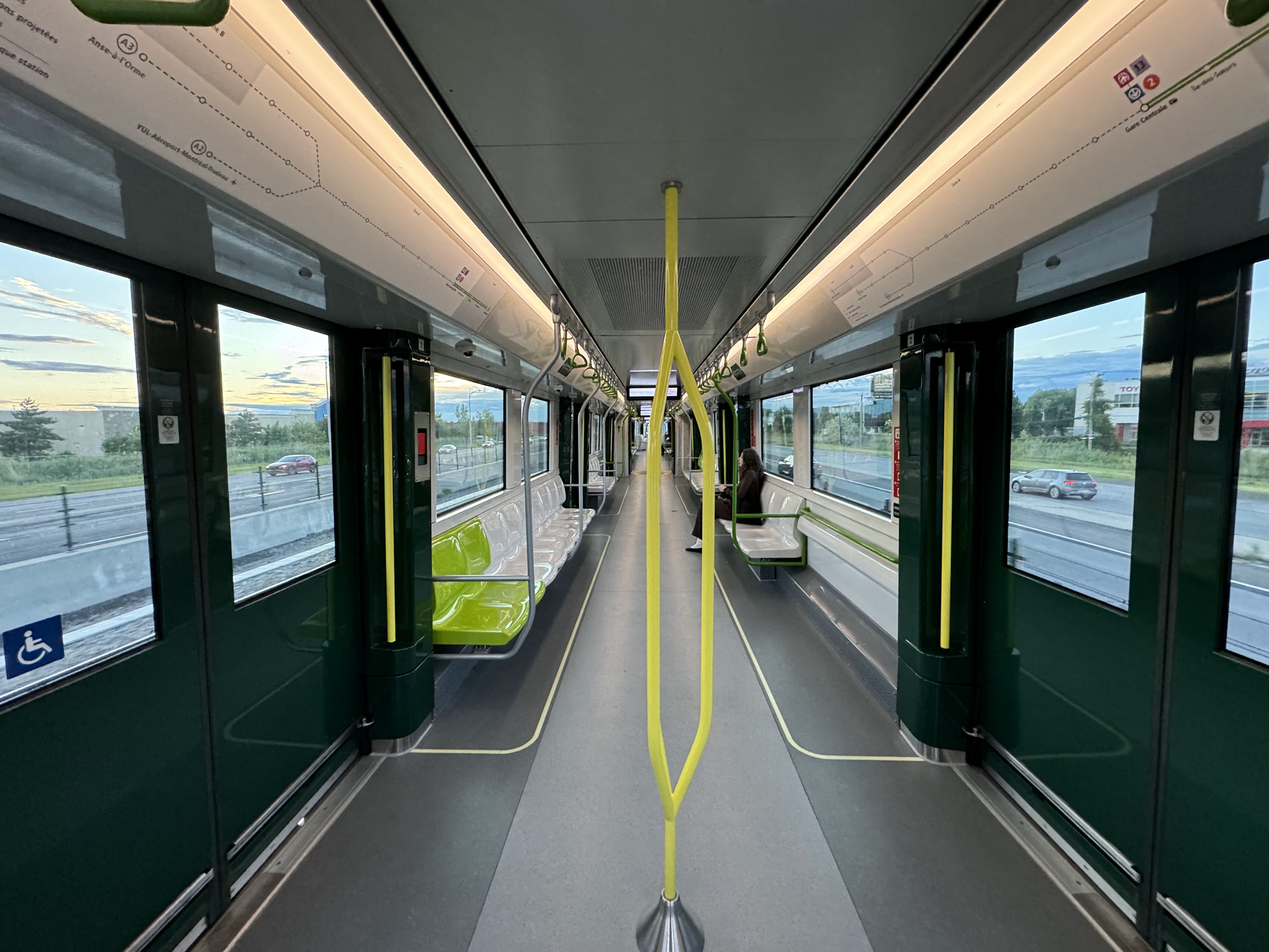
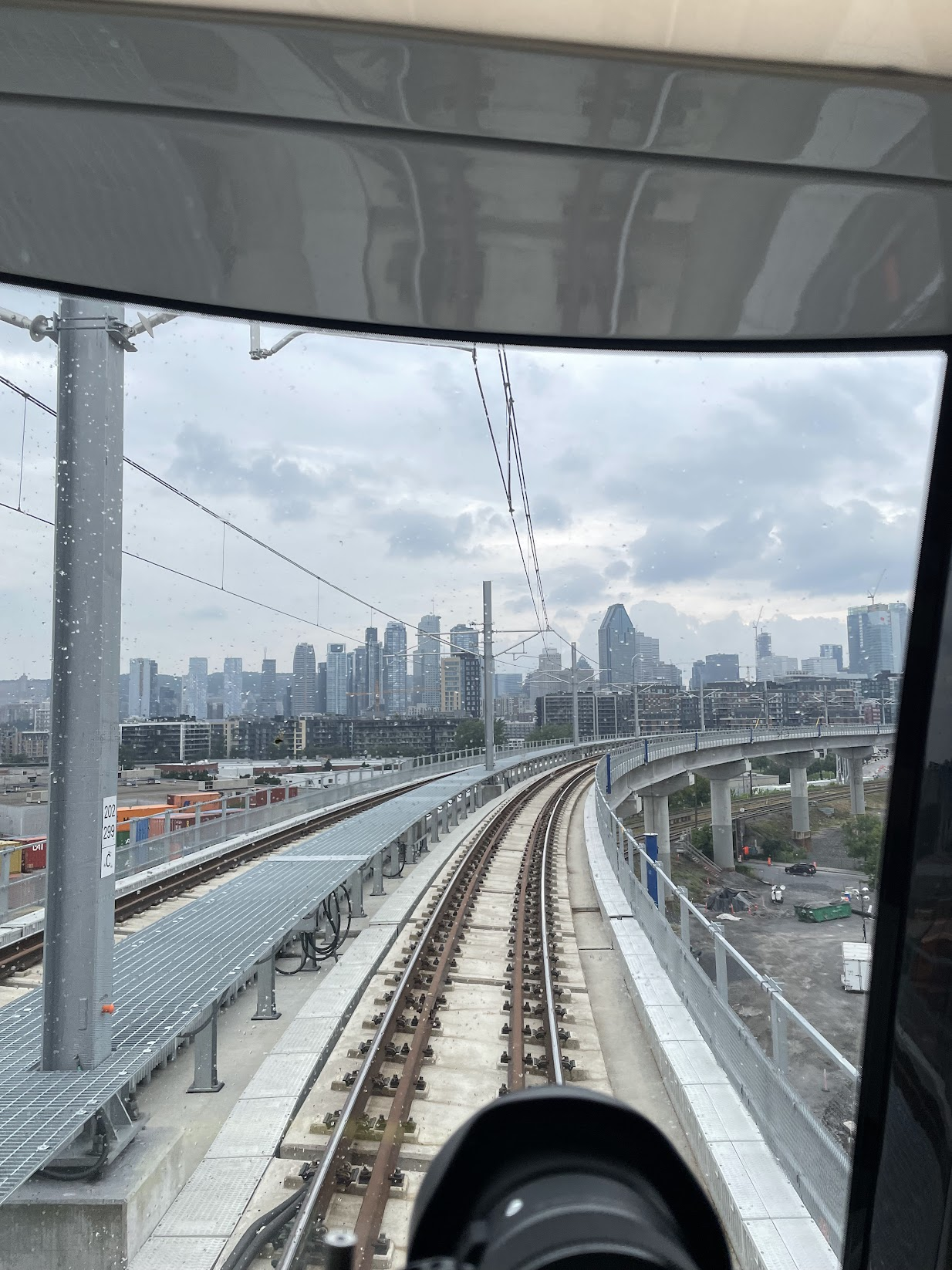
Montreal REM.
To be clear, it’s not good when a project is late or over budget: we have schedules and budgets as guidelines and ideally targets to hit. But the unfortunate reality is that projects do frequently run pricey and slow (two things that are intrinsically linked: more hours to pay and disruption costs more!). What is more important than the low information binary — late/on time & on/over budget measures — is they don’t give us a baseline, making them very dubious metrics.
The REM as highlighted by the Transit Costs Project (really the go to) is not a world beating low-cost project, but it is much less expensive than other recent Canadian transit projects, and is coming in at a tiny fraction of the cost of the Montreal Blue line metro extension.
People often mention that the REM is low cost because it got the Mt. Royal tunnel for “free” (this is hyperbolic, they needed to do a ton of work), highway right-of-way, and the existing Deux Montagnes regional train line. Some of these points do make sense, but I think there are two important counterpoints:
For one, using existing right-of-ways to some extent is almost always an option for transit projects, and will broadly help bring down the cost — the REM doing this is just smart planning.
For two, the REM still had to deal with a lot of technical challenges, such as certifying tons of new equipment like platform screen doors in an extremely harsh winter environment, integrating with a massive new bridge across the St. Lawrence, and doing a fair amount of tunneling work under a major airport, through downtown Montreal, as well as excavating one of North America’s deepest rail stations around a century-old tunnel!
Construction of the Mount Royal tunnel, circa 2021.
The point here is that the REM is actually a really cost effective project and media coverage talking about the budget being blown neglects to mention that, instead trying to farm outrage around the unfortunate increases in cost (largely covered by the CDPQ).
What’s worse than the way this misleads the public is that it creates huge incentive for project bloat in the future. If you get a ton of crap for delivering a project over budget, the easiest solution is to increase the budget next time. In some imagined world, a higher budget would simply mean a project of the same price that now comes in on budget — the public knows what they are getting into, and all is well. The issue is that more budget means more slack, and so you can imagine how higher budgets just incentivize waste, extraction from many directions, and less disciplined management, which is probably a substantial part of why infrastructure costs so much in some places. There’s a perverse incentive where it might be better for an agency or public authority to be under a high budget than slightly over a low budget, even if the actual difference being paid by the public is huge.
And all of this also applies to how timelines work: we encourage beating a crazy drawn out timeline as opposed to just missing an aggressive one, and every time media brings out these arguments and people engage with it, they are encouraging this self destructive decision making.
Ok, but how bad it is really? Not that bad! The REM all told is coming in for well under $10 billion for 67 kilometres of frequent rail. This would be seen as very cost effective for a Canadian tram project, and the REM is delivering metro, with high-frequency all day service, fairly high capacity, and high speeds. The project’s first phase opened in the middle of 2023, 5 years after construction began, and the final phase should open around 2027 — 9 years in, which is also pretty good, if not amazing for a project that is mostly above ground. That being said, most structures on the project look more or less complete today, and you do have to factor Covid into those 9 years.
At the end of the day, I bring all of this up because encouraging the media to be fair and critical about infrastructure projects is really important to fostering an environment where these projects head in the right direction and get better, and it’s something all of us can do.
As a resident of Seattle, I have to say the the Sound Transit PR machine is one of the most impressive operations I have ever seen. Despite the challenges that has only allowed an isolated segment of the Eastside Link light rail line to open, ST really turned this into the proverbial lemons-to-lemonade. They are huge on social media, and community outreach. The local media- online and print- picks up and responds to this. Is everything perfect? Of course not. But ST seems to get out in front and helps drive the story, so that when the inevitable bad press pops up, they are ready and pretty transparent. Bottom line: Transit agencies need to be proactive. Stop playing defense. Keep telling the good story over and over. Don’t hide the bad news; turn it around. Remember: you are building for the ages.
I like the REM, I really do. It is definitely one of the best recent projects in the US and Canada, BUT it is still kind of expensive. It cost about 150 million/km, for a system that is mostly aboveground and in existing rights of way.
For comparison: the Canada line, built around 20 years earlier cost about 100 million/km in 2006, which is 150 million/km today after adjusting for inflation. The Canada line includes multiple underground stations in Downtown Vancouver, more than the REM in Downtown Montreal. Both lines use short, fully automated trains to reduce station cost. And the Canada line is largely underground!
The CDPQ seen better at controlling costs than most in the region, but it seems like they are mostly achieving this through reducing the amount and scope of expensive engineering works like tunnels and viaducts, without actually reducing the unit costs of such structures.
This can also be seen with the dead REM de l’Est, which was supposed to cost 312 million/km for a mostly elevated line before it was sandbagged. That’s still kind of expensive, and this was an initial proposal, so the costs would likely be higher if actually built.
The REM concept seems like the best case scenario for a world in which unit construction costs remain very high. It makes strategic use of expensive construction only where it is absolutely necessary, unlike other recent projects. These seem to either go insane with extremely expensive rights of way where cheaper options are available (BART San Jose) or cheap out and don’t build the small bits of expensive infrastructure to massively improve overall service (Interborough Express as light rail).
I hope we are able to actually cut unit costs, allowing for more Canada lines, but if not, I think the REM concept is a decent fallback option.
I’d be real wary of using the Canada Line as a benchmark, while it’s had its successes its notoriously underbuilt with cut corners all over the place. Single tracking to Richmond Center, the small station size and cut and cover. While the expense side of the leger certainly appreciates cut and cover the impact that left on the Cambie commercial district was pretty severe. There’s a reason why the Broadway extension is tunnel Ed with cut and cover stations with bridges over the station pits, there was no way to repeat the Canada Line approach and get away with it. Also the capacity of Canada Line really isn’t that great at 8000 pphpd with a max infrastructure capacity of 15 000 pphpd. Compare this to the 25 000 pphpd of the expo line. My understanding is that the infrastructure of the Langley extension will support similar capacity at around 280 million per kilometer. As much as we might wish for the costs of 2008 I think we need to keep REM in its context and the Evergreen Line is useful here. A mix of tunneled and overhead for 130 mil/km in 2016 ending up just over 150 mil/km in 2023 and certainly a more realistic expectation.
I certainly agree that you can’t make a like for like comparison of the Canada Line and the REM for numerous reasons, but I would suggest that a lot of the critique of the Canada Line has the exact same problems.
Are corners really “cut” as long as the line hits its required performance? I don’t think so, the infrastructure is certainly not opulent or overbuilt, but it also has never really come off as totally overwhelmed to me any more than any other subway line. Small stations were just a wise strategic decision to keep costs down since capacity requirements were low.
I feel much the same way about disruption and I think the media plays into that, the lawsuits etc from the Canada Line as well as its construction got tons of hyperbolic media coverage, and for the cost of that and a few inexpensive legal battles (relatively speaking) we got a cheap subway and we got it fast!
Loading…
John D Wilson
The conservative media in the Anglosphere and probably other places loves to create dissent and is generally just as “anti” as the Marxists of the sixties and seventies just on principle. They seem to be just cranky for cranky’s sake, which is a waste of journalistic time and subscribers’ money. I suspect there is a power play involved but which game is a mystery, unless it is to sell more cars?
See, I think you’re actually off here. I do think there are probably some Conservatives opposed to this project, but a lot of the media is more progressive in tone generally, they seem to see the project, which is not delivered by the traditional public transport operator as bad and imposing.
I too found the opinion of the media to be far too critical on the REM, is it perfect? No, but it is a good project that was only slightly delayed and over budget. It also had to deal with an, in my opinion, an over ambitious timeline and (as you mentioned) Covid. Remember, even the original Shinkansen was over 50% over budget.






Leave a Reply