

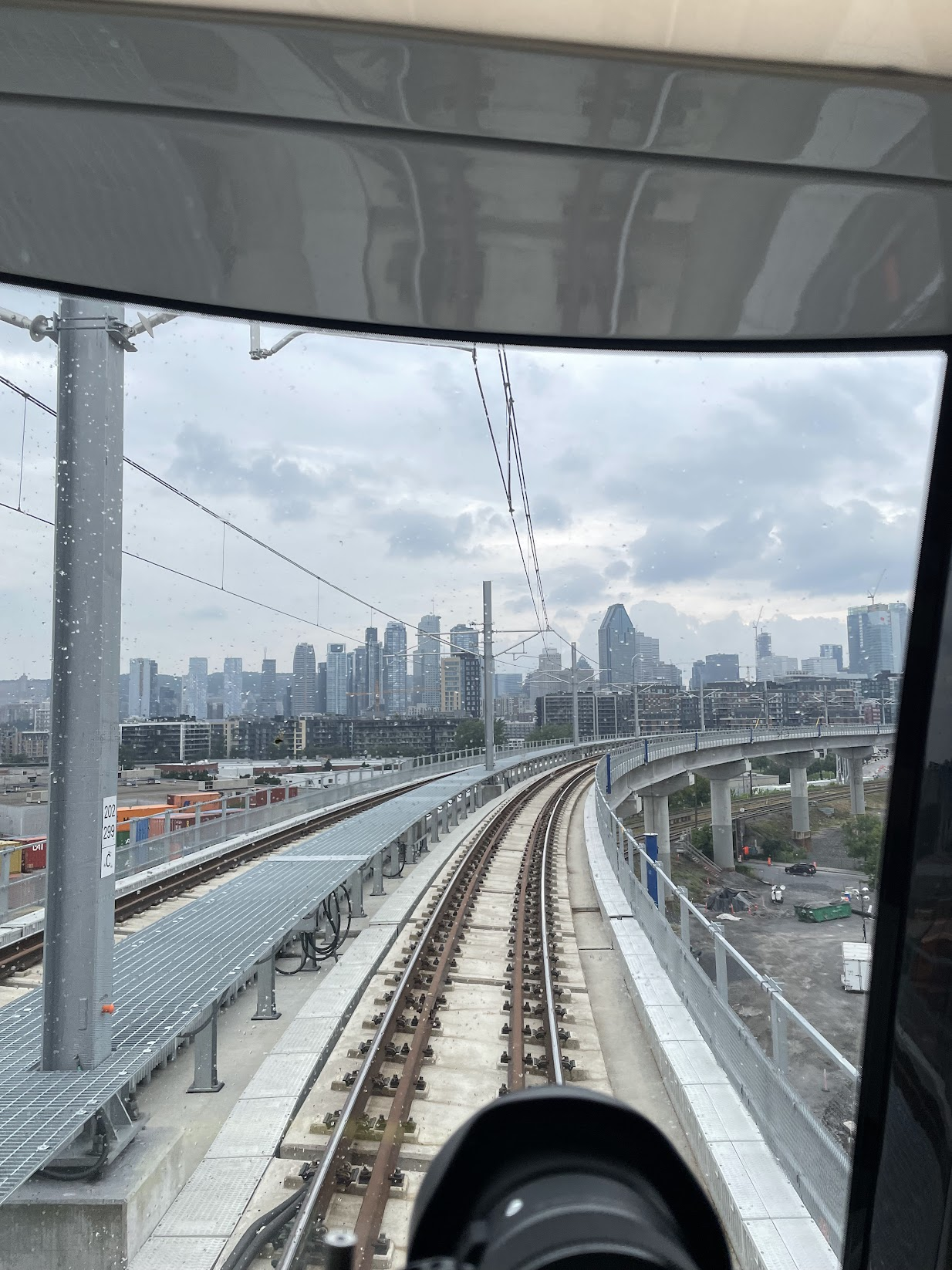
Montreal’s REM is something that has fascinated me since it was first opened, and I’ve only grown to like the project more after experiencing its first phase in person — which, from what I can tell, has been going pretty well.

In a lot of ways, it just does the things that any modern transit system should do — platform screen doors, bog-standard specifications, Wi-fi, etcetera — and it does these things with attractive stations, and trains.
In many ways though, what’s most exciting is what comes next; part of that is the extension of service under Mount Royal to points north, west, and eventually the airport; but it’s also about what the service will enable, how it will shape Montreal, what communities will pop up near stations, and as we are seeing with the development of the Peel basin — where entirely new stations will go.
Suffice to say, I think the REM, even when all 67 kilometres of it is operational, will be an organic network that will see not only a lot of passenger growth, but also pressure to expand further. While plans for the eastern REM line were killed, I think when the REM A is fully running and the annoyance of construction is over, people will realize that this was a mistake, and areas adjacent to the existing REM line may well be interested in new stations and potentially also extensions.

What’s interesting is that the automated nature of the system, alongside the majority of it being at grade or elevated, means that such additions are actually quite practical — Vancouver’s SkyTrain and to an even greater extent London’s DLR have both seen new stations and incremental branches and extensions that have turned modest initial lines into complex networks — often with expanded and redesigned stations to enable more capacity and additional connections. Given the REM when completed will be large enough to be considered a “network” in and of itself, I think that these type of interventions are likely in its future.
And because of this, I wanted to start what will likely be a long-running series on proposals as well as ideas on how the REM A can be expanded, with new branches, services, improvements to infrastructure, and perhaps even new trunks that allow the system to slowly expand to fulfill the role of what might have been other lettered lines, incrementally; as well as potential extensions to other transit services to connect them into the REM.
Some ideas I will talk about in subsequent articles include:
- Bois Franc Station’s Future
- More REM Branches south of the St. Laurent
- REM Branches to Ville-Emard, Lasalle, Lachine and the Airport (from the south)
- REM to the Plateau
- REM to Central Laval
- REM to Montreal North
- Expanding REM Capacity
- A Second REM Trunk (Pink Line, Plateau, Laval, Lachine)
If you’d like to hear more, make sure to subscribe to my blog to get all of these articles delivered to your mailbox directly, as soon as a new one is released!






Leave a Reply to Reece MartinCancel reply