
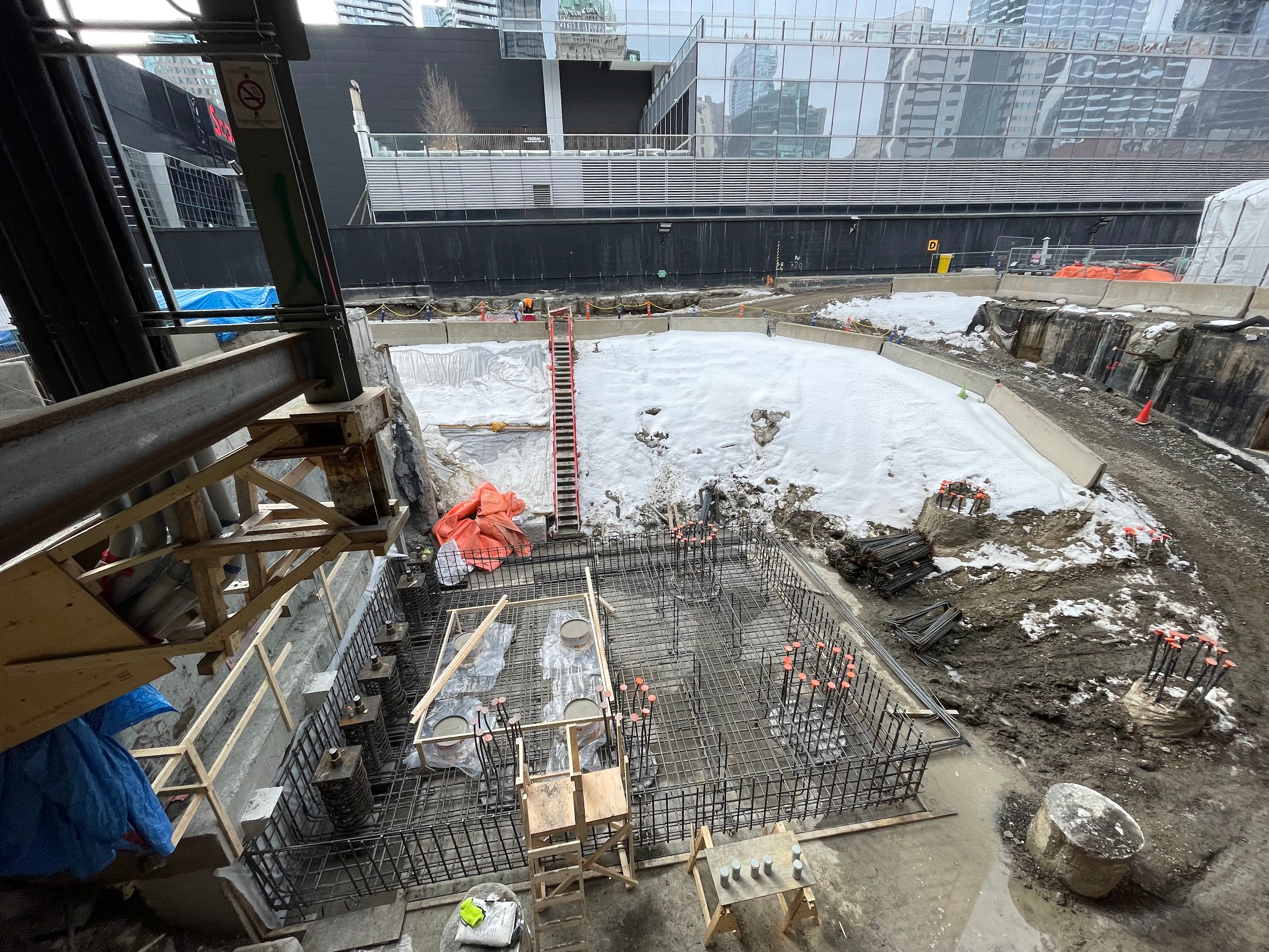

The Toronto region, and by extension Canada, need Metrolinx to deliver.
The agency is infamous for the now half-decade-late Eglinton Crosstown subway/tram project, and despite this has been tasked with delivering over $100 billion CAD of transit projects. These are projects that are urgently needed, not only to fight crippling congestion both on roads and as importantly on the existing transit system, to help us reach our environmental goals, to create a fair society, and to boost our economy — something looming with the new administration in the United States. B
But it’s clear that Metrolinx is not delivering, and moreover the agency is (and has been) dropping the ball on a generational infrastructure investment. Something needs to change, and quickly if we wish to avert this Titanic agency from hitting the metaphorical iceberg.
Since I’m retiring from YouTube and most online transit commentary, I thought it made sense to write down my thoughts as someone who has followed both the agency and transit in Canada and North America more broadly for over a decade, someone who isn’t currently working in industry, and someone who cares deeply that this region, which has such enormous potential, stops screwing up and starts getting things right. This is even more timely as Metrolinx only recently got a new CEO who has the opportunity to chart a new better path.
Even though Metrolinx’s problems are many, it makes sense to start with the one that is most well known by the public: its inability to execute on one of its core mandates — actually delivering transit infrastructure. Now, I’ve talked on radio, and TV and of course YouTube about the most famous infrastructure project in Canada, the Eglinton Crosstown.
Ironically, when I moved to Toronto permanently in 2016, I assumed that by the time I finished my Computer Science Degree around 2020, the project, which had been under construction for years already, would be done. What’s incredible is I’m now retiring from my first “mini-career” after graduating, and the project is still not done!
Now, the Eglinton Crosstown’s problems are many, and what’s perhaps most interesting to me is how it manages to touch on so many of Metrolinx’s issues, so I will refer back to it a lot in this article. That being said, I think it’s extremely important to remind people that the Eglinton Crosstown is far from Metrolinx’ only project, and it’s actually even been eclipsed in cost and scale by a few others. Unfortunately, Toronto’s rather under-resourced (and sometimes seemingly uninterested) media rarely talks about the other projects, besides in passing mention.
What’s remarkable is that from the Eglinton Crosstown’s cousin — the Finch LRT, to the Hurontario LRT, GO Electrification, Presto, the Union Station Bus Terminal (and Union Station more broadly) and far more, Metrolinx’s projects are virtually all late and over budget, often by significant margins. In fact, there are lots of projects like the re-signalling of the Union Station rail corridor, or the double tracking of the Stouffville line that are super late, yet which virtually never are mentioned in media or even by opposition politicians. Every single Ontario taxpayer (and Canadian for that matter) is funding this, and every single one of us also is missing out on all of the benefits of these projects, both in terms of time and scope (which is often cut back when things go awry). While this stuff is happening, the Conservatives (who’ve been in power for over 5 years at this point) are focusing not on fixing this critical but very much off-course agency, but on actively making the transportation network in the province worse and more expensive by removing bike lanes all to score cheap political points.
The first big problem that comes to mind for me regarding Metrolinx is its responsibilities — in many cases, these feel arbitrary, and often imposed responsibilities from the province hinders the agency’s core mandate.
The idea of Metrolinx is logical on its face. From London to Paris, and Stockholm to Singapore, having a high-level agency responsible for a large portion of public transport operations and planning is a common and valuable thing. The issue in the Toronto case is that Metrolinx’s responsibilities are all over the place. In some cases, it’s responsible for building infrastructure, in others for running it; it operates some of the regions trains and buses, but not all.
Issues around responsibilities frequently rear their heads. On the Eglinton Crosstown, the TTC (the city of Toronto’s own transit agency) is involved in such a way that they can make demands without really being accountable for the impacts of these demands on the system. In other cases, Metrolinx relies on cooperation from the city, which is often slow or fragmented, to provide the very infrastructure the city needs to function. Looking myopically, it makes sense why each organization acts the way it does (even if one would hope we could work together for the greater good), but it’s clear that in order to avoid upsetting anyone by reorganizing regional transport governance in a significant way we’ve created a system which makes delivering results difficult.

Now, many of the projects Metrolinx is currently delivering became its responsibility when the TTC seriously botched the delivery of the York Subway extension project, as outlined in the fantastic “Station to Station” Toronto subway costs report. However, this was pretty much the dictionary definition of a reactionary move: the TTC for all its flaws clearly has more experience delivering capital projects, and infinitely more delivering capital projects for costs that aren’t on track to become the highest in the world, but the TTC got the boot instead of careful reform.
To be clear, the TTC has many problems that inhibit it from delivering great transit, and by extension, transit projects. The agency is conservative, parochial, ossified, and sometimes arrogant about its capabilities. It also fails at providing many elements of a high-quality transit system, historically in areas like wayfinding and service speed reliability, and more recently in basic service on the subway.
It’s also the case that the TTC does not seem interested in serving the greater region or filling that role — even though sometimes this is suggested. I’d say the almost nonexistent wayfinding attention given to passengers connecting to other transit agencies is a pretty good indication of this.
Unfortunately, when Metrolinx took over, instead of learning from the TTC’s mistakes it threw the baby out with the bathwater and adopted the “anglosphere model” of transit building originating from the UK (which Metrolinx draws a lot of its expertise from). Now, to be clear, the UK is better than, say, America at railways and transit, but anyone who knows anything about railways in Britain and London will know that not a lot has been built relative to other nations, and what has been built has been crushingly expensive — as is so well detailed by Alon Levy and the Transit Costs Project.
Now, the idea that is used to sell the “internationalized” P3 approach
is that agencies like Metrolinx will get the best and brightest transit builders from around the globe to build Toronto’s transit. However, generally the case seems to be that prescriptive requirements and relational issues (“You can’t propose cut-and-cover subway building, the locals will never accept that!”) mean that projects are built out in a very conventional and poorly optimized way, for high prices, all while making the contractors look bad, and not using their skills and knowledge to the fullest, while Metrolinx delivers (well one day…) projects which are worse than they could be.
Part of the reason for this, and a problem with the modern P3 approach in general is that ultimately, responsibility is always going to fall on Metrolinx if things go badly, which incentivizes playing it safe to a fault, and because the agency is not, say, RATP it doesn’t have the in-house expertise to know what it does and doesn’t know, and where taking a “risk” is a good idea. Basically, it’s hard to be a good customer when you yourself don’t have the capability to deliver projects yourself, and while you can hire consultants to help you ask the right questions, how will you know if they know what their doing if you yourself don’t have the capability to deliver projects yourself?
That being said, Metrolinx does have a fairly large staff with thousands on the sunshine list. While I think its completely reasonable to have a large agency staff for purposes of having in-house expertise, its not clear why you would if you’re going to pass most things off to private P3 consortiums anyways — and as CDPQ Infra shows, this can be done with a much smaller team.
Another thing which somehow hasn’t been done is a clear and public postmortem on the Eglinton Crosstown — yes, the project is not operational yet, but that hasn’t stopped Metrolinx from starting another whole generation of even bigger projects, like the Ontario Line. Now, I know there have been learnings — and given Metrolinx and the province are also aware of this, it’s really unfortunate they don’t feel the need to tell the public, but clearly making this stuff the standard practice makes sense!
Part of the problem here is we don’t seem interested in giving Metrolinx much of the responsibility (for, say, local buses and urban rail across the region like you see TFL have in London), which is kind of what motivates the creation of expertise. When you run and maintain subway systems, you’re kind of going to be a natural at thinking about building them! And similarly, if you’re moving millions of people on buses every day, you’re going to think differently about buying buses, planning transit facilities, and procuring fare payment systems.
The issue is, actually giving Metrolinx this responsibility is hard when they do not have a good reputation, but it also seems essential for Metrolinx learning the right things and having the mandate to do the things it needs to. Much like how it is an arm of the almighty province, but most deal with sometimes uncooperative municipalities, we’ve kind of tied the agencies hands: Expecting a lot, but not always providing the requisite tools.
The generally parochial attitude of many Toronto transit fans and commentators historically probably also has not helped, since the idea of regional integration of service and fares — a common sense measure seen across the worlds good transit systems, had to fight an uphill battle over people demanding “local control” as if buses should work fundamentally differently in one town versus another.
Another big issue with capital project delivery originates in Metrolinx’s absorption of GO Transit. Others have suggested to me over the years that this likely resulted in a reversed situation, where GO (an established agency with structure, and expertise — albeit perhaps not in the right things) ate Metrolinx (a young and barely-established organization). Under this mental model, Metrolinx might be overly inclined to approach subway-building (a capital project) the way GO would have historically approached its big capital projects (building new parking structures at stations). Unfortunately, transit projects and parking structures probably have a lot of important differences that means experience and learning from one probably do not transfer over to the other.
There is also the issue of accountability and transparency. Metrolinx is meant to be arms length, but in reality functions as an arm of the provincial government of the day, which probably makes executing a flurry of subway projects (expensively) easy, but is unhealthy long term. In my travels back to Vancouver I am always reminded how much more functional Translink feels, probably in no small part because it is governed by the mayors of the region it serves on a basis proportional to population. It ends up functioning as a true intermediary and independent body which operates and plans transit, and that means it can do things like openly advocate (I literally saw signs around Vancouver with just this) for more provincial funding.
By comparison, Metrolinx, despite having a large communications apparatus, has a poor reputation, and increasingly doesn’t make basic system information (like ridership) available. Even more anodyne stuff like details of the currently underway projects set to benefit the regions residents are very hard to find (so hard people have made YouTube careers explaining this stuff, or so I hear) and sometimes treated like top secret information, even if it’s critical to actually planning out the region. And even despite having a large communications apparatus, it’s not clear when it can be used, because as an arm of the province, the province sometimes gets in the way. While in other cases it’s used to create ads insulting the public for asking for better, literally adding fuel to the dumpster file.
What’s even more concerning is some huge projects like “GO Expansion” which have been faced with delay after delay (going back to the “oooo Hydrogen!” Liberal government era), are arguably even more important to the regions future than subways, and the public and probably government for that matter have far too little visibility into what the project entails, or what’s actually coming of Metrolinx’ smassive contracts with “ONxpress” — the DB-led consortium running the project. We’ve been told that what DB is pushing for is better than Metrolinx’ original “plans”, but when the original plans were as light on details as they were, and while Metrolinx still doesn’t seem to know whether it (or DB, or both of them?) will do things like buy EMUs, or build more downtown train stations (both good ideas by the way!) it’s hard to imagine any coherent and solid plan exists — even at present.
Now again, none of this is entirely on Metrolinx. In some cases, the organization is bound to work with uncooperative partners, or the province overrules the agency (and we’ve seen this with both the Conservatives and the Liberal government that created the agency), and that’s not to mention the ever-present issue of NIMBYism and politics that sympathize with that. At the same time, I think the media has been less than helpful, pouring disproportionate resources into a single problem-laden project, instead of covering the agency’s work (and indeed problems) more broadly, and maybe even doing more to promote reforms and solutions to the problems.
Clearly, the road to a better Metrolinx is going to be a long and winding one, but I do have some ideas of how it might look.
For one, transparency and actual arms-length status seem like a good idea, if governments could realize they won’t always be the ones calling the shots.
Metrolinx also needs to get serious about self reflecting and analyzing where things have gone wrong in its projects publicly, so that the public and politicians are better informed, but also so that we can avoid extreme and reactionary corrections.
While Metrolinx is reformed, its probably also wise to give it more responsibility for the things that we want it to be good at — like running and building transit. The fact that we have an agency that’s supposed to be capable of building modern subways and regional rail, and yet there are separate projects to build just these things in other parts of Ontario (without Metrolinx involvement, and still with lots of problems) seems questionable, and certainly not what you would want in an ideal world.
At the same time, Toronto is currently building some of the most expensive subway and transit projects in the world, but we could be the first place to take that on the chin in a serious way and actually get on with fixing it: We increasingly know what we need to do, but we will need a healthy, dynamic, and open regional transit builder-operator to do that — and we’ll probably need better politics on the way. Doing this will require the Conservative and Liberals to realize they can’t simply meat-axe their way to building projects using provincial powers, but it also means NDPers in Toronto need to accept that the TTC is not infallible and needs to be more regionally-integrated, even if not by strict Metrolinx takeover (with knowledge and personnel transfer) as some suggest, then by the very models that the TTC and its political supporters seem so incurious about (like the German Verkehrsverbunds).
And the importance of this work cannot be overstated. Not only does the future of Toronto, the region, and the province depend on it, Metrolinx is having national-level impacts. Because of a sort of domestic cultural cringe I’ve already heard officials in places outside of Ontario talk about how they are learning “best practices” from Metrolinx of all places, and it sort of makes sense if you don’t think about it much — why wouldn’t an agency with the mandate to build tens of billions of dollars of transit know what it’s doing? Similarly, it seems that the national-level VIA high-speed rail project is also likely to be influenced by Metrolinx, which scares me about the potential of a white elephant Eurotunnel type project getting built.
Ultimately, I think Toronto can have a world class transit system, and in many ways Metrolinx and the province have been moving directionally in the right way: even former Metrolinx CEO Phil Verster clearly had a lot of positive impacts – most notably on things like construction safety standards and knowing what a modern railway actually can look like. Hoever, if we want to actually get there, we need Metrolinx to deliver, and to do that, we need to get on with reform and rebuilding. This is what the places that are excellent at delivering do — recognize their problems, and fix them!








Leave a Reply to Norm FazekasCancel reply