
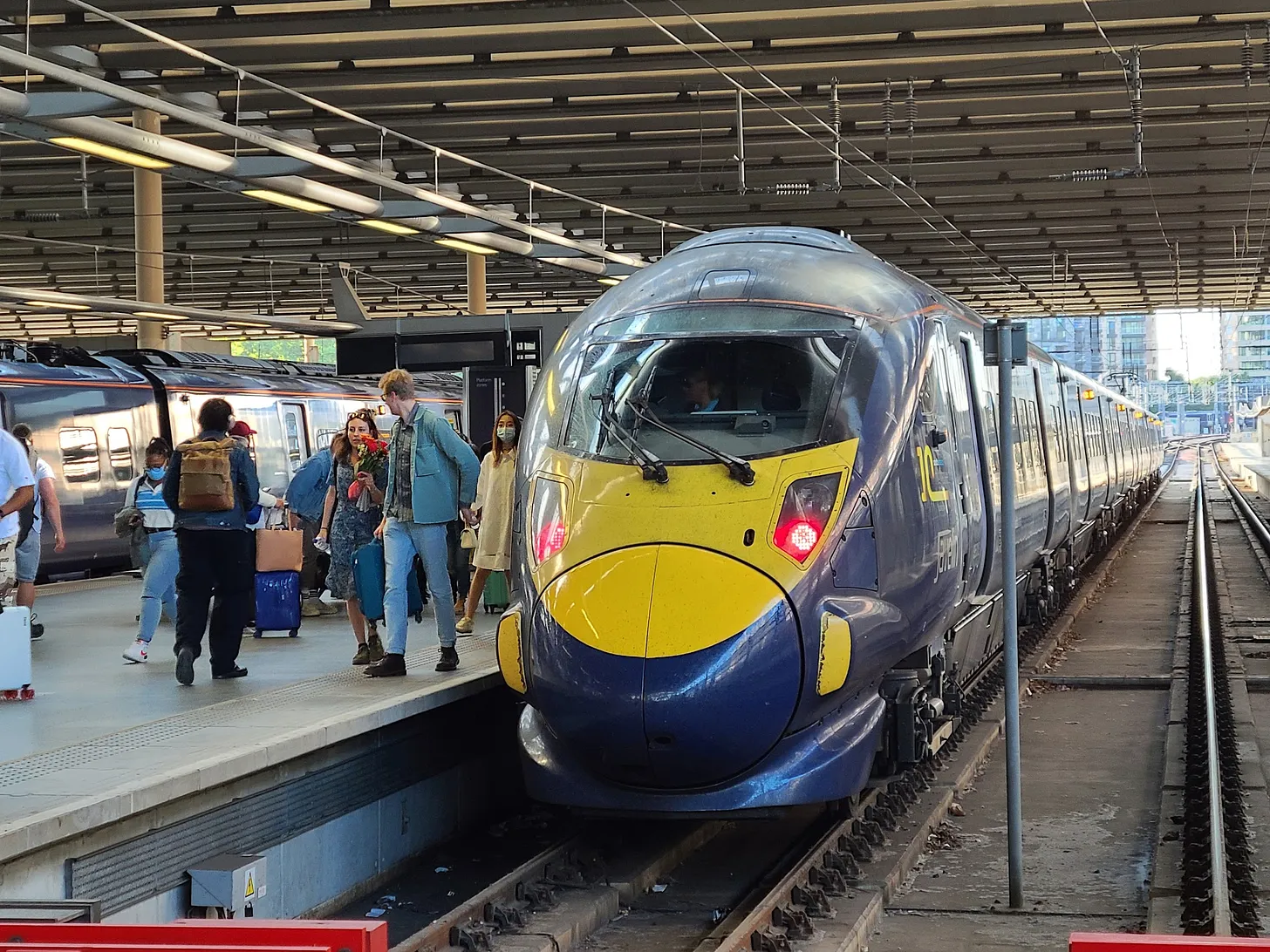
I love trains and transit, but this station was not a great experience.
When I was in London, I spent a lot of time exploring various rail hubs and services entirely for fun (as one does). Now, after some time spent exploring the areas around St. Pancras and Kings Cross (particularly north of Kings Cross where a lot of interesting development has been happening), I realized I wanted to get a change of scenery, and heading over to the Olympic Park seemed like a good idea. Now, there were a few ways I could make that trip, but I decided that taking a high-speed train would be kind of fun and a little hilarious since it’s just one stop from St. Pancras International to Stratford International — which I think may well be my least favorite high-speed train station (a friend brought this topic up recently).
Curious what the service is like? Well, nothing particularly special: A few Southeastern trains — using the Class 395 Javelin — head down HS1 per hour, and so you can pretty much just show up and hop on. That said, the trains (at least the sets I saw) are not huge at only 6 cars, and the one I got on was quite crowded. Of course, it’s important to note two main things about the actual ride as well: For one, you don’t appear to go all that fast and for two, about 97% of this trip is in the tunnel running from just north of St. Pancras to Stratford International, which you arrive at in just a few minutes.

Arriving at Stratford International, I got a sense that this may end up being my least favorite high speed rail station that I’ve visited, and I have visited a fair few! Before we dive into exactly why, let me set the stage for the context of Stratford International.
Stratford was, as you’ve probably figured, at the center of the London 2012 Olympic Games. The area actually has two major stations: You’ve got Stratford International to the north and Stratford uh, regular, to the south. North of Stratford International is a lot of pretty nice transit-oriented development, which was pleasant to walk around in. I have to say, the general quality of developments and streetscaping here feels better than what I’ve experienced in Toronto. I should also mention that as you can see in the picture below, the DLR has a short spur which runs from Stratford up to the high-speed station.

To the south of Stratford International is a big Westfield shopping center (a chain that exists across a bunch of cities) which is bounded by the high-speed station to the north and Stratford Station to the south, which serves two tube lines, two DLR branches, the Elizabeth Line, the Overground, and National Rail trains. There are also rail lines running all over the place, of course.

Now, you can temper everything I am about to say by the fact that I am immensely jealous of anyone who lives or works around here and gets access to the absurd amount of transit available – Stratford actually was Britain’s busiest station during part of the pandemic.
It’s worth actually mentioning how the station is laid out since that will probably help with the context: The high-speed tracks are below grade — and run between the mall and the developments to the north. The tracks are tunneled on either side of the station, which is literally just a box with an open top that runs over half a kilometer from end to end. In addition, if you look at the open sections at either end with cross bracing overhead, the whole station and surrounding special trackwork is about a kilometer long. The tracks noticeably ramp up on each side as they enter the station, splitting into three in each direction with one track in both directions bypassing the station, one serving a central island platform, and one serving a side platform on either side. There is also a very unique single-track ramp that runs through the middle of the station, climbing over the island platform and heading over to a yard for Eurostar to the north.
The first thing that is a bit bothersome with SI (as I’ll call it) is that it really doesn’t get much service. It’s well known for example that despite the name, Eurostar services do not actually stop here even though the longer side platforms could accommodate the trains. In addition, the once planned “Regional” Eurostar trains which were meant to go to other parts of the UK also never materialized. That means the station really only gets those few trains per hour, which would be fine if this was a London Overground Line, but it is a super high-end high-speed rail line that can provide service to the Southeast of England!
That said, the service is not even as much of an issue as I think the station design itself is. Even just walking around the site is not exactly impressive, despite the utterly massive scale I mentioned before — the mall next door and even the standard regular-speed Stratford feel more architecturally interesting, and that’s probably because the main building at SI doesn’t feel all so special, walking inside the building doesn’t reflect the scope of its importance, and the blank walls and closed off rooms made it feel a bit like the area around an old airport baggage carousel area.
At the same time, potential cool vantage points where one could easily see high-speed trains zooming by are all blocked by very high opaque walls, which feels needlessly hostile to anyone who might want to see a train. That feels like it’s broadly the case: walking around the area, you can hardly tell what’s actually there, leaving the station feeling like an uncomfortable void.

The less than thoughtful design continues at platform level. Getting off the train, the platform didn’t exactly wow, despite again being in a giant below grade box. The station feels very barebone despite its expensive and complex location, almost like it got an extreme value engineered makeover in the 11th hour. Looking around on the platform you’ve got lots of concrete and asphalt, some steel, and not much else — I think it could best be described as… parking garage chic (or car park chic, in British)? In fact, large parts of the station aren’t even protected from the rain, and because of the long open form of the station the wind can really pick up as well — I got a bit chilly just standing here, and I visited in May!

That said, all hope is not lost — there is a way that this whole site could be made way better! It appears the structure would allow for overbuild (some sort of structure or alternate use on top), and while I know there is already a lot of park land in the area, there is a lot of potential for a park or public space on top of the chasm. Not only would this fix the environmental issues — essentially turning the station into a tunneled one, but it could also incorporate interesting viewport designs and maybe some sort of live train alerting system to allow people enjoying the park to see trains passing by at high speed. At the same time, more service should absolutely be added, and a good potential way of doing that would be to utilize the links to the North London Line to provide trains to more destinations, potentially across the UK. Reducing flights and getting more people on trains is clearly imperative with the climate crisis we are in. At the end of the day, while Stratford International is my least favorite today, its potential is huge!




Leave a Reply to Table of Contents – Reece MartinCancel reply