This is actually the third and final post in my series of “The Good and Bad Of” posts on Berlin, and I recommend reading the first and second post before diving into this one!

Good Roads and Buses 👍

Depending on how you look at this ,it’s either very good or very bad. I’ll start with the bad so nobody thinks I am ignoring it — Berlin feels quite car-oriented. What was remarkable about the city having spent so much of the last decade in Toronto is that people talk about Toronto being car-oriented, and while this is also said of Berlin, the truth on the ground is that I felt similarly unsafe walking around Berlin.

Subscribe for free to help support the blog!

Trying to cross the street and having aggressive drivers not yield was not great, and worse still was when I saw a driver slam on the gas and weave around a cyclist at high speed on a narrow street near Friedrichstraße.

That being said, Berlin is more refined in its car-oriented nature, and a lot of that ends up paying off for transit riders — particularly those on buses (once you get off the vehicle it can be rough). At one point when I was “investigating” a very nice Mercedes bus at the Hauptbahnhof, the bus took off and headed into the (surprisingly long) tunnel under the Tiergarten and the Spree, which gets you most of the way to Potsdamer Platz. While this infrastructure probably overwhelmingly benefits cars, it was amazing how quickly I made that trip on bus, and it felt almost like it would be competitive with rapid transit that might make a stop between the two big stations.

A bus speeding along on a Berlin road.

The other thing I really notice when compared to Canada — and not just Toronto and Montreal, but even Metro Vancouver — was the buttery smooth quality of the roads, which meant riding a bus (a good bus to be sure) was quite the blissful experience.

Retail in Transit 👍

Something that was very nice in Berlin that you basically do not see in Canada is an enormous amount of shops and services in train stations. While perhaps not so unique for big train stations like Berlin Hauptbahnhof, what was cool to see was how many fairly small S-Bahn and U-Bahn stations have shops right on the platform. This is interesting because obviously Berlin generally has more minimal stations, which tend to not be very deep and do not have faregates or turnstiles and thus eliminate an entire portion of what you see in stations in London, Paris, or New York. Despite this, the many wide island platforms in the city are put to good use with kiosks that offer all kinds of things.

The S-Bahn platform at Ostkreuz, with lines of shops down the centre.

Probably my favorite example of this is at Ostkreuz (which is just generally an awesome station) where the S-Bahn platform for the Ringbahn is ultra wide, and thus has enough space for passengers to wait for trains going in both directions, but also for a central “walkway” down the middle of the island platform that is flanked by two rows of shops.

The approaches seen in Berlin are interesting, because instead of slightly expanding intermediate spaces, the preference is for large open volumes that are frequently filled with lots of utilities for passengers (there’s probably something to be drawn from this regarding how at Berlin Hauptbahnhof you’re kind of meant to hang out on the platforms). I think this works especially well due to the lack of fare paid and unpaid zones, which allows people to easily flow through parts of the station.

Digitally-Enabled 📱

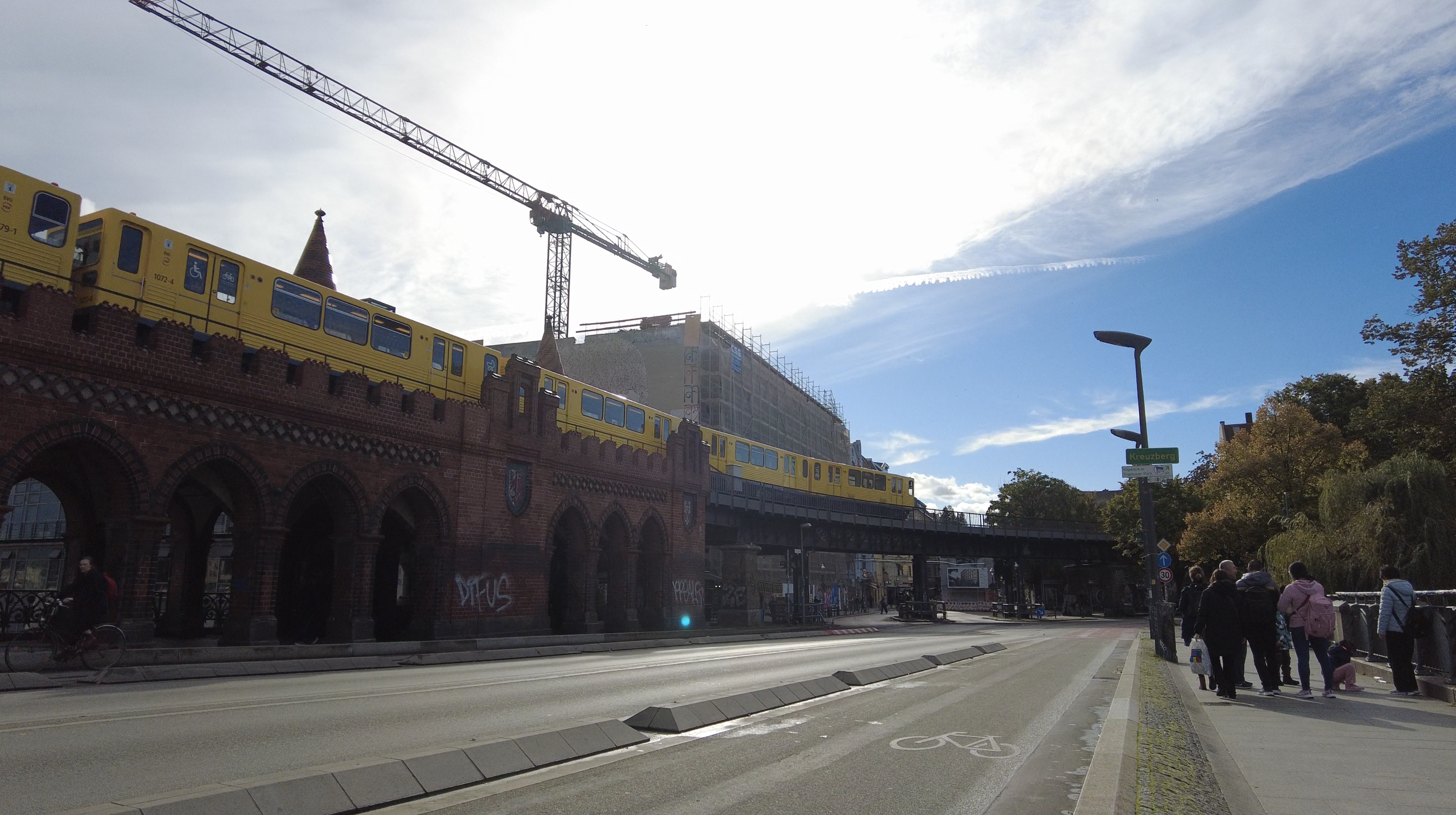
Berlin’s system often does not look all that modern — I love the elevated section of U1 and U3 precisely because it looks and feels so “old-timey”. But what’s amazing about the system overall is how modern it feels.

An U-Bahn train on dated infrastructure near Schlesisches Tor.

This may be unremarkable to you if you are from Berlin, but the pervasiveness of free public wifi on the transit system was awesome, especially coming from London where free wifi basically doesn’t exist (unless you already are signed up with a British phone carrier, at which point why are you using Wifi?).

The “digitally-enabled” ticketing was also awesome, and yet another reminder of why proof-of-payment can be so great. As I was waiting to get off my flight in Berlin, I was able to download the BVG app (which is really good!) and get a zonal transit pass, as well as activate it and put it in my Apple Wallet. From then on out, I never really thought about ticketing again, and that’s a pretty cool experience. Even though that flow is all digital, since there isn’t fixed station infrastructure I had to interact with, it should be pretty easy to implement and inexpensive to operate, and frankly I really enjoy not having to ever pull out a card or ticket while riding around town.

And I think this all goes to highlight why Berlin’s public transport is such a good experience. — the embodiment of less is more!

18 responses to “The Good and Bad of Berlin Transit: Part 3”

  1. An important addition to the retail at train stations is a legal exception from the ban of most commercial activities on Sundays. This means that convenience stores and drug stores that are in the territories of any train stations may be open for business on Sundays where other city stores must remain closed. A tricky state mandated way to generate some extra income for the transit agencies!

    1. Yeah, not opening stuff on Sunday is something which I cannot get behind haha.

  2. Two (related) points relating to shops at railway stations in German-speaking countries. I strongly agree that the lack of ticket barriers means more room for shops etc. and more customers. Some of them may not be catching a train! As a generalisation, shops at Bahnhofs are exempt from restrictions on Sunday trading.
    On one point though, I find Germany rather different from Austria and Switzerland. In Germany many Hauptbahnhofs (including the new Berlin Hbf and the long-established Hamburg Hbf) have too many shops! I find myself thinking, where on earth are the trains?

    1. I tend to disagree. I understand your point, and it does infuriate me at some airports (Brussels Zaventem?), but at Berlin Central Station (or Berlin Lehrter Bahnhof, which it should be known as), I don’t. The retail options are all off to the sides, and if you don’t want to interact with them, you don’t have to. You can go from train to train without passing a single retail point if you want. (Why would you? DIfferent question.)

    2. If you are actually at Berlin Lehrter Bahnhof (or Berlin Central Station), like, in person, where the trains are is going to be obvious. You can literally see them from anywhere.
      I am somewhat familiar with that station as it is my home (long-distance) station.

      1. I agree, the case there is hard to make since they are peripheral and don’t interfere with the many available sightlines.

  3. You should have come way back when the wall was still standing (for you, that would require a time machine of course 🙂 ); our West Berlin streets were really good back then. The quality of road surfaces has gone down considerably since then. While I have been to Toronto several times, I don’t recall the streets to be so much worse, but TBH I didn’t experience that much of the street surface since I usually walked or used the subway.

    1. Perhaps the road quality has declined in Toronto (and the climate is never going to help) but we have a lot of cracks and potholes – which you really feel on a bus or bike!

  4. When I visited Berlin, the main thing I noticed was that a lot of the junctions were really confusing – especially as a pedestrian! The traffic lights are also confusing – we learnt that they are automated (i.e. the button does nothing!), but this is not clear at all. However, the public transit is incredibly well designed and linked – we walked and transit-ed everywhere on a five-day trip, and never once used a car or taxi.

    1. Yes I found the way the traffic signals work was rather unintuitive and in my opinion left too much guessing.

    2. If there are buttons at a traffic light, they do something. We are too poor to add non-functional buttons that only cost money. There are devices for visually-impaired people that are there to be touched, not pressed (they vibrate to indicate that is safe to walk). They look somewhat remotely similar to buttons but they are not buttons.

  5. And I agree that Ostkreuz, which has been re-built thoroughly recently, is awesome. I like that station a lot. It used to be an absolute shithole, but now it’s really a great station!
    I hope you noticed the historic water tower and the “Molecule Man” sculpture in the middle of the river, both of which are very close to Ostkreuz.

  6. Hi Reece – I’m not able to consume all the stuff that you put out each month so I want to unsubscribe. Unfortunately, this means I need to sign in to WordPress. I don’t have a wordpress account. Can you please remove me from your list? Thanks!

    1. Sorry about that! I’ve removed you from the list 🙂

      Email: reece.martin.transit@gmail.com YouTube https://www.youtube.com/c/rmtransit | Twitter https://www.twitter.com/RM_Transit | Instagram https://www.instagram.com/rm_transit/ | Website https://rmtransit.com/ Note: I work flexibly and you may get emails from me outside normal working hours, I do not expect you to respond outside of regular working hours.

    2. Sorry about that! I’ve removed you from the list 🙂

  7. […] The Good and Bad of Berlin Transit: Part 3 […]

  8. Abdullah Rizwan Avatar
    Abdullah Rizwan

    I think the idea of having a few small shops at the non-main stations is a great idea. I think transit in North America could benefit with a little more retail.

  9. The part about shops in railway stations reminded me of being a kid in Germany and desperately wanting to get British teen magazines. The American ones I could get on the base. So my dad would always pick up Smash Hits as a treat for me on his way to work, since it took him past the Hauptbahnhof.

Leave a Reply to myersmediaCancel reply

Trending

Discover more from Reece Martin

Subscribe now to keep reading and get access to the full archive.

Continue reading