
This is actually the third and final post in my series of “The Good and Bad Of” posts on Berlin, and I recommend reading the first and second post before diving into this one!
Good Roads and Buses 👍
Depending on how you look at this ,it’s either very good or very bad. I’ll start with the bad so nobody thinks I am ignoring it — Berlin feels quite car-oriented. What was remarkable about the city having spent so much of the last decade in Toronto is that people talk about Toronto being car-oriented, and while this is also said of Berlin, the truth on the ground is that I felt similarly unsafe walking around Berlin.
Subscribe for free to help support the blog!
Trying to cross the street and having aggressive drivers not yield was not great, and worse still was when I saw a driver slam on the gas and weave around a cyclist at high speed on a narrow street near Friedrichstraße.
That being said, Berlin is more refined in its car-oriented nature, and a lot of that ends up paying off for transit riders — particularly those on buses (once you get off the vehicle it can be rough). At one point when I was “investigating” a very nice Mercedes bus at the Hauptbahnhof, the bus took off and headed into the (surprisingly long) tunnel under the Tiergarten and the Spree, which gets you most of the way to Potsdamer Platz. While this infrastructure probably overwhelmingly benefits cars, it was amazing how quickly I made that trip on bus, and it felt almost like it would be competitive with rapid transit that might make a stop between the two big stations.

The other thing I really notice when compared to Canada — and not just Toronto and Montreal, but even Metro Vancouver — was the buttery smooth quality of the roads, which meant riding a bus (a good bus to be sure) was quite the blissful experience.
Retail in Transit 👍
Something that was very nice in Berlin that you basically do not see in Canada is an enormous amount of shops and services in train stations. While perhaps not so unique for big train stations like Berlin Hauptbahnhof, what was cool to see was how many fairly small S-Bahn and U-Bahn stations have shops right on the platform. This is interesting because obviously Berlin generally has more minimal stations, which tend to not be very deep and do not have faregates or turnstiles and thus eliminate an entire portion of what you see in stations in London, Paris, or New York. Despite this, the many wide island platforms in the city are put to good use with kiosks that offer all kinds of things.

Probably my favorite example of this is at Ostkreuz (which is just generally an awesome station) where the S-Bahn platform for the Ringbahn is ultra wide, and thus has enough space for passengers to wait for trains going in both directions, but also for a central “walkway” down the middle of the island platform that is flanked by two rows of shops.
The approaches seen in Berlin are interesting, because instead of slightly expanding intermediate spaces, the preference is for large open volumes that are frequently filled with lots of utilities for passengers (there’s probably something to be drawn from this regarding how at Berlin Hauptbahnhof you’re kind of meant to hang out on the platforms). I think this works especially well due to the lack of fare paid and unpaid zones, which allows people to easily flow through parts of the station.
Digitally-Enabled 📱
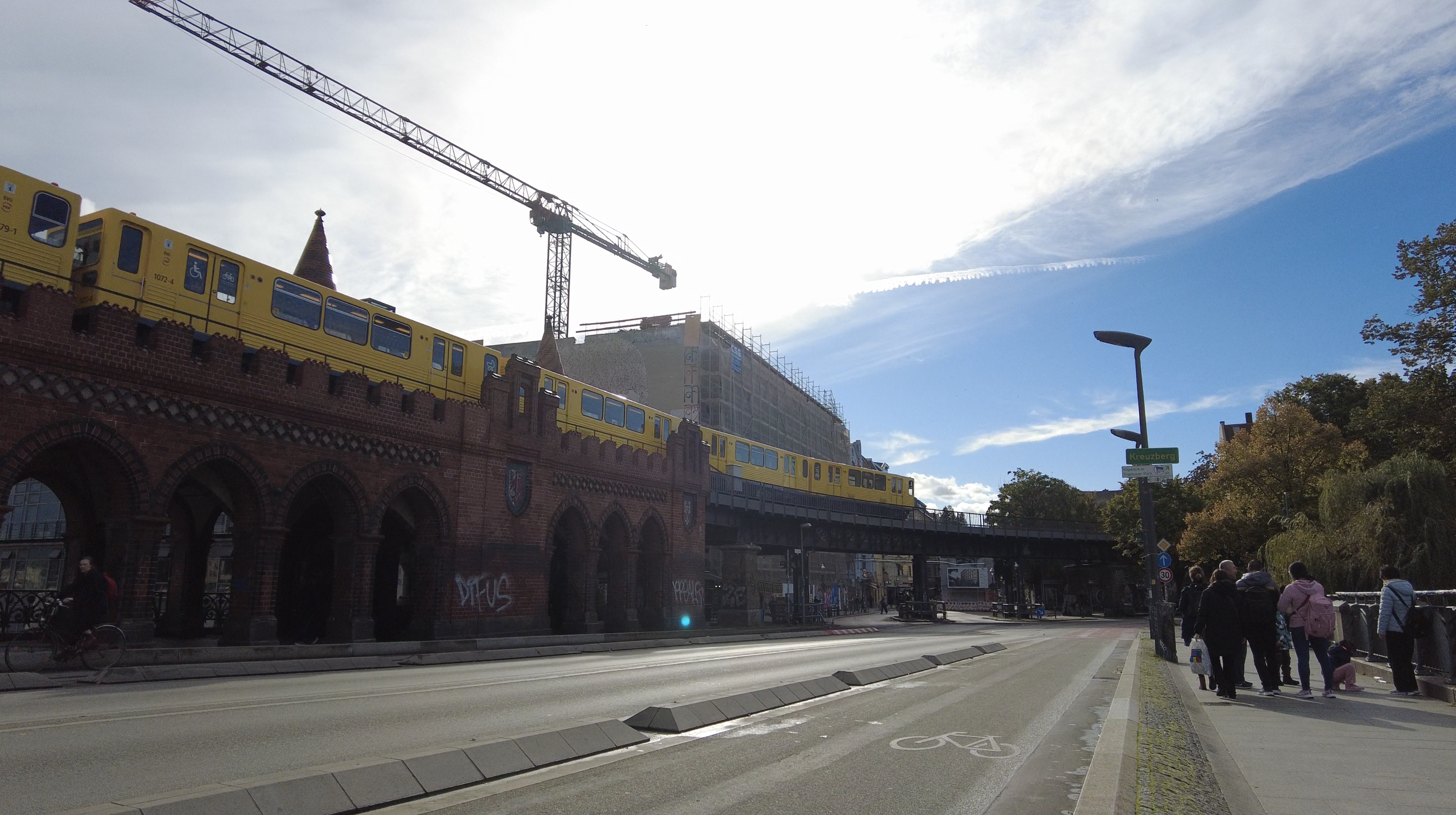
Berlin’s system often does not look all that modern — I love the elevated section of U1 and U3 precisely because it looks and feels so “old-timey”. But what’s amazing about the system overall is how modern it feels.

This may be unremarkable to you if you are from Berlin, but the pervasiveness of free public wifi on the transit system was awesome, especially coming from London where free wifi basically doesn’t exist (unless you already are signed up with a British phone carrier, at which point why are you using Wifi?).
The “digitally-enabled” ticketing was also awesome, and yet another reminder of why proof-of-payment can be so great. As I was waiting to get off my flight in Berlin, I was able to download the BVG app (which is really good!) and get a zonal transit pass, as well as activate it and put it in my Apple Wallet. From then on out, I never really thought about ticketing again, and that’s a pretty cool experience. Even though that flow is all digital, since there isn’t fixed station infrastructure I had to interact with, it should be pretty easy to implement and inexpensive to operate, and frankly I really enjoy not having to ever pull out a card or ticket while riding around town.
And I think this all goes to highlight why Berlin’s public transport is such a good experience. — the embodiment of less is more!




Leave a Reply to GaborSCancel reply