If you enjoy my blog and want to help support it, please subscribe (it’s free)! You’ll get weekly articles about transit and cities (as well as the odd off-topic post) directly to your inbox!


I watch a fair few interviews and read articles that I see on Twitter and Mastodon, and one thing that frustrates me to no end is the way the media covers public transport (usual disclaimer that this is obviously not universal, but absolutely very widespread) and urbanism.

Eglinton Crosstown construction, circa 2022.

Even in Toronto, a city where a very large portion of the public doesn’t even own a car, its not uncommon for construction for projects like the Eglinton Crosstown to garner complaints from news anchors about parking and traffic impacts. In the same segment, you might see complaints about a bike lane from anchors, and then talk about how climate change is clawing at the edges of human civilization. While a lot of the public seems onboard with the idea that transit is just a rational way to get around that is more affordable, better for the planet, and better for our shared spaces than driving; at best, the media seems stuck in the “transit means other people might not drive, so I get less traffic” mindset. There are also the dopey comments you hear when the odd transit disruption is reported on that makes it obvious how few members of the media speaking to the public about public transport actually regularly use it. And all of these feelings I have for transit can basically be extended to all urbanist subareas — from bike lanes (“oooh traffic!”) to more housing (“so many condo towers oooh we’re just like Hong Kong”).

On top of this, what stories are written about the public transit being built in our cities rarely gets into the history or nuance of our systems — sometimes just repeating press releases is all we get. There’s always lots of attention given to delays and over budget projects (Eglinton Crosstown in Toronto for example, or the Second Avenue Subway in New York), but very rarely to the systemic issues that produce them. I’d argue a big part of why we let our government transit engineering and planning expertise atrophy is because of hyperbolic media reporting in the past about government waste and delays. Now, of course, lots of projects really are poorly executed — but most media outlets are horrible at providing context.

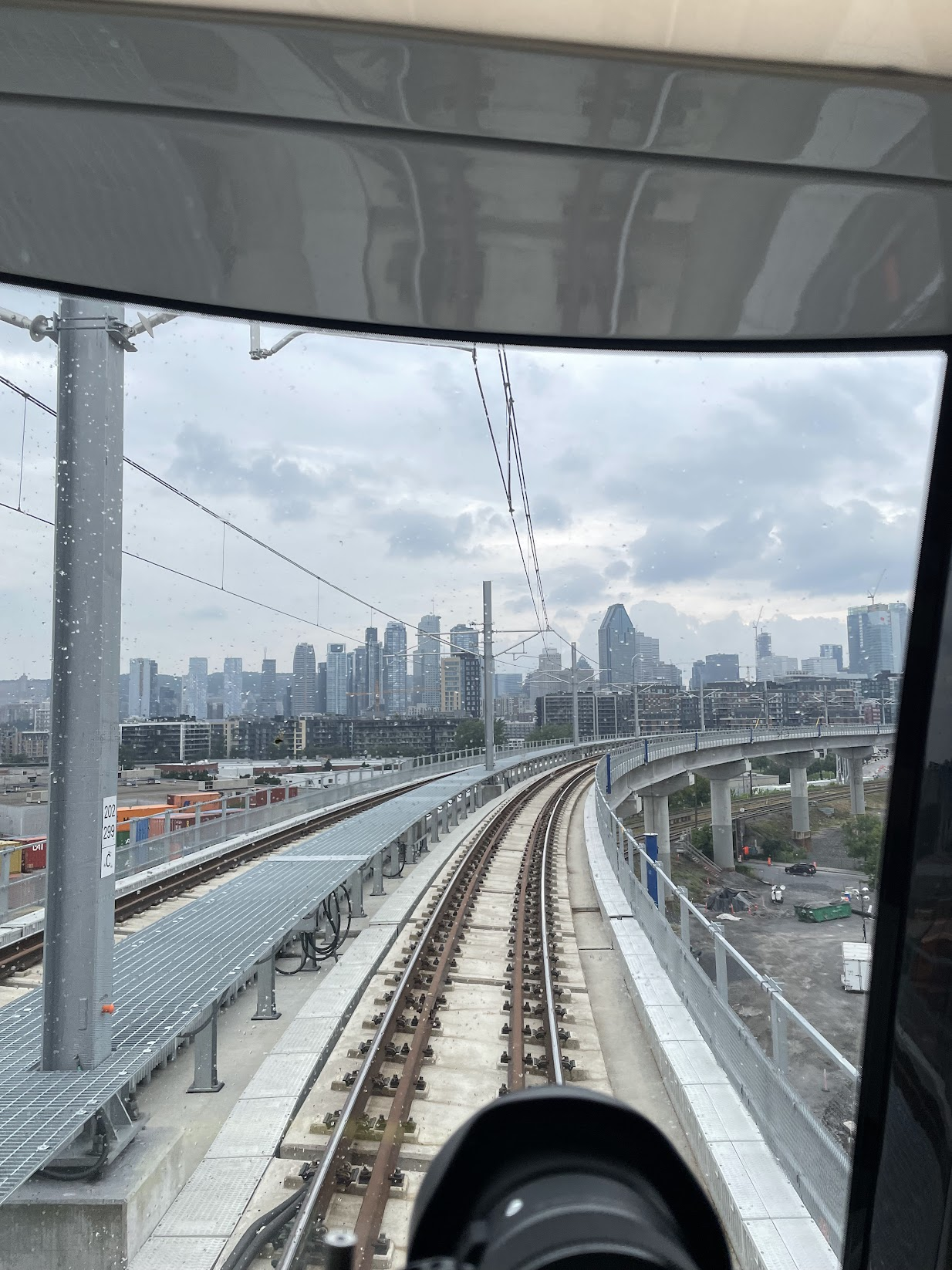
For example, coverage of Montreal’s REM project in local and even national media has felt overwhelmingly negative even as the project has clearly been overwhelmingly good. The only article I can recall off the top of my head that has been seriously positive about the project was one in Bloomberg by my sometimes collaborator Dr. Jonathan English. The high-level point here is that despite the project being built for a fraction of what others in Montreal are being built for, media lambasted the project for not meeting its own aggressive budget and timeline. This kind of mindless critique that doesn’t ask — “this project was over budget, but was the budget actually low to begin with?”.

Montreal REM.

Layered on top of the usually poor-quality coverage is the suffocating negativity. Obviously, the negative bias of media is well-known (I think it exists on YouTube, but is much less prevalent), but at least when media is talking about a “wave of crime” or the climate crisis, the attention might at least wake some people up to a real problem (even if its severity is overstated). But so often for transit, media does little to acknowledge its fundamental society benefiting elements, and rags on issues that are not unique to it (in places that can’t build transit, other infrastructure build usually aren’t going great — big surprise there!).

This issue extends in an obvious way to housing, but media also often loves giving coverage to the NIMBYs out there, even without seemingly assessing whether they are helping unreasonable rich people block policy changes, and projects that would obviously help everyone, but especially the most in need in our societies.

This element of hyperbolizing problems with transit as compared to roads is obvious, a sudden increase in crime on transit over a very low baseline leads to tons of attention given to the mortal dangers created by subways and buses, and yet cities in North America have an epidemic of drivers running over pedestrians and cyclist that still get referred to as “collisions”. While media does little to boost the obviously good of public transport, it is so often the media at the centre of the problem we have with victim-blaming pointed at vulnerable road users. Perhaps it’s not media’s job to tell a positive narrative and push the world forward (this is generally how I approach making media, but that might just be me), but surely not actively contributing to problems is within the media’s mandate.

Ultimately, it’s really only those within media organizations which can control what those organizations release to the public. That being said — whenever I see people lamenting the loss of traditional media I am reminded of how I see that apparatus cover the topics I care about, and I am left to wonder if every topic is covered in the same flippant and negative way.

30 responses to “North American Media is Bad on Transit and Urbanism”

  1. As along-time devotee of media criticism, I would say that yes, virtually “every topic is covered in the same flippant and negative way.” Establishment media tells stories from an establishment point of view, a perspective that tends to be resistant to change and mired in unacknowledged prejudices. Nuanced issues are oversimplified into X vs. Y dichotomies, which overemphasizes extreme takes. Also, I don’t how it is in Canada, but in the US about half of all newsroom jobs have been cut since the year 2000 due to consolidation of media ownership, so those reporters who do remain have less time to devote to investigating and understanding complex issues. Given that climate of job insecurity, reporters are also hesitant to rock the boat by saying anything that doesn’t hew exactly to establishment narratives.
    Which is why I appreciate independent media like you are presenting. Keep up the great work!

    1. Great comment all around haha

  2. Andrew Marszalek Avatar
    Andrew Marszalek

    Here in Sydney whenever the state transport minister or state premier post anything to social media about new transit projects by and large the comments are negative (the projects aren’t perfect but they certainly improve Sydney by being built). But those reader comments run the gamut from “stop claiming the success of something the last government started”, “it’s a waste of many”, “it’s in the wrong place”, “you should have done this”, “why is it going there and not here” and “why is the money always spent in Sydney”, to outright attacks on policy on completely unrelated items.
    So maybe we, meaning all of the population, get the media coverage we deserve… as sad as that is. Certainly a bad side effect of the “angertainment” industry that many news services have turned into.

    1. Of for sure comments are super negative, but it’s easier to set a policy to be positive and constructive as an org than as a society!

  3. I remember how when a light rail referendum in Orange County, CA failed the local paper said light rail is increasingly difficult to build because all the freeways have led to “dwindling space” to fit train tracks on.

  4. when a bus falls off a cliff or a bridge, its a major story. The following days or week will see a number of bus accident stories. This is just lazy news media.
    Did a window blow out of an airplane? Then for the next week(s) expect stories prominently mentioning the plane manufacturer for minor airport issues that having nothing to do with the manufacture of airplanes, but their operation. Lazy.
    Are their tunnels in Gaza in the headlines? Then headline something else that can be characterised as a tunnel in NYC. Lazy.
    Is local train service disrupted? Headline news, followed by commentary about “why I’ll never take the train” type stories. Lazy reporting, plus a sort of rationalization by folks who could but wont take transit.
    Key freeway shut down for half and hour or hours due to protests or collisions? Dont mention it much at all.

    1. There certainly is a bias to favorable reporting (or omitting negative stuff) with cars.

  5. Yeah, North American news media has been terrible for a while. Here in the US, the most frustrating thing is that they insist that Trump is going to win the election in November, despite plenty of evidence to the contrary.

  6. You pretty much summed up exactly how I feel about most stories in the major media outlets these days. Too many of the articles are being told by those wrapped up in their own little world with little understanding of how others go about their lives. It isn’t just the lazy journalists. How many decision makers working for transit authorities use the systems they manage?

    1. The issue of people not understanding the “product” which they or their company makes is a real problem

  7. Hi, I don’t actually waste my time watching, listening to, or reading MSM and I gave up on them years ago for the reasons you mention when I discovered that I could get much, much better news, info, and commentary from author-publishers like yourself:- why waste time complaining about them, they will soon all be extinct and good riddance! A much more interesting issue is how to adequately compensate freelancers like yourself for the work you do without costing or inconveniencing the reading/viewing public too much. Internet distribution of news and info and commentary by freelancers is still an evolving field and no one has yet developed a good business model to compensate content-creators so we can keep getting quality content on any subject. Just some thoughts…..

    1. Where do you get your local news then? How are author-publishers compared to journalists with established media organizations when it comes to doing investigative journalism?

    2. I think theres still a big gap between the two and a lot of good that MSM does, though it usually seems to be more in the “news news” and stuff like weather than investigative journalism these days (with exceptions of course!)

  8. Josh Christopher Avatar
    Josh Christopher

    When one of those awful auto terrorism things happens where someone uses a car or truck to ram a bunch of people it’s never painted as a car thing. I don’t think the same can be said for pretty well any transit based violence. As for the epidemic of car ‘accidents’, there is no transit equivalent to compare these to.

  9. Maybe we just need more long-form journalism, magazine articles/ news magazine programs on television for detail/nuance about policy. How does a show like The Agenda with Steve Paikin for example cover transit compared to the nightly news?

    1. We do need that, the Agenda is better (though I think its dying?) than most, but still suffers from a lot of the problems I mention.

  10. I am encouraged that the media here is Europe is very positive when it comes to transit and transit projects.

    1. They are, but they are also less positive than they probably could be and a little too NIMBY friendly too (at least in some places!)

  11. I remember when light rail in Phoenix celebrated its 10th anniversary back in 2018. The local daily newspaper, the Arizona Republic, decided to cover the milestone by having its reporters, most of whom don’t usually use transit, take the train for a day and report on their experiences.

    Their reports were generally favorable, but there was still an element of fish-out-of-water journalists writng about somthing outside their experience. Most said light rail worked fo them on that day but then offered all sorts of reasons, some valid and some not, why they would not use it regularlly.

    What was missing: interviews with actual passengers who ride the train regularly and can give experience-based critiques of what’s working and what needs improvment. Also missing was any sort of benchmarking of our light rail vs. systems in peer cities. In this case, the problem wasn’t so much negativity as it was exoticization.

    1. This is such a perfect example of what I am talking about. People who don’t use a thing saying that they wouldn’t use a thing, instead of talking to people who find it useful!

  12. “If it bleeds it leads”. Media thrive on controversy and outrage. Has for centuries. If you want media coverage, generate some controversy about the NIMBYs

    1. It does seem like NIMBYs are still getting the coverage, but at least in the other direction!~

  13. @reecemartintransit the hit pieces done every day by the Journal de Montreal in the week leading up to the opening were crazy to witness.

  14. @reecemartintransit damn, it's sick that this just shows up in my mastodon feedOn top of your points, and the existing financial incentives for media negativity, I saw Joseph Politano make the point on threads that "the news industry itself has been in perpetual recession for years so media workers have much worse "lived experience" of the economy, which also informs their priors on economic reporting."

    1. I think that’s likely accurate that the media is a biased subset of the public. Curious to see if my reply appears on Mastodon!

  15. JonahDoesTransit Avatar
    JonahDoesTransit

    It really drives me up a wall how bad our media is on reporting everything public transit. For example: always making it out to be way less safe than it actually is and focusing on all the traffic and construction problems a transit project causes. Something tells me this is a deeper rooted (i.e. executive) issue than what we see on the surface.

    1. I do agree its likely deeper, but I do not think it is coming down from an exec level. I would imagine well travelled leadership might even be more open minded. Instead I think the issue is cultural.

  16. Man do you remember last summer when there was a string of violence on the TTC subway there were like headlines after headlines on the issue? I remember at that time that I was a bit scared to ride the TTC if I ever go the chance (I don’t live in Toronto). I also used to wonder why RM Transit never covered the issue. Looking back, I can see how the MSM did a fairly poor job covering the issue. I think when it came to that particular issue most news agencies never put all the crimes on the TTC into context, i.e. what is the crime in the city generally? how much more crime was committed on the TTC in that summer compared to say, last year? and how much more dangerous is it to take other forms of transportation? None of these were ever mentioned.

    1. It wasn’t great but it was also overblown

Leave a Reply to kollibriterreCancel reply

Trending

Discover more from Reece Martin

Subscribe now to keep reading and get access to the full archive.

Continue reading