
I recently Tweeted out quite the hot take that transit basically should not require marketing — this, like most Twitter hot takes, has little nuance to it. Obviously there are exceptions, but I thought it would be good to give some background and talk about why the central thesis here is something I feel so strongly about.
This whole line of discussion began because of a discussion being had in Toronto about ads released by regional transit agency Metrolinx, which appeared to basically communicate what must be the internal attitude towards critiques of slow and over budget transit projects.
The ads more or less mock people who are upset about things such as the thirteen-year construction timeline (the Channel Tunnel was 6-7 years) for a rather ill-conceived subway surface line in midtown Toronto (the bad plan is more on the city), suggesting that people should suck it up because the project is big and transit is hard. These things are true of course, but suggesting that people shouldn’t take issue with Toronto’s situation is anti-intellectual and frankly offensive because other cities in wealthy developed countries show that the crazy timelines and cost of Toronto’s projects are not inevitable.
This egregious example is just the latest in years of ads from Metrolinx that have very little substance despite having crazy production value: One campaign essentially just said “it’s happening” without really even saying what was happening — it’s just bad.
Now of course, communicating with the public and marketing are arguably a spectrum that describes more or less the same thing, I would distinguish Metrolinx’ advertising for its low information, and the fact that the agency is spending significant public money to blast these ads back out to the public just does not sit well with me. And to be fair, Metrolinx is not the only guilty party for this in North America, but I think they get away with it because in the US a transit agency spending money to advertise would be a lot more likely to draw ire from fiscal hawks. In Canada, we tend to be more passive and we generally like public transit, so calling marketing like this out is less likely.
But you can do “marketing” of transit in a good way — perennial North American transit overachiever Translink from Vancouver is a great example of this.
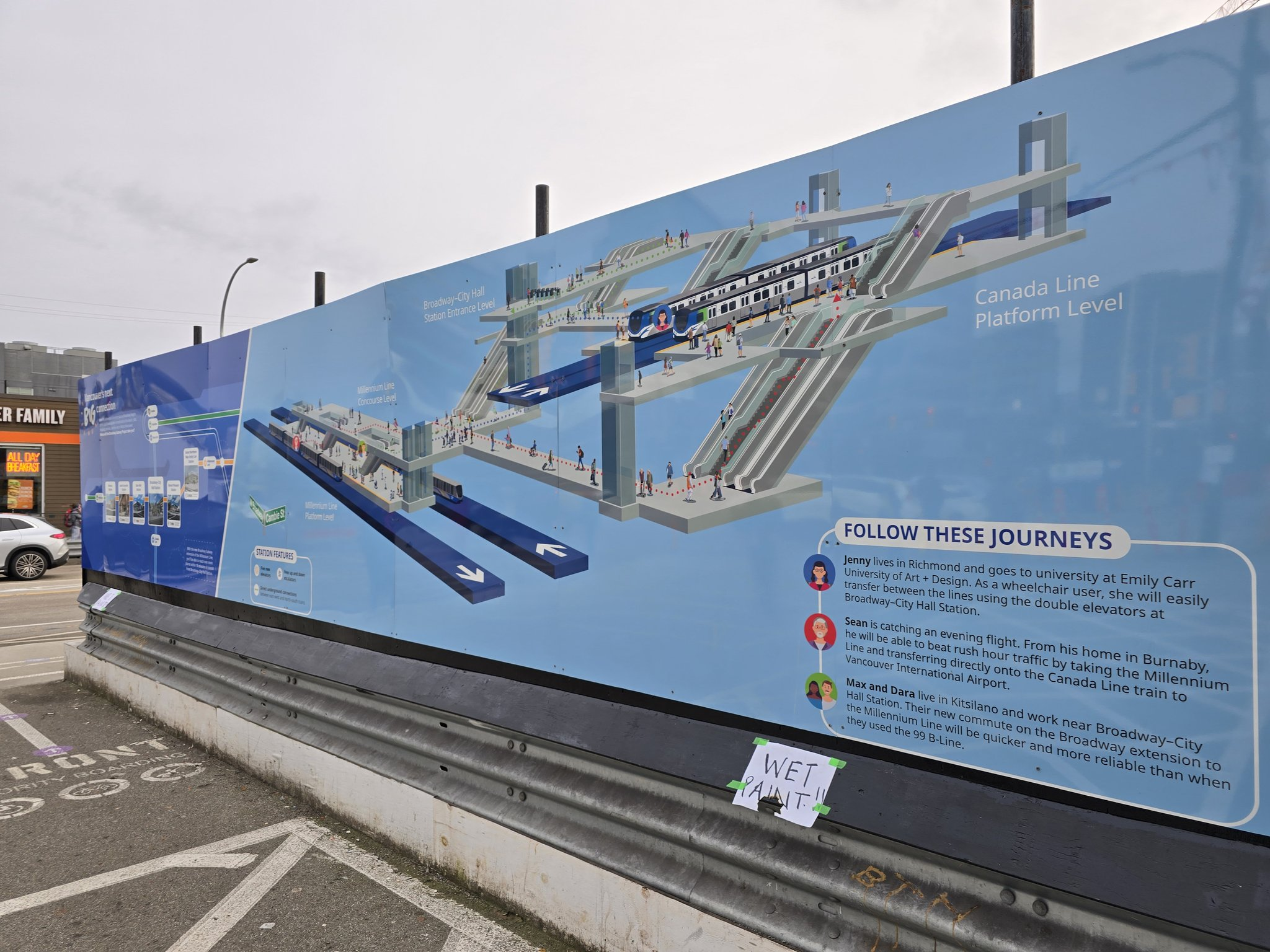
Translink markets itself an enormous amount, but without paying for ads in movie theatres or on social media. Translink does this through a great social media presence, working with online creators (but importantl not paying them to create ads), bright, bold, and distinctive wayfinding that stands out on streets across Metro Vancouver, and tons of information in stations and onboard vehicles. And this high-quality media environment seems to have rubbed off on other organizations too — the Broadway Subway project is not being built by Translink, but when visiting Vancouver this past week I was amazed at the quality and presentation of information even just on construction hoarding sitting at a busy station. There was information about the new interchange for nerds, a diagram to show people what it would look like, as well as history and more. I’ve never seen anything of the sort in Toronto – despite the endless construction hoarding and fencing seen in places like along Eglinton Avenue. That Translink is able to get so much messaging across, remain classy, and not spend tons of money shows how much Toronto (and many other cities) have to learn.

So, I think what you can see is that I am okay of transit systems communicating information to passengers and the public using the mediums they have available (Translink is unique in also managing major roads and so you could imagine them putting up digital signs highlighting delays and suggesting taking public transit!). What is less cool with me is spending money to advertise (when you already have tons of free or at least low-cost “ad space”), especially when it’s to communicate a message with so little substance. You might say “but what if Metrolinx wants to warn transit riders about disruptions?” (which these ads don’t) in this case they already have the perfect medium for this — stations, vehicles, and announcements!
That being said, there are obviously exceptions. On rare occasions, it might be worth getting a message out, and the cost benefit of aggressive marketing probably changes when you have a transit system where most of the low-hanging service and infrastructure improvements have already been actioned. A big marketing campaign might cost as much as some platform doors, for example!
Heres’ one of my favourite transit ads of all time, for the debut of the N700S model Shinkansen:
But, beyond what I’ve said, I remain highly skeptical that we should be advertising to people that they should be taking transit.
There are a number of reasons for this: For one, public transit operators generally have an effective monopoly on providing public transit in their cities, and while yes, they do not have a monopoly on providing transportation, the awareness of public transit as an option is generally much less of an issue than service which is noncompetitive. If transit is a faster, more comfortable option than driving (or at least competitive), then people will see when they plan a trip in their maps app, and the convenience of it will spread quickly by word of mouth. Does it sometimes take lots of time for people to learn of and start taking public transit? Yes, but I’d suggest thats usually just because people are slow to change their travel patterns and living arrangements. Spending effort marketing transit service when it isn’t fast, frequent, clean, convenient, and safe is just inverting spending priorities.








Leave a Reply to JuliusCancel reply