I recently Tweeted out quite the hot take that transit basically should not require marketing — this, like most Twitter hot takes, has little nuance to it. Obviously there are exceptions, but I thought it would be good to give some background and talk about why the central thesis here is something I feel so strongly about.

This whole line of discussion began because of a discussion being had in Toronto about ads released by regional transit agency Metrolinx, which appeared to basically communicate what must be the internal attitude towards critiques of slow and over budget transit projects.

One of the now deleted ads of the Metrolinx campaign (reupload).

The ads more or less mock people who are upset about things such as the thirteen-year construction timeline (the Channel Tunnel was 6-7 years) for a rather ill-conceived subway surface line in midtown Toronto (the bad plan is more on the city), suggesting that people should suck it up because the project is big and transit is hard. These things are true of course, but suggesting that people shouldn’t take issue with Toronto’s situation is anti-intellectual and frankly offensive because other cities in wealthy developed countries show that the crazy timelines and cost of Toronto’s projects are not inevitable.

This egregious example is just the latest in years of ads from Metrolinx that have very little substance despite having crazy production value: One campaign essentially just said “it’s happening” without really even saying what was happening — it’s just bad.

Now of course, communicating with the public and marketing are arguably a spectrum that describes more or less the same thing, I would distinguish Metrolinx’ advertising for its low information, and the fact that the agency is spending significant public money to blast these ads back out to the public just does not sit well with me. And to be fair, Metrolinx is not the only guilty party for this in North America, but I think they get away with it because in the US a transit agency spending money to advertise would be a lot more likely to draw ire from fiscal hawks. In Canada, we tend to be more passive and we generally like public transit, so calling marketing like this out is less likely.

But you can do “marketing” of transit in a good way — perennial North American transit overachiever Translink from Vancouver is a great example of this.

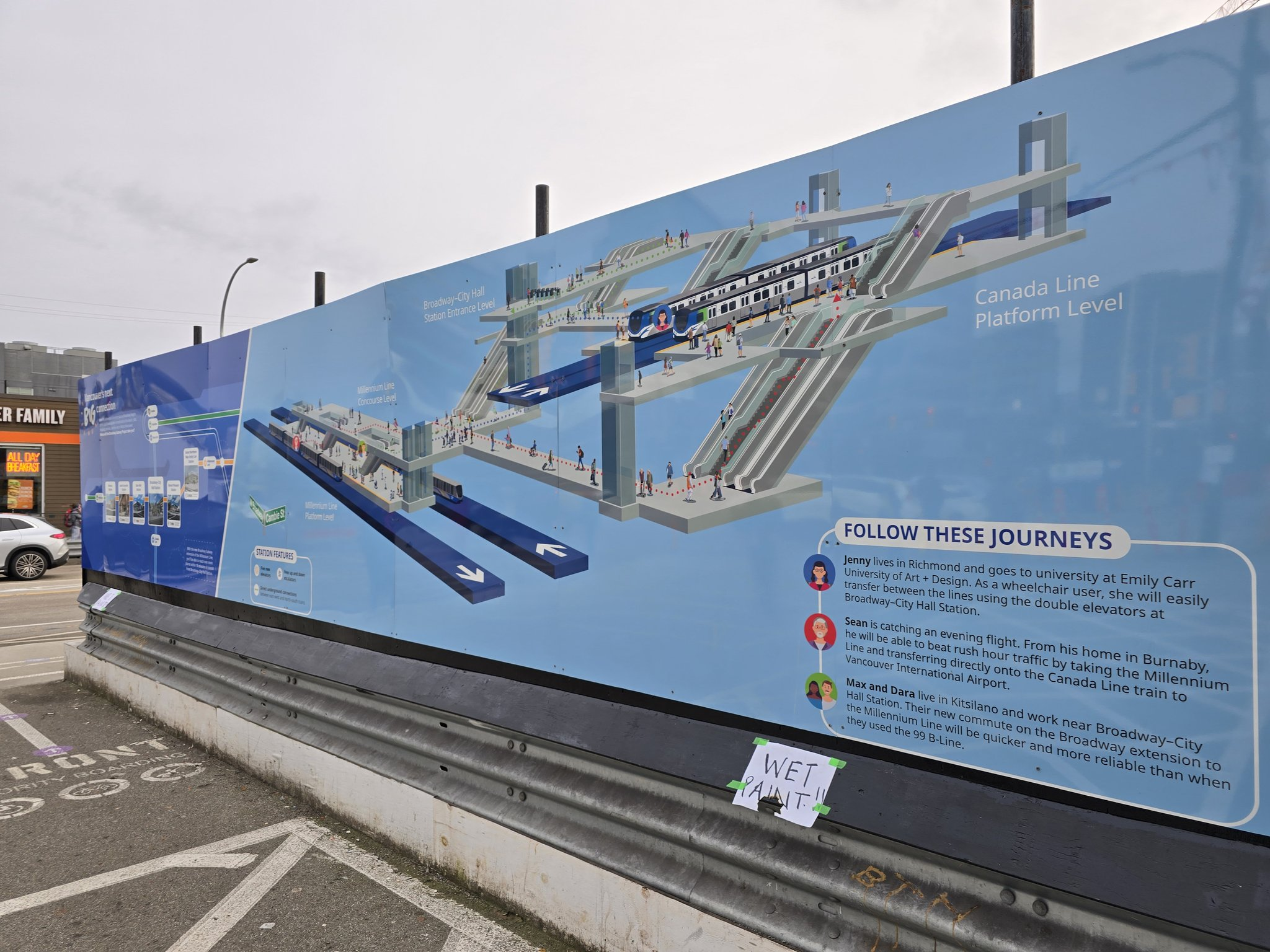
Translink markets itself an enormous amount, but without paying for ads in movie theatres or on social media. Translink does this through a great social media presence, working with online creators (but importantl not paying them to create ads), bright, bold, and distinctive wayfinding that stands out on streets across Metro Vancouver, and tons of information in stations and onboard vehicles. And this high-quality media environment seems to have rubbed off on other organizations too — the Broadway Subway project is not being built by Translink, but when visiting Vancouver this past week I was amazed at the quality and presentation of information even just on construction hoarding sitting at a busy station. There was information about the new interchange for nerds, a diagram to show people what it would look like, as well as history and more. I’ve never seen anything of the sort in Toronto – despite the endless construction hoarding and fencing seen in places like along Eglinton Avenue. That Translink is able to get so much messaging across, remain classy, and not spend tons of money shows how much Toronto (and many other cities) have to learn.

Hoarding for the construction of the Broadway Subway.

So, I think what you can see is that I am okay of transit systems communicating information to passengers and the public using the mediums they have available (Translink is unique in also managing major roads and so you could imagine them putting up digital signs highlighting delays and suggesting taking public transit!). What is less cool with me is spending money to advertise (when you already have tons of free or at least low-cost “ad space”), especially when it’s to communicate a message with so little substance. You might say “but what if Metrolinx wants to warn transit riders about disruptions?” (which these ads don’t) in this case they already have the perfect medium for this — stations, vehicles, and announcements!

That being said, there are obviously exceptions. On rare occasions, it might be worth getting a message out, and the cost benefit of aggressive marketing probably changes when you have a transit system where most of the low-hanging service and infrastructure improvements have already been actioned. A big marketing campaign might cost as much as some platform doors, for example!

Heres’ one of my favourite transit ads of all time, for the debut of the N700S model Shinkansen:

But, beyond what I’ve said, I remain highly skeptical that we should be advertising to people that they should be taking transit.

There are a number of reasons for this: For one, public transit operators generally have an effective monopoly on providing public transit in their cities, and while yes, they do not have a monopoly on providing transportation, the awareness of public transit as an option is generally much less of an issue than service which is noncompetitive. If transit is a faster, more comfortable option than driving (or at least competitive), then people will see when they plan a trip in their maps app, and the convenience of it will spread quickly by word of mouth. Does it sometimes take lots of time for people to learn of and start taking public transit? Yes, but I’d suggest thats usually just because people are slow to change their travel patterns and living arrangements. Spending effort marketing transit service when it isn’t fast, frequent, clean, convenient, and safe is just inverting spending priorities.

31 responses to “Do we need to advertise transit?”

  1. Jonathan Douglas Avatar
    Jonathan Douglas

    My goodness, I didn’t think I could ever have such a viscerally negative reaction to a public transit ad, but here we are. I do think the public has the capacity to be understanding if the promoters are clear, transparent and empathetic, but as you pointed out, Metrolinx is showing none of these in this case. I’d rather they spent the time and energy (and money) to work on the actual issues, and maybe help educate people as to why they are happening (even if they still puzzlingly won’t commit to any date for the Eglinton Crosstown, for instance). Company apologies are somewhat meaningless these days, so I don’t think they need to go that far, but I genuinely (and skeptically) doubt that they are even concerned — and it is here that they could take a page out of the Japanese lesson book.

    1. Couldn’t agree more with all of your points!

  2. @reecemartintransit those ads were REAL? I thought they were a film student joke.

    1. They are truly crazy.

  3. I think we should “advertise” public transit, for a definition of advertising that might as well be given a completely different name.

    We should make sure people know that the new bus route gets them where they want to go, faster and more frequently than before. We should make sure they’re aware of and excited for upcoming transit projects, so they can reach out to their local representatives in support and make voting decisions accordingly.

    We should provide the tools, the transit maps and isochrones and data visualizations, that make people understand how transit makes their lives better today and tomorrow.

    I do not, of course, think we should gaslight people about the inefficiency of our public transit administration. The word for that shouldn’t be advertising, either.

    1. To be honest I think a lot of this is existing comms to transit users, as opposed to how I envision advertising going out into the wider world.

  4. “Translink markets itself an enormous amount, but without paying for ads in movie theatres…”:- hmmm, so who goes to movie theaters anymore? I mean there are very, very few movie theaters in Toronto and probably less than 100 across Canada:- does Metrolinx or anyone at all actually advertise in movie theaters? Metrolinx obviously has a problem with ossification of management and a very obnoxiously bureaucratic attitude:- they remind me of the “Vogons” in “The Hitchhiker’s Guide to the Galaxy”. Here’s a bried description from Wiki:- Vogons are described as “one of the most unpleasant races in the galaxy—not actually evil, but bad-tempered, bureaucratic, officious and callous”, and having “as much sex appeal as a road accident” as well as being the authors of “the third worst poetry in the universe”.:- just replace “poetry” with “ads” and you have a perfect description of Metrolinx Vogons. Methinks it might be time to euthanize Metrolinx!

    1. I love HGTTG! Metrolinx and lots of other organizations do advertise at movie theaters, and there are a lot of movie theaters out there!

  5. Just for comparison:- I live near Pembroke which used to have a public-transit “system” long ago but it also died long ago due to a lack of interest but now they are planning to revive it in the form of two whole buses shutting along old Hwy 17 between CFB Petawawa and the Pembroke Mall:- however they’re still only taking about it which they have been doing intermittently ad infinitum since forever even without any help from Metrolinx.

  6. Yesterday I saw a Translink ad (at Marine Drive Station) encouraging people to contact politicians at the provincial level about the need to spend more on transit expansion. Headlined “Are you tired of waiting for over crowded transit?” with a QR code

    1. Thats pretty good to see!

  7. Most of my life when I’ve heard an ad for transit I was taking a trip that would either be impossible on transit, or theoretically possible but not practical (if the last bus leaves before I’m ready to leave it doesn’t work).

    Eventually I found myself in a position where transit worked. The advertisement that told me that: seeing a bus on my route every single day while I was driving it.

    1. Exactly, literally just getting more buses on the road is often the most effective advertisement!

  8. To me it seems pretty clear cut. Spending money on what amount to public service announcements is fine.

    Spending money on propaganda or pointless rebranding exercises is a waste of public money.

    That Metrolinx commercial should have never been made, let alone see the light of day.

    1. Yep, this is a good guideline

  9. While I agree with most of your points, I think you missed a not unimportant reason for public transit marketing.
    Here in Berlin for example, the local transport provider BVG is known for their great marketing campaigns. This status of being „cool“, they developed through viral, fun(ny) videos and lighthearted ads and social media posts. This of course aids bringing new users to the system (especially younger folks) but – as you pointed out – this effect can‘t counteract bad service.
    There is, however, another point that is worth considering: Many transit agencies (around the world) struggle to recruit more personnel, above all drivers. Here a focus on conveying an attractive image of your company can have a big impact on reaching recruitment goals.
    As you might have noticed/heard during your recent stay in Berlin, BVG struggles to stick to their schedule due to staff shortages so there are many ad campaigns encouraging to apply to BVG.

    1. I think BVG has a lot less low hanging investment fruit to use their Euros on!

  10. I think the STM and ARTM do an okay job here in Montreal; I see their ads of course always on their buses, metros and stations, but also I will see more ads at events that attract thousands of people, like at the Jazz Festival, National Bank Open tennis, or the Alouettes or Canadiens events. I think this makes sense as there is a mix of drivers and transiters to these events, so the ads are aimed towards those who are driving.

    1. Its ok, but STM would be far better spending that money running decent bus service, which is surprisingly rare in Montreal

  11. Interesting angle, Reece. I really enjoy your work, that is your videos, articles, and the research you do. We are all the more knowledgeable for it. Keep up the great work!!

  12. You make so many good points, but I have to disagree slightly on your conclusion.

    I’ve been howling at the moon now for quite awhile that Big Auto’s advertising is actually enemy #1 to urbanism and transit. Until we do something about that, we’ll continue to lose or make minimal progress.

    I mean, I’ve become staunchly anti-car (as in, get rid of all inner urban roads, private cars and parking, completely), yet on the rare occasion I catch an automotive ad on someone else’s TV, it can still trigger an insane desire in me for the latest truck or car. This isn’t accidental of course, because Big Auto pays big money for maximum psychological manipulation.

    Now, I’ve been saying that we should actually be regulating this advertising, because it’s as dishonest and manipulative as cigarette advertising was. There’s not a single ad that will ever show gridlock traffic, mind-numbing daily commuting, searching for parking, trying to pay all the bills from owning an automobile, kids/people being run over, or anything realistic. Instead, ads are either always pushing the idea that with this car/truck you’ll finally live free in the untouched wilderness or that you’ll become the coolest person in your race-track city that never has traffic. Problem is, I think our so-called “democratic” governments have become kind of useless at making meaningful decisions, and because Big Auto is such a fixture to our GDP in North America, regulating Auto Ads won’t happen anytime soon.

    So, it occured to me awhile ago, that **WE** should be advertising, because there is literally nothing else on TV to push back against the toxic manipulative ideas Automotive Ads sow. But relying on already underfunded transit operators to advertise their own systems at the same level of Big Auto, is a fool’s errand. Not only due to anti-public-spending voters, but due to the scope and scale that GM, Ford, Toyota, etc. have on all North American media. They easily blow close to an entire transit system’s annual budget, in just one month, on advertising (I’d love to see an actual comparison, as I’m just guessing).

    What we need to do is something similar to what the Dairy industry (and other industries) have done, by creating a North American association of urbanists and transit providers who create and fund whole-continent advertising to represent **all** communities and all public transit systems (current and future). Like with Dairy, where individual local farmers and processors had almost no benefit from local limited advertising, which just couldn’t compete with multinational non-dairy product advertising (like Coke – for example), this is where individual transit operator advertising is right now, which makes it’s very easy to make a strong case for why it’s a complete waste of taxpayer funds to engage in. However, unlike Dairy, which discovered their national collective power over a decade ago and came together to create some of the most iconic advertisements of our lifetimes (“Got Milk?”), which skyrocketed the popularity and consumption of dairy products to the benefit of all dairy farmers and processors, we’re still struggling as disparate individuals and transit operators, at great cost, to just drum up all but a trickle of popularity and consumption for transit and urbanism. But if we just followed Dairy’s lead here, we could potentially turn the whole thing around for everyone, to everyone’s benefit.

    With all of that said: Since I realized this awhile ago, and because I’m a bit of an indie filmmaker who’s made some commercials before, I’ve had time to come up with all kinds of ideas and scripts for advertising. From ads that popularize the problems and realities of private urban automobiles, by creating something that uses Big Auto’s own advertising tactics and styles against them, to ads that exemplify and popularize transit and urbanist planning. Of course, they’re all big budget, and could only reach people if funded and distributed at the scale of Big Auto or the Dairy Industry.

    Final thought: Right now, we have to go out and spend so much time, whether in person or with small niche YouTube channels, just to convince a handful of people, and it’s exhausting and often feels impossible; like we’re just not making any headway. But imagine if we flipped that, and people started flooding in, seeking to get what they saw on TV, brought to their own city. Our whole job changes, and I think we we could go from doing this advocacy grind, which gets us the bare essentials at best, to actually talking about our big ideas and the planning required to get to where we actually want to be. A transition from fighting to collaborating instead.

    Anyways, thanks for the great articles, Reece. Appreciate the hard work you do.

    1. I was curious, so I looked it up. Statista (I can’t link this without it getting eaten by spam protection) reports US$20.8 billion in 2023 ad spending across the automotive industry, or US$1.7 billion a month. The MTA (and New York City as a whole) has a budget of $19 billion but is an outlier with a budget more than twice as large as LACMTA’s (US$9 billion) and LACMTA’s budget has an extreme degree of capital spend that makes it an outlier compared to systems that are not being built in real time, for example BART (US$2.6 billion), CTA (US$1.99 billion), or even the TTC (US$1.91 billion based on exchange rate at the time of this comment.)

      In other words, your supposition is broadly correct for some of the top North American transit operators in terms of scale but once you get past these big fish the numbers get a whole lot smaller – the entire state of Rhode Island has a single transit operator (RIPTA) with a budget of $142 million after cutting everything possible and is still $18 million short of disaster also at the time of this comment. RIPTA represents the reality of transit in North America, not the few limited examples we have of large operators.

      And therein lies the true reason why I reject your position in favor of Reece’s. It certainly sounds nice to imagine a nationwide coalition of operators and advocates coming together to transform America through the power of advertising, but bluntly, no amount of advertising is capable of changing reality. You can certainly put together any number of ads that can make someone believe in the transformational potential of transit, you can make the bus sexy again, but you cannot advertise it into existence: that bus is still running hourly or worse, still invisible once the ad clicks off, still a challenge to use even if you want to. And, part of the power of automotive advertising isn’t just how much that ad makes you want to buy the car, it’s how easy it is in the US to go from wanting the car to driving one – and that’s equally true at both extremes of the wealth scale, because thanks to the prevalence of predatory dealerships who also make up a portion of that ad spend, you can have nothing and it’ll be easier for you to get a car than a safe place to sleep. In fact, one demographic within the broader demographic of the unhoused is people living out of their cars!

      So, no, while I understand your message and where you are coming from, I don’t agree. In fact, I don’t agree with you so completely that I’d go so far as to say that the idea of a transit superPAC is perhaps the one thing I would consider to be more useless than collecting a fare.

    2. I may be being a little unfair to you in particular. I apologize – but part of the reason I react so strongly to this in particular is that we are not in a fair fight and have not been for at least 70 years. More than just believing that there are much higher and better uses for $1.7 billion should we find it laying around somewhere, I believe that anything along the lines of “beating them at their own game,” e.g., advertising is simply already doomed to failure and worse yet, takes up oxygen which might otherwise be going towards, e.g., campaigning (which is similar to advertising I admit, but distinct and also far more potentially impactful.)

      In general, transit is broken in the United States and to a lesser extent in Canada. And yes, there are bright spots, there are places moving the needle in the right direction, there is “hope” – but LA’s ongoing quest to speed run building a network to match New York and Chicago with is not going to save the Central Valley or the Central Coast, and it’s the same with the impact that Vancouver has on Nanaimo, and it’s the same with the many smaller cities, towns, and municipalities that are worth keeping unlike the sprawling suburbs immediately adjacent to our largest cities.

      I use the examples of WMATA, LACMTA, CTA, BART, and the MTA in my comments because these are the places people recognize immediately, but advocacy has to involve more than them – by which I don’t mean the NIMBYs in their monied suburbs, but rather, the places you don’t think of – Savannah, Des Moines, Victoria, Thunder Bay.

    3. I get the message, but I think car companies need to spend precisely *because* the product is actually not very enticing. The opposite should be true for public transit, spend on the service and its a very good product!

  13. “Spending effort marketing transit service when it isn’t fast, frequent, clean, convenient, and safe is just inverting spending priorities.”

    Kind of like when a nonprofit advertises instead of providing humanitarian aid.

    1. Sort of, but a nonprofit is going to have a much more direct impact on its donations with advertising than transit will on ridership, good video here: https://youtu.be/bfAzi6D5FpM?si=Tt0KjwtfYXAVONG1

  14. Translink sounds a lot like Melbourne when it comes to advertising, any construction work to do with transit in Melbourne always has information, artwork and history on the fences.

  15. Politics. The provincial government is investing a lot of money into transit. They run ad campaigns for all sorts of things.
    Part of the purpose is to manage PR and get more votes.

  16. Going to inject an American perspective in here… In Los Angeles, where I come from, most people I know will still choose driving on a jam-packed freeway over taking a faster parallel subway line due to concerns about safety and cleanliness that are partially grounded in reality. Even in American cities where transit is much cleaner and more reliable than LA’s, I still hear acquaintances (often newcomers) confess that they take Uber because they are “worried about safety.”

    For most middle-/upper-class Americans, transit bears a race-/class-based stigma that can only be overcome by marketing. Marketing should not substitute for service or capital improvements but can provide a non-trivial boost to ridership in my opinion.

    1. I don’t think marketing is the solution here, I think increased safety and cleanliness is!

Leave a Reply to Mark LundieCancel reply

Trending

Discover more from Reece Martin

Subscribe now to keep reading and get access to the full archive.

Continue reading