An interesting stat that I find you’ll often hear about different cities is how many buses they operate. You’ll hear things like “London has over 7000 buses!” as a measure of how impressive the scope and scale of the bus network is. I think this would be an interesting number to calculate for Toronto, because it could provide a very rough approximation on how the city is doing compared to other global centres; the issue is, unlike most global cities, our buses are administered and operated by local municipalities, so finding a single number for everything is hard.

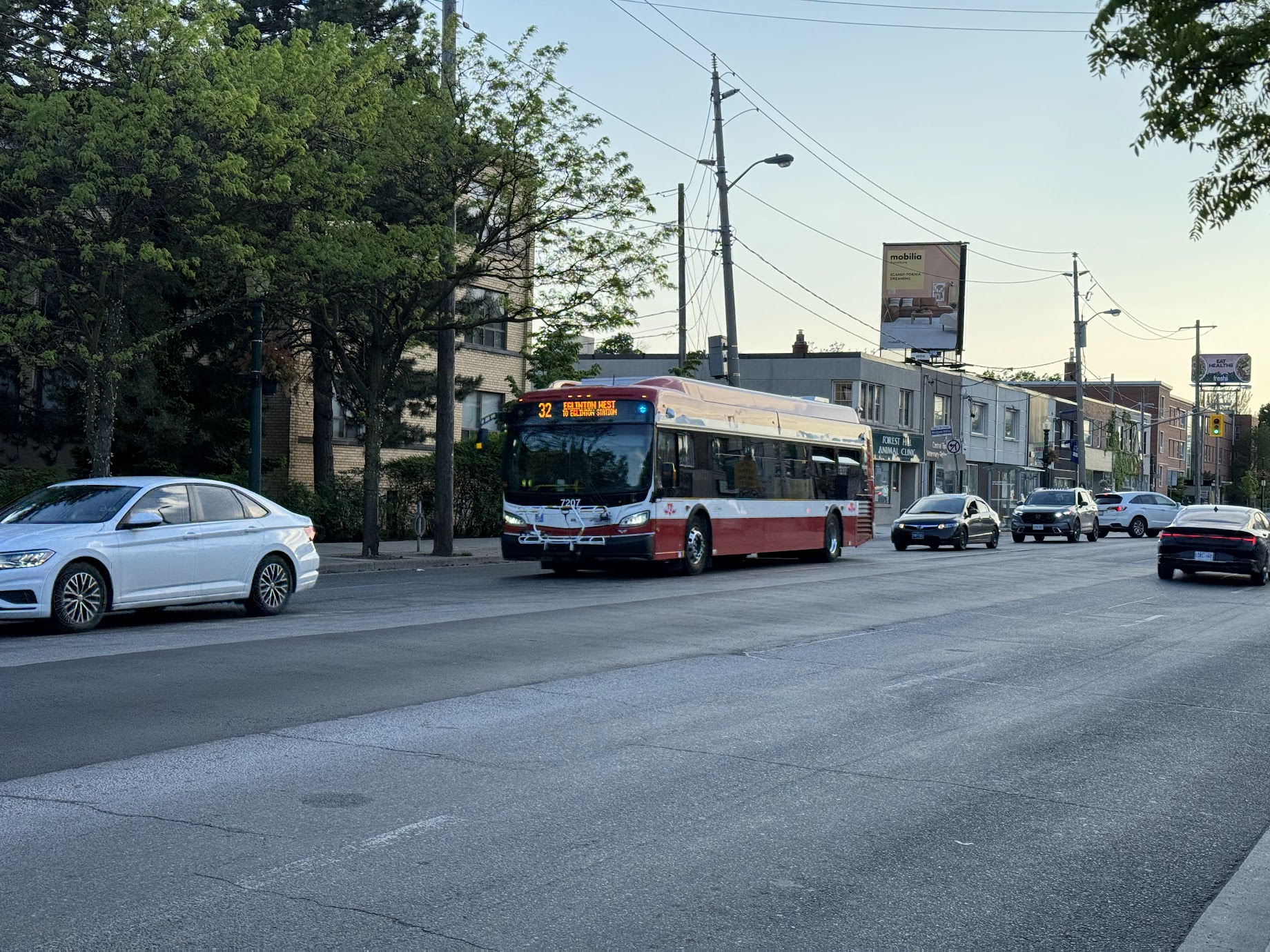
A TTC bus in Toronto.

If you enjoy my content, consider subscribing to my blog:

or supporting me on Patreon:

Your support will help me bring you more content faster!


Now, it is true that the number of buses a city has is a pretty poor measure of how good the bus system is — for one, because we don’t know how much those buses are actually being used; and for two, because it’s hard to judge a city’s transit by fleet size without knowing what the “city” part of that equation includes — drawing the boundaries of a city is just a classic problem that nobody seems to have a great solution for.

That being said, when I saw a stat recently that suggested London has roughly ~8700 buses, I decided to bring together some stats so I could have a reference for the future on how many buses Toronto actually has. While I was at it, I looked up a few other cities numbers as well — the MTA in New York has about ~5700 buses (this would clearly be supplemented by suburban agencies and NJ Transit), Paris has ~9000, and Seoul supposedly is over 30,000 — which sounds insane unless you’ve seen what a lot of major streets in that city look like with buses end on end as far as the eye can see.

Buses in Seoul. (Credit: JR Urbane Network)

My Toronto numbers are pretty unscientific as I just pulled the first data I could get for any city, meaning this might include data that is from different years, not reflecting new fleet additions or retirements, but here are the numbers I got for the Toronto region.

For the core urban areas:

  • TTC (Toronto) – 2100
  • MiWay (Mississauga) – 523
  • Brampton – 422
  • Durham – 178
  • York – 529
  • Burlington – 67
  • Oakville – 101
  • Hamilton – 267

And then there is also GO: I am less sure of this number, but given how many routes GO provides travel through urban parts of the region I think including them makes sense:

  • GO – 700.

I also pulled data from Waterloo and Guelph ,because while they aren’t part of the contiguous urban area, I do think people see them as being part of the “Toronto Region” more than, say, Niagara or St. Catherines.

  • GRT (Waterloo Region) – 259
  • Guelph – 70.

With all of that data together, I decided to plot the number of buses each urban area had (GO does not appear since I did not want to create a formula for dividing its buses up) and the number of people per bus:

What’s really interesting is that Mississauga actually has fewer people per bus than Toronto, even though it does not have a reputation for great transit, which really suggests that it ought to amp up its route redesigns to try and make better use of all those vehicles. Brampton as you can see is also in the same realm as TTC and MiWay, with <2000 residents per bus.

Next up you have York, Burlington, Oakville, Hamilton, Waterloo, and Guelph, and I think their range of 2-3000 residents per bus does align with a sort of vague sense that these agencies provide substantially less service than the three leaders, although the variability in how much service agencies actually put out is highlighted here, since Waterloo seems to provide more than York (a lot more), but has less buses — probably because it seems to be less of a commuter focused system.

The standout underperformer all things considered is Durham, which has roughly 3x more residents for every bus it has than Toronto, and really needs to more than double its bus fleet to catch up, especially since it’s growing rather quickly!

A MiWay bus at Mississauga City Centre.

All in all, for the region I got a total of 4887 buses, which is not actually that far off of the MTA’s fleet — and to be fair ,Metrolinx does organize large scale procurements for the agencies so they do get some of the benefit of operating as a unit. This number is probably accurate to +-500 buses.

Beyond that, I did consider our electrification rate, which for fully electric buses seems to be about 2-3% — which is better than I would have thought, and for Hybrids the number appears to be more like 15-20%. All in all, the numbers aren’t terrible, but they should be a lot better, especially the number of Hybrid buses and buses in Durham!

13 responses to “How many buses does Toronto have?”

  1. The CPTDB site says GOTransit has 437 buses not 600

    https://cptdb.ca/wiki/index.php/GO_Transit

    1. Thanks for that, I don’t think the difference is substantial enough to alter my conclusion though!

  2. Required buses is a function of service miles–half the density requires twice the buses, all else equal. So jurisdictions with a high ratio of buses/person probably more sprawling. Alternately, they may be using the buses differently–running more ‘direct’ indirect/looping routes to provide one seat rides, rather than using a high frequency network of transfers.

    1. But it’s also not the case that every bus you have is heavily used, such as with York Region!

  3. You really need to look at total “transit seats” and “transit seats per 1000 residents” and average ride-time per passenger, and average distance between transit stops and origins and destinations and number of transfers per trip, etc:- Toronto also has streetcars and subways and with streetcars and, even more so subway cars, each of these vehicle types replaces several buses:- just consider how many shuttle buses are needed to replace subway trains during a planned shutdown of a subway line:- comparitively measuring transit capacity and quality is much more complex than just the total number of buses wanddering about on the streets. You could do a nice PhD thesis in transportation engineering on this topic but it’s definitely a complex topic which needs much more effort than dabbling with a few odd statistics skimmed off the Internet.

    1. These are all other interesting statistics, but they don’t make the number of buses less interesting.

      Having subways and trams does not necessarily “replace” buses, and cities all around the world rarely have networks of a single transport mode, so a cross comparison is still valid.

      A rough comparison is still something we can learn from. You don’t actually see the number of buses operating in the GTHA published very often, but it’s of great relevance to things like integration and fleet planning. Not to mention getting a sense for what urban areas are using their assets well (Brampton) and poorly (York).

  4. huh? While I applaud the effort, buses are just a PART of the public transportation system. Without the inclusion of STREETCARS (a 19th centruy solution embraced by Toronto) and subways (which Toronto is woefully short of) and LRT’s which, much like streetcars plague the city – how can any “comparison” be useful for public policy purposes. A teacher might comment – much more work needed – but an interesting start.

    1. Of course they are only part, but they are only part in most cities, and so its still an interesting comparison! At the same time, the presence of other modes does not necessarily mean that there will be fewer buses, the city may simply choose to reallocate them.

  5. A city with really, really great transit will have very few buses, because everything is served by rail, and the only need for buses is for replacement services!
    So no, the number of buses is really not indicative of the quality of transit. It is kind of a bell curve. Really bad transit: few buses. Mediocre but somehow tolerable transport: many buses (but nothing else). Stellar transport: few buses (because superior modes exist).

    1. I don’t agree at all, and I think there are many easy counterexamples, such as Berlin, Hong Kong, and Seoul – all great transit cities with lots of buses.

    2. Ah, interesting you mention Berlin. It is a city I like very much, in fact, I like it so much that I live there and have done so for over 10 years. I have also very much enjoyed the videos you made about that city. I found them largely accurate, which gives me great confidence in the videos you made about other places. And that leads me to comment on the number of busses we have. Berlin is a fairly large city. I don’t mean our population of about 4 million (the actual population is a good bit higher then the official 3.7 statistic one will find on Wikipedia, due to the way population is measured in Germany), Berlin is large in surface. Many suburbs are officially part of the city.

      In Berlin we have always – and by always I mean the last 15 or 20 years – had about 1300 busses, a very stable number that didn’t change. That was the official number, the number of busses registered to BVG. In fact it was 1400, because there are about 100 busses are operated by subcontractors, they are almonst identical to BVG busses, same corporate identity, and can only be distinguished by there licance plate.

      Anyhow, it used to be a lot more. There were about 2000 busses in former West Berlin alone. So what happened? Well, busses got a lot bigger. The 2 axle double deckers got replaced with 3 axle Models (currently the same Alexander Denis type that Go Transit uses, or be it in a three door variation) and many of the two axle single deckers got replaced with articulated busses.

      So the number of busses went down while the capacity actually went up. They no longer run “double tractions” where a peak hour scheduled trip was served by two busses tailgating each other, which was a thing in the 80s (and still is a thing in Hamburg, should you ever find yourself there)

      Right now the number of busses is going up. BVG is moving from 1300 to 1700 by 2030.
      Why is this, is it because we will get better bus service? We could certainly use it, outside of the city center many lines still run on 20 minute headways. But, alas, unfortunately, no.

      It is because the whole fleet is supposed to be battery electric by 2030 and unfortunately the battery busses currently available can’t do “double shifts”, they have to go home to take a little nap at the plug after a few hours and this means that BVG is currently building two new yards and hiring 700 drivers.
      (if anyone here wants to move to Berlin and become a bus driver: you are very welcome, unemployment is very low here and they are actively looking for foreigners)

      But regardless of these details, 1400 or 1800 is still a very low number for a city that size and that is, as was pointed out, because with exception of the north – west almost everywhere is served by dense rail.

      Hong Kong is a bit of an exception in that regard, the population density is so incredibly high that they can run triaxle double deckers parallel to 3 minute headway, 8 car subway lines and parallel to the green roof and red roof Toyota coaster “minibuses” and all of them still make a profit, but that is only possible due to the sort of urban planning that would cause a revolution in the west.

      I still think you have a point and that it is a good rough metric, but it needs to be adjusted for local circumstances.

  6. Crazy to think though that both STM and Translink has more Articulated buses than the TTC

    1. It was a really odd thing to experience coming to Toronto, but I think it makes sense given the very high frequencies probably make the case for artics less obvious while at the same time the TTCs various terminals are mostly not designed for them!

Leave a Reply to john hartleyCancel reply

Trending

Discover more from Reece Martin

Subscribe now to keep reading and get access to the full archive.

Continue reading