
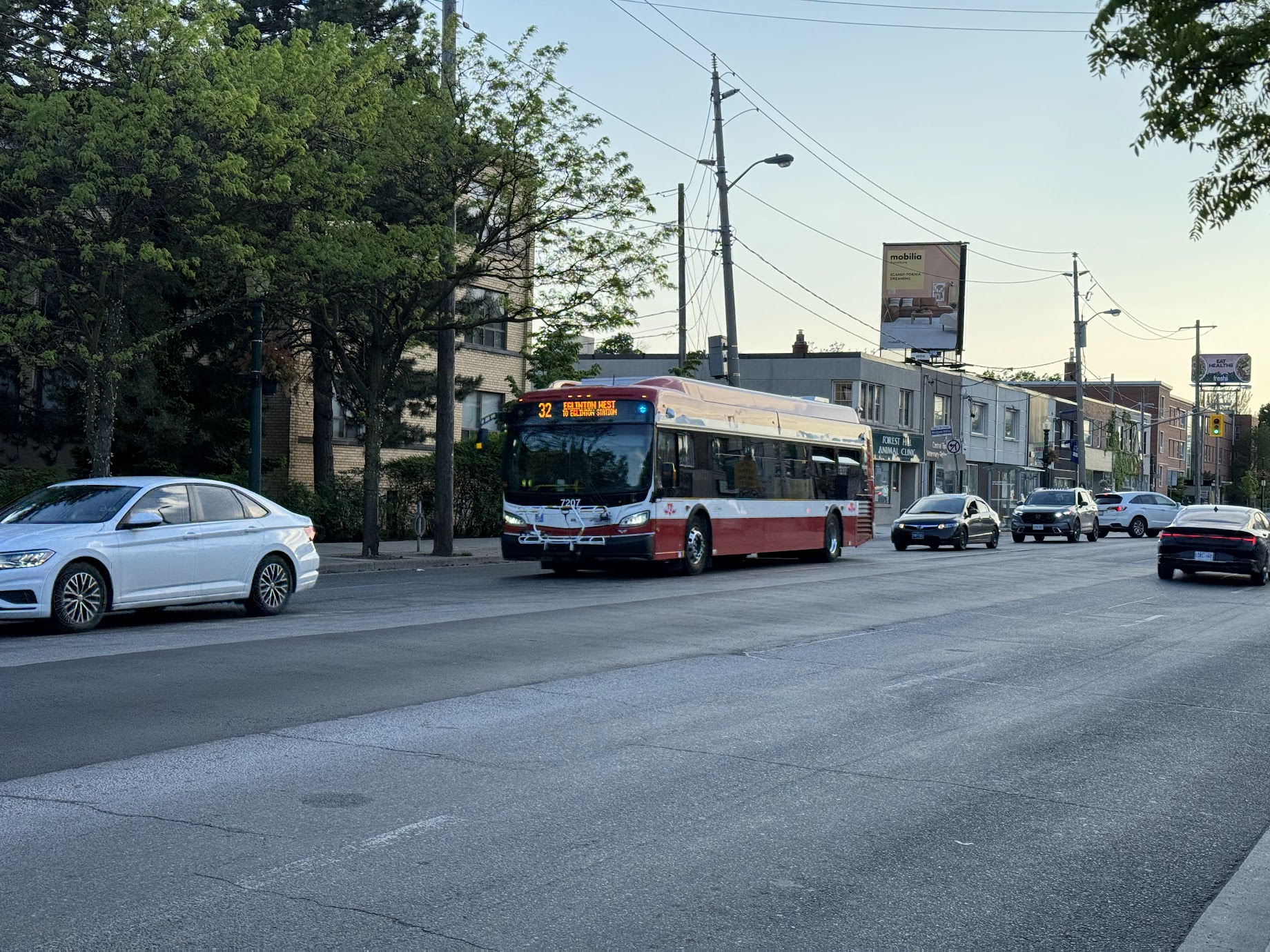
An interesting stat that I find you’ll often hear about different cities is how many buses they operate. You’ll hear things like “London has over 7000 buses!” as a measure of how impressive the scope and scale of the bus network is. I think this would be an interesting number to calculate for Toronto, because it could provide a very rough approximation on how the city is doing compared to other global centres; the issue is, unlike most global cities, our buses are administered and operated by local municipalities, so finding a single number for everything is hard.

If you enjoy my content, consider subscribing to my blog:
or supporting me on Patreon:
Your support will help me bring you more content faster!
Now, it is true that the number of buses a city has is a pretty poor measure of how good the bus system is — for one, because we don’t know how much those buses are actually being used; and for two, because it’s hard to judge a city’s transit by fleet size without knowing what the “city” part of that equation includes — drawing the boundaries of a city is just a classic problem that nobody seems to have a great solution for.
That being said, when I saw a stat recently that suggested London has roughly ~8700 buses, I decided to bring together some stats so I could have a reference for the future on how many buses Toronto actually has. While I was at it, I looked up a few other cities numbers as well — the MTA in New York has about ~5700 buses (this would clearly be supplemented by suburban agencies and NJ Transit), Paris has ~9000, and Seoul supposedly is over 30,000 — which sounds insane unless you’ve seen what a lot of major streets in that city look like with buses end on end as far as the eye can see.

My Toronto numbers are pretty unscientific as I just pulled the first data I could get for any city, meaning this might include data that is from different years, not reflecting new fleet additions or retirements, but here are the numbers I got for the Toronto region.
For the core urban areas:
- TTC (Toronto) – 2100
- MiWay (Mississauga) – 523
- Brampton – 422
- Durham – 178
- York – 529
- Burlington – 67
- Oakville – 101
- Hamilton – 267
And then there is also GO: I am less sure of this number, but given how many routes GO provides travel through urban parts of the region I think including them makes sense:
- GO – 700.
I also pulled data from Waterloo and Guelph ,because while they aren’t part of the contiguous urban area, I do think people see them as being part of the “Toronto Region” more than, say, Niagara or St. Catherines.
- GRT (Waterloo Region) – 259
- Guelph – 70.
With all of that data together, I decided to plot the number of buses each urban area had (GO does not appear since I did not want to create a formula for dividing its buses up) and the number of people per bus:

What’s really interesting is that Mississauga actually has fewer people per bus than Toronto, even though it does not have a reputation for great transit, which really suggests that it ought to amp up its route redesigns to try and make better use of all those vehicles. Brampton as you can see is also in the same realm as TTC and MiWay, with <2000 residents per bus.
Next up you have York, Burlington, Oakville, Hamilton, Waterloo, and Guelph, and I think their range of 2-3000 residents per bus does align with a sort of vague sense that these agencies provide substantially less service than the three leaders, although the variability in how much service agencies actually put out is highlighted here, since Waterloo seems to provide more than York (a lot more), but has less buses — probably because it seems to be less of a commuter focused system.
The standout underperformer all things considered is Durham, which has roughly 3x more residents for every bus it has than Toronto, and really needs to more than double its bus fleet to catch up, especially since it’s growing rather quickly!

All in all, for the region I got a total of 4887 buses, which is not actually that far off of the MTA’s fleet — and to be fair ,Metrolinx does organize large scale procurements for the agencies so they do get some of the benefit of operating as a unit. This number is probably accurate to +-500 buses.
Beyond that, I did consider our electrification rate, which for fully electric buses seems to be about 2-3% — which is better than I would have thought, and for Hybrids the number appears to be more like 15-20%. All in all, the numbers aren’t terrible, but they should be a lot better, especially the number of Hybrid buses and buses in Durham!





Leave a Reply to Daniel SmithCancel reply