The Toronto streetcar system has long been held up as a symbol of the city’s progressive and forward-looking attitude towards transportation, even while simultaneously the one thing all Torontonians seem to agree on is that the streetcars are unfailingly painfully slow.

Two streetcars on the 512 St Clair route.

But as the city and congestion grow, and alternatives become more and more available, the shocking status quo (that is, a mode of transportation so frequently seen as a symbol of the city has become so completely dysfunctional) threatens to bring us back to an era where serious doubt is cast on the future of the streetcars. (If you’re curious, I think the streetcar preservation and symbolism as a reaction to those once pushing their removal, and the disdain for them politicians like Rob Ford have had, has unfortunately blinded many to their real and obvious flaws.)


If you enjoy my content, consider subscribing to my blog:

or supporting me on Patreon:

Your support will help me bring you more content faster!


Not once but twice in the last week while talking to transit-urbanist types, I’ve been reminded how bad things are for the streetcars.

I frequently talk about the frustration of their low speeds, dated infrastructure and operations, and lack of reliability, but I’m used to people saying “it would be fine if they just had their own lanes in more places!”. To be clear, more dedicated lanes would be nice — but suggesting that they are a panacea betray a lack of serious thought about the network. The 510 Spadina route has dedicated lanes and is painfully slow and inconsistent. It’s actually typically in “outer” areas — old suburbs — where I find the streetcars work best, where traffic is light, road space is copious, and stops feel slightly less plentiful.

But, what did my conversations reveal?

Well, one person just flat out mention they don’t ride the streetcars these days: Too slow, they said, and cycling is easier (something I’m hearing more and more, and which will only become more common as the cycling network rapidly expands). The other person had comments with more of a city building spin: If we can’t remove street parking or drop-off zones, and we want more bike lanes, and we aren’t willing to rethink how our streetcars interact with the streets, maybe they should just go.

Indeed, if you think the streetcars are universally loved, a lot of people who do love public transport and this city seem to be over them!

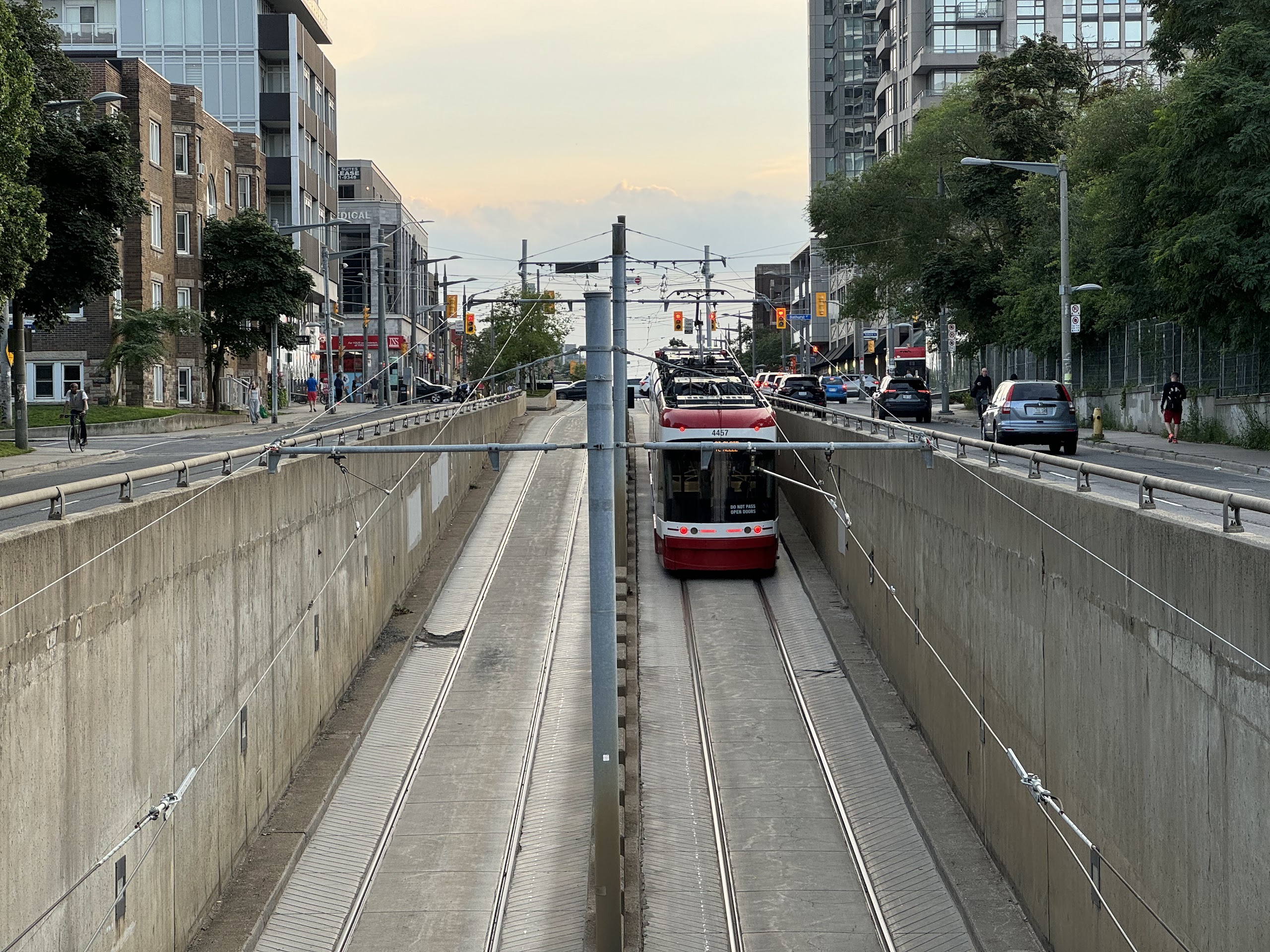
A streetcar coming out of the St. Clair West tunnel.

Meanwhile, I hear other people saying that if they want to get somewhere downtown that isn’t on the subway, they’ll often just Uber; it’s surely faster than the streetcar, and with friends the cost is not much higher — I don’t regularly use Uber or Lyft myself, but this makes sense to me and is concerning.

This post isn’t meant to be about the various problems with the streetcar network (I’ve talked about this lots before), but something I’ve been thinking a lot about is what Toronto might look like without the streetcars.

The sad thing is, I think there’s a good chance it would be better.

The issue here is that with the status quo of the bad streetcar network, so many problems are festering and going unfixed, from infrastructure to operations — and I’ve talked a lot about how we need a big ambitious plan to come in and fix a lot of these things at once, but there appears to be no will for one.

Meanwhile, I think (as a thought experiment, obviously) the winding down of the streetcar would probably be enough of an event to shake us out of our complete inaction. Even under a progressive city hall, projects like the King Street priority corridor have gotten minor attention at most. New routes could be designed, better stops could be implemented, stop spacing could be rationalized due to the different performance characteristics of buses, and service levels could be boosted. Already, when buses replace streetcars during increasingly common shutdowns, a contingent of people say the experience is better, and since nobody with the power to do so seems interested in seriously improving the streetcars, maybe the need to create a new downtown transit service would startle them awake.

Now, there is the obvious response “we would need three times more buses!” and maybe we would, but I doubt it — at least not to match the level of service currently being provided on the streetcar network, which sees many cars out of service on any given day. We might need three times more buses to replace a streetcar network in its ideal form, but that’s not what we have. Of course in any case, we should plan transit for a high level of service, but we seem to forget that that’s not something the streetcar network consistently has today — and as a result it has lost many riders to cycling, driving, and probably even walking.

What hasn’t been helping is the unending streetcar route closures and reroutings, some of which feel like they happen just months after other related closures in a completely uncoordinated mess. When I got on board the St. Clair streetcar recently after months of being closed, I realized that now the bus and streetcar loop at St Clair West station has been closed, making a key connection on the route much less convenient. Could this work have been done at the same time as the rest of the line being shutdown? I don’t see why not, and I can’t imagine most people feel this inspires confidence in their mode of transportation.

A streetcar in the St Clair West station loop.

And these shutdowns frequently seem to come out of nowhere. No doubt they are communicated in advance, but you won’t hear announcements on the transit system, and so it can be easy to miss.

But even considering that, the execution of the closures leaves so much to be desired. The replacement for the Spadina streetcar — a mixed traffic bus without even temporary bus lanes (despite the drawn out nature of the closure) — has been a real mess, particularly getting stuck in traffic near the Gardiner (temporary bus lanes may well be coming, but it really feels like a classic too little too late). And of course, none of this would be a problem if the streetcar right-of-way was designed to enable use by replacement buses (this is something I wish we didn’t have to do, but Toronto seems unable to consistently keep key streetcar routes open).

The usual traffic on Spadina at Front — now imagine buses added to the mix.

I think it’s clear that the streetcars are facing an existential crisis, because at the moment they do not have a strong raison d’etre. 10 years ago, the streetcars were slightly less slow, slightly more reliable, and the alternatives were less well established; these days, it’s becoming less clear who the streetcars are actually for.

I think for this reason it’s absolutely critical that a streetcar “rethink” is pursued as soon as possible. I see this as so important, because I think the Ontario line (which will provide a much faster more frequent and all around better alternative for many destinations and trips that are currently usually accessed/made with streetcars) could be the straw that breaks the camel’s back for the network as I’ve discussed previously.

23 responses to “Toronto’s Streetcars are Teetering on the Brink.”

  1. “Already, when streetcars replace buses during increasingly common shutdowns, a contingent of people say the experience is better…” I think you meant when buses replace streetcars, correct?

    You may be right, but if the streetcars go, it will be an injustice. It’s our accommodation of cars that cause almost all the streetcar delays aside from construction; our deliberate blindness to drivers repeatedly breaking the law by blocking intersections, and our complete disinterest in actually enforcing a transit-only corridor on one single street (King).

    One point that’s never mentioned by those who always want to eliminate the streetcars is that riding a bus is a much more horrible experience than riding a streetcar. I’ve ended up with some nasty bruises from getting slammed around. Sitting on a streetcar is far more pleasant. If the streetcars are ever eliminated it will be for the perceived benefit of drivers, not transit users, and it will be a simple admission of our many other failures.

    1. Thanks for your note, I have corrected.

      I don’t think ride quality issues are ignored at all, but buses being this bad is not universal, another Torontoism.

      1. It’s probably because Toronto buses travel on Toronto roads – and they are the worst.

  2. Adam Wetstein Avatar
    Adam Wetstein

    Im waiting for announcements that Toronto city council will be stringing razor wire around the Spadina -Bloor-parliament lakefront area with landmind just make sure no one come downtown

  3. rogersexton140 Avatar
    rogersexton140

    Reece
    THere is something wrong with the passage
    ‘Already, when streetcars replace buses during increasingly common shutdowns, a contingent of people say the experience is better, and since nobody with the power to do so seems interested in seriously improving the streetcars, maybe the need to create a new downtown transit service would startle them awake.’
    I think the words ‘streetcars’ and ‘buses’ have been interchanged.

    On a more positive point, some cities in Europe which have retained ‘streetcars’ have banished them underground. But in Zurich, which I first visited in 1971, even then I thought , ‘The Strassenbahn is still in the Strasse. They have just banished all the other traffic from the tram tracks.’ And nowadays in the more enlightrened Eruopean cities, trams have all sorts of proiorties at traffic lights.

    1. Thanks Roger, I have made a correction. The trams in Zurich are truly marvelous and we have much to learn!

  4. Jonathan Douglas Avatar
    Jonathan Douglas

    I have to admit that I like the idea of the streetcars more than the streetcars themselves as they exist today. I think that’s a shame, because I’m theory streetcar service should be at least as good as bus service in terms of speed, comfort and reliability (except in cases of street closures where buses can more easily divert). If that parity is not happening, that means there are fundamental ways that streetcar maintenance and infrastructure is being marginalized.
    I find Paris to be an interesting comparison because their tram lines have been built largely on the periphery, where congestion is not as much of a problem. Granted, their rights of way are also far more generous, but to your point, those outlying areas are where Toronto’s streetcars also fare better.
    Amsterdam’s trams are also successful, but they have 50 years of de-priorotizing cars.
    I really think Toronto ought to go all-in. More pedestrian, cycling and streetcar only streets. That probably won’t work for a major thoroughfare like Spadina, so either cut-and-cover bury it, or elevate it, in the core.
    Point is, some transit is still needed where streetcars currently serve. Buses shouldn’t be a better solution. Cars can adapt to new routes. It’s not a matter of whether this can work, it’s the willingness to do so.

    1. I think your comment is on point. Paris is instructive as is Amsterdam, but there appears to be no will to make the necessary changes.

  5. I absolutely agree with your assessment, Reece. The Carlton streetcar is so infrequent, slow and overpacked that I simply prefer walking!

    1. It need not be this way!

  6. I think you’re overstating the goodness of the Ontario line. It’s a line that’s being built first and foremost as a kickback for the construction industry. The transfers at Queen and Osgoode are going to be deep, unpleasant, and slow. The detour to West Harbour adds minutes to every trip for a destination that doesn’t exist and undermines the line’s ability to relieve Bloor-Yonge. Metrolinx’s track record of transforming a lot of expensive concrete and rail into an operational line is poor.

    I appreciate that the value of your blog is the relentless optimism and vision, but you are applying it unevenly in this post. Either both the Ontario line and our streetcar system are going to become magically good, or neither. I do hope the City and TTC Management can figure out that manual switches need to be automated and every slow order in the streetcar system needs to be eliminated.

    1. I am not sure how I am supposed to reply to the line “being built first and foremost as a kickback for the construction industry”, we know why projects cost a lot, and this doesn’t reflect that.

      The lines “diversion” south to *East* Harbour is not all that substantial and just part of using an existing rail right of way, and it will be very fast, thus its ability to relieve Bloor Yonge will be substantial.

      I am not sure what you mean by “the Ontario line and our streetcar system are going to become magically good, or neither” the Ontario line is a project conceived by Metrolinx, the Streetcar network is run by the TTC who is under the city – they are not inherently tied together. It is absolutely possible, and I’d say currently likely that the OL will be good and the streetcars will continue their decline. There is nothing uneven about this, the streetcars are not good today, and I have no reason to believe they will improve with the direction we are going. The OL on the other hand I have no reason to believe will be bad (I am not sure why you use the world “magical”), it will be fast and frequent (which will be pretty amazing!) thanks to a generally good alignment and open up a ton of new connections. I wish the stations were shallower at Queen and Osgoode – but that is very hard given the alignment along Queen.

  7. Graham McColl Avatar
    Graham McColl

    The current streetcar network is just the penultimate expression of Leary’s TTC. Where maintenance was forgotten and shutdowns and diversions are the norm. Strong leadership needs to come in and undo the damage of the last 10 years.

    1. I concur, but I would say that was just a continuation of things not improving previously.

  8. Henry E Argasinski Avatar
    Henry E Argasinski

    Streetcars are Toronto. I grew up riding them, then rode them to work downtown. I got my bike tires stuck in the tracks, but that was just an expected part of riding downtown. Now, when I visit my hometown, I make a point of taking the streetcar somewhere just to ride one again. Honestly, dedicated right of ways and signal controls would help because automobiles are the issue, but I think you made a great point in that new routes may be the answer here to entice people back onto them. As I said, streetcar are Toronto.

    1. These things will help, but they won’t fix things by themselves.

  9. So what you’re saying that when the Ontario line opens, streetcars will no longer have a place in Toronto?

    1. That’s not what I am saying, I am saying that their niche is being cut down more and more, and limited even further by their poor service etc.,

  10. […] Toronto’s Streetcars are Teetering on the Brink […]

  11. Decline started with the Flexities: not enough, uncomfortable, and horrible doors.

  12. […] Toronto’s Streetcars are Teetering on the Brink. […]

  13. I grew up near streetcar lines (St. Clair & Dufferin, Broadview & Gerrard) and on top of the slow speeds and inconsistent reliability, I’ve always been perplexed by the amount of maintenance the infrastructure requires. During the 11 years I lived near Broadview & Gerrard, they had to completely tear up the road and replace the rails 3 times! I believe another tear-up happened this past year. I have a little “if I was the Sun King” transit fantasy line: an automated metro line to replace the East-West 501 streetcar corridor along King St./Queen St. but splits into a loop within downtown between [roughly] College & King and Parliament & Roncesvalle/Lansdowne.

  14. So tne entire continents of Europe and Asia have figured out how to make streetcars work but this moron things actually we just just completely capitulate for more private bullshit

Leave a Reply to Jonathan DouglasCancel reply

Trending

Discover more from Reece Martin

Subscribe now to keep reading and get access to the full archive.

Continue reading